
Brookdale vs Sunrise Senior Living for Memory Care: Cost, Services, and What Families in DFW Actually Need to Know
Brookdale vs Sunrise Senior Living for Memory Care: Cost, Services, and What Families in DFW Actually Need to Know
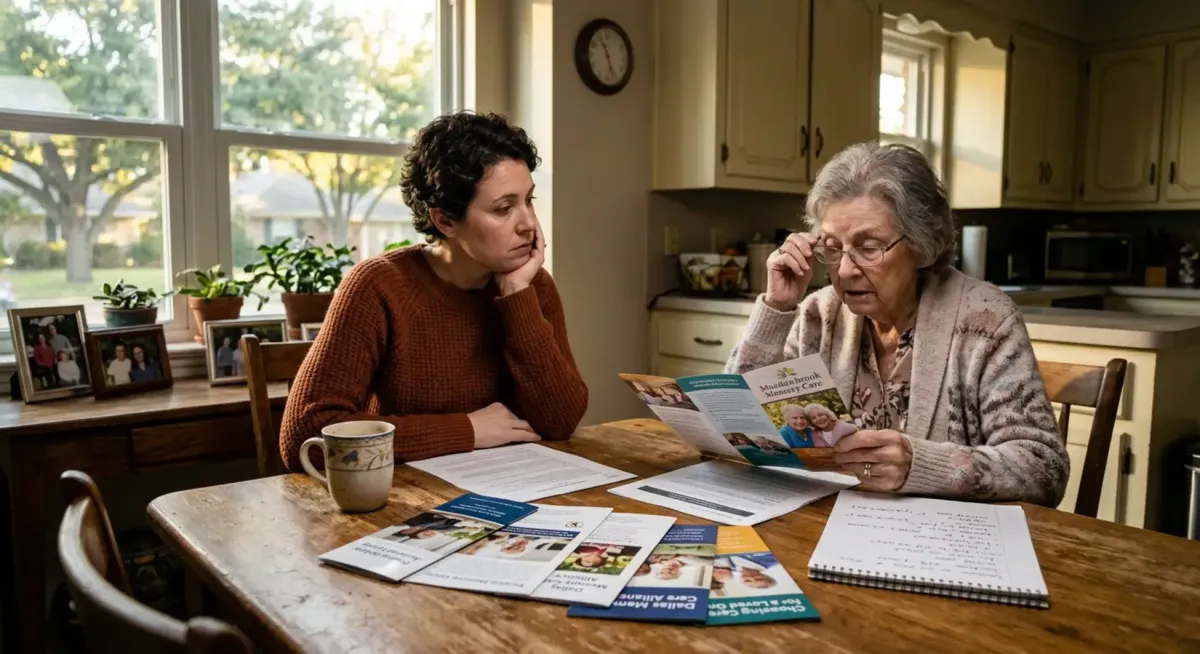
You're sitting at a kitchen table — maybe your parent's kitchen table — surrounded by paperwork, a laptop with seventeen browser tabs open, and a feeling in your chest that's somewhere between urgency and dread. The doctor used words like "moderate cognitive decline" or "she can't be left alone anymore," and now you're trying to figure out what comes next. Someone mentioned Brookdale. Someone else said Sunrise. You've read enough brochures to know that every memory care community sounds exactly the same until you need one.
This isn't a brochure. This is a real breakdown of two of the largest memory care providers in the country — Brookdale Senior Living and Sunrise Senior Living — with honest information about their costs, care models, staffing philosophies, and what families in the Dallas-Fort Worth area actually encounter when they walk through those doors. Because when you're making this decision for someone you love, you deserve more than marketing language.
Key Takeaways
- Brookdale Senior Living is the largest senior living operator in the U.S., with a broad national footprint and multiple DFW locations offering memory care through their Clare Bridge program.
- Sunrise Senior Living operates smaller, more residential-style communities with a consistent care philosophy and strong emphasis on individualized programming.
- Memory care costs in the DFW area typically range from $4,500 to $8,500+ per month depending on the provider, level of care needed, and community type.
- Neither Brookdale nor Sunrise accepts traditional Medicare for memory care room and board — understanding your payment options before you tour is essential.
- The right choice between these two providers often comes down to your parent's specific stage of dementia, personality, and what kind of environment helps them feel calm and safe.
- Selling a parent's home is often the primary way families fund memory care — and you have more options than you may realize, including a direct, compassionate sale that can close in 30 days.
Why Comparing Brookdale and Sunrise Senior Living Actually Matters for DFW Families
Both Brookdale and Sunrise are household names in senior living. They're large, established, and have communities scattered throughout the Dallas-Fort Worth metroplex — which means when a placement agent, a hospital social worker, or a well-meaning neighbor says "have you looked at memory care options?" these two names come up constantly. But size and name recognition don't tell you whether a community is the right fit for your mom or dad.
What makes this comparison genuinely useful is understanding that Brookdale and Sunrise have meaningfully different operating philosophies, physical environments, staffing models, and pricing structures — and those differences can matter enormously depending on where your loved one is in their dementia journey. A parent who is in early-to-mid stage Alzheimer's and still has strong social instincts may thrive in one environment and wither in another. A parent who is further along and needs more hands-on physical care may need a different level of staffing than either community provides at a base rate.
In the DFW area specifically, the senior living market is competitive and growing. According to the Alzheimer's Association, more than 400,000 Texans are currently living with Alzheimer's disease, and that number is projected to grow to 490,000 by 2025. The Dallas-Fort Worth metroplex, as one of the fastest-growing metro areas in the country, has seen a corresponding expansion in memory care options — which is good news for families, but also means more decisions to navigate.
If this feels overwhelming, you're not alone. Every family we've ever worked with has started exactly where you are right now — trying to figure out too many things at once, feeling guilty for even having to make this choice, and wondering if they're doing right by their parent. The fact that you're doing this research means you're already doing right by them.
The goal of this comparison isn't to tell you which community is "better." It's to give you enough real information that when you walk into a tour, you know what questions to ask, what red flags to watch for, and what truly matters versus what's just a beautiful lobby.
Brookdale Senior Living Memory Care: What the Clare Bridge Program Actually Offers
Brookdale Senior Living is the largest senior living operator in the United States, with more than 650 communities across the country. In the Dallas-Fort Worth area, Brookdale has multiple locations offering memory care, including communities in Plano, Frisco, Arlington, Fort Worth, and the broader Dallas area. Their memory care program is called Clare Bridge, and it's been a core part of Brookdale's identity for decades.
The Clare Bridge Memory Care Philosophy
Clare Bridge is built around structured daily programming designed specifically for residents with Alzheimer's and other forms of dementia. The philosophy centers on what Brookdale calls "meaningful moments" — the idea that even in advanced stages of cognitive decline, residents can experience joy, connection, and purpose through carefully designed activities. Programming typically includes music therapy, sensory activities, reminiscence exercises, gentle movement, and social engagement tailored to different ability levels.
One of Clare Bridge's distinguishing features is its consistency. Because Brookdale operates at scale, their programming curriculum is standardized across communities, which means you can generally expect a similar daily structure regardless of which Brookdale location you're visiting. For some families, that consistency is reassuring. For others, it can feel less personalized than a smaller community might offer.
Brookdale Memory Care Staffing and Environment
Brookdale's memory care neighborhoods are typically secured units within a larger community, or in some cases, standalone memory care buildings. Staff-to-resident ratios vary by community and by time of day, but Brookdale generally follows state-mandated minimums with some communities exceeding those benchmarks. When you tour a Brookdale community, one of the most important questions you can ask is about the actual staffing ratio during overnight hours — this is where many larger operators stretch thin, and it's something families rarely think to ask until it becomes a problem.
The physical environment in Brookdale's Clare Bridge neighborhoods tends to be purpose-built for memory care, with circular walking paths (to reduce the anxiety of "dead ends"), visual cues to help residents orient themselves, and secured outdoor spaces. Many DFW Brookdale communities have been renovated in recent years, so the quality of the physical space can vary significantly depending on the specific location.
What to ask on a Brookdale tour: Ask specifically about staff turnover rates at that community. High turnover in memory care is a significant quality indicator — residents with dementia depend heavily on familiar faces, and frequent staff changes can cause measurable distress. A good community director will answer this question directly. Evasiveness is a yellow flag.
Brookdale Memory Care Costs in the DFW Area
Memory care pricing at Brookdale in the Dallas-Fort Worth area typically ranges from approximately $4,800 to $7,500 per month for a private room, depending on the specific community, the size of the unit, and the level of care required. Brookdale uses a tiered care assessment system — meaning the base rate covers a standard level of assistance, and additional care needs (help with bathing, incontinence care, medication management, behavioral support) are assessed and priced separately as "care add-ons."
This tiered pricing model is important to understand before you sign anything. A family might tour a Brookdale community, see a quoted rate of $5,200 per month, and feel relieved — only to discover after the care assessment that their parent's actual needs place them in a higher care tier, bringing the real monthly cost to $6,500 or more. This isn't deceptive — it's how most large memory care operators structure their pricing — but it catches families off guard when they haven't been told to expect it.
Watch out for the base rate vs. all-in rate gap. Always ask for a care assessment before committing to any memory care community, and ask them to give you a realistic estimate of what tier your parent is likely to fall into. The difference between the advertised rate and the actual monthly cost can be $1,000–$2,500 per month. That gap matters enormously when you're planning how to fund care.
Sunrise Senior Living Memory Care: A Smaller, More Residential Approach
Sunrise Senior Living was founded in 1981 and operates more than 270 communities across the United States, Canada, and the United Kingdom. In the DFW area, Sunrise has communities in locations including Dallas, Plano, and surrounding suburbs. Compared to Brookdale, Sunrise operates at a smaller scale — both in terms of total number of communities and in terms of the physical size of individual buildings — and that difference in scale shapes almost everything about the Sunrise experience.
The Sunrise Memory Care Philosophy: Reminiscence and Person-Centered Care
Sunrise's memory care program is built on a person-centered philosophy that emphasizes individualized care plans, life history integration, and what they call "Reminiscence programming." The idea is that memory care isn't just about managing symptoms — it's about honoring the whole person, including who they were before the diagnosis. Staff are trained to learn residents' life histories, their preferences, their routines, and their sources of meaning, and to incorporate that knowledge into daily care and activities.
In practice, this means a Sunrise memory care resident might have their room decorated with family photos and meaningful objects, their favorite music playing during morning routines, and activities that connect to their former hobbies or career. For someone who was a gardener, that might mean a raised garden bed in the secured courtyard. For someone who was a teacher, it might mean leading a simple group activity. The programming is less standardized than Brookdale's and more dependent on the individual team at each community — which can be a strength or a weakness depending on the specific location and staff.
Sunrise's Physical Environment and Community Size
One of the most frequently cited differences between Sunrise and Brookdale is the physical environment. Sunrise communities are typically designed to feel more like a large home than an institution. The buildings are often two or three stories, with smaller memory care neighborhoods of 15–25 residents rather than the larger units you might find in a big Brookdale community. Common areas tend to feel more intimate, dining rooms feel more like family dining rooms, and the overall atmosphere is generally quieter and less institutional.
For residents in early-to-mid stage dementia who are still socially aware and sensitive to their environment, this residential feel can make a significant difference in their comfort and sense of security. For families, it often translates to a feeling of being known — staff tend to know residents and family members by name, and communication between the care team and families is often more consistent.
A pattern we see often: Families who tour both a large Brookdale community and a Sunrise community on the same day frequently describe the same experience. They walk into Brookdale and feel impressed by the amenities and the programming calendar. They walk into Sunrise and feel something different — quieter, more personal, more like someone actually lives there. Then they go home and try to figure out which feeling to trust.
The honest answer is that both feelings are valid data. The question is which environment matches your parent's personality and current stage of cognitive decline. A parent who is still social and active may love the energy of a larger community. A parent who is easily overstimulated may do better in a smaller, calmer setting.
Sunrise Memory Care Costs in the DFW Area
Sunrise Senior Living tends to price at the higher end of the memory care market in DFW. Monthly costs for memory care at Sunrise communities in the Dallas-Fort Worth area typically range from approximately $5,500 to $8,500 per month, again depending on the specific community, room type, and assessed care level. Like Brookdale, Sunrise uses a tiered care pricing model, so the base rate is a starting point rather than the full picture.
Sunrise communities generally include more services in their base rate than some competitors — things like three meals per day, housekeeping, laundry, and a full activity calendar are typically included. However, the higher base rate reflects both the more residential environment and, in many cases, higher staffing ratios. Families who have toured both Brookdale and Sunrise communities in DFW often report that Sunrise feels more staffed — more people visible, shorter wait times for assistance, more staff-resident interaction during common times of day.
Trying to figure out how to afford memory care is one of the hardest parts of this whole process. Our free guide walks through every option — from VA benefits to Medicaid bridge programs — so you can see the full picture before making any decisions.
Get The Guide To Pay For Long-Term CareSide-by-Side Comparison: Brookdale vs Sunrise for Memory Care in DFW
Sometimes the clearest way to see the differences is to put them next to each other. Here's a direct comparison of the key factors families in the Dallas-Fort Worth area should weigh when choosing between these two providers.
| Factor | Brookdale (Clare Bridge) | Sunrise Senior Living |
|---|---|---|
| DFW Locations | Multiple (Plano, Frisco, Arlington, Fort Worth, Dallas and more) | Several (Dallas, Plano, and surrounding suburbs) |
| Community Size | Larger communities, typically 80–150+ total residents | Smaller, residential-style, typically 40–80 total residents |
| Memory Care Neighborhood Size | Larger secured units, 25–50+ memory care residents | Smaller neighborhoods, typically 15–25 memory care residents |
| Care Philosophy | Structured programming (Clare Bridge curriculum) | Person-centered, life history integration (Reminiscence) |
| Monthly Cost Range (DFW) | ~$4,800–$7,500/month (before care tier add-ons) | ~$5,500–$8,500/month (before care tier add-ons) |
| Pricing Model | Tiered care assessment; base rate + care add-ons | Tiered care assessment; base rate + care add-ons |
| Physical Environment | Purpose-built, often larger/more institutional feel | Residential, home-like, more intimate atmosphere |
| Best Fit For | Families who value structured programming and broad amenities | Families who value personalized care and smaller community feel |
This table gives you a framework, but it doesn't replace the experience of actually visiting both types of communities. We strongly encourage families to tour at least two or three communities before making a decision — and to bring a list of specific questions rather than relying on the standard tour script the community will walk you through.
What Memory Care Actually Costs in DFW — And How Families Pay for It
Let's talk about the number that keeps most families up at night: the actual monthly cost of memory care, and where that money is supposed to come from.
According to Genworth's 2023 Cost of Care Survey, the national median monthly cost for memory care is approximately $6,935. In the Dallas-Fort Worth area, costs tend to track close to or slightly above that national median, with significant variation based on the provider, the specific community, and the level of care required. When you factor in the tiered care add-ons that both Brookdale and Sunrise use, many families in DFW are looking at real monthly costs between $6,000 and $9,000 once their parent's full care needs are assessed.
Does Medicare or Medicaid Cover Memory Care at Brookdale or Sunrise?
This is one of the most common — and most painful — surprises families encounter. Traditional Medicare does not cover the room and board costs of memory care at assisted living communities, including Brookdale and Sunrise. Medicare may cover short-term skilled nursing care following a hospitalization, and it covers certain medical services (like physician visits or physical therapy) that occur within a memory care community — but the monthly cost of living in that community is not a Medicare benefit.
Medicaid is more complex. Texas Medicaid does have programs that can help cover some costs of memory care, but eligibility requirements are strict, the application process is lengthy, and not all communities accept Medicaid. Both Brookdale and Sunrise have some communities that accept Medicaid, but availability is limited and wait lists can be long. If Medicaid is a potential path for your family, working with an elder law attorney early in the process is essential — not optional.
The most common funding sources families actually use for memory care include: long-term care insurance (if your parent was fortunate enough to purchase a policy), Veterans benefits (if your parent is a veteran or the surviving spouse of a veteran — the Aid and Attendance benefit can be significant), personal savings and retirement accounts, and the proceeds from selling the family home.
The VA Aid and Attendance Benefit is one of the most underused resources for memory care funding. Veterans and surviving spouses who need help with daily activities may qualify for up to $2,300+ per month in tax-free benefits to help cover the cost of assisted living or memory care. Many families don't know this benefit exists until someone tells them — which is exactly why we make it a point to ask about military service in every conversation we have with families. If your parent served, this is worth exploring immediately.
How Selling the Family Home Funds Memory Care
For the majority of families navigating memory care placement, the family home is the largest asset available to fund care. This is both a practical reality and an emotional one — the house isn't just a financial resource, it's where decades of life happened. It's where your parent raised children, celebrated holidays, and built a life. Selling it is rarely simple, and it's almost never just a transaction.
But here's what we've seen consistently: families who address the home question early — before the financial pressure becomes a crisis — have far more options and far less stress than families who wait. When care costs are mounting and a family is scrambling to find funds, the home sale becomes rushed, emotional decisions get made under pressure, and families often feel like they didn't get a fair outcome.
When there's time to think clearly, families can explore every option: listing the home traditionally with a trusted real estate agent, making targeted improvements to maximize the sale price, renting the property as a short-term income source, or selling directly to a buyer who specializes in working with families in exactly this situation — without repairs, without staging, without months of uncertainty.
If you're trying to figure out what to do with a parent's home while also navigating memory care placement, you don't have to figure it out alone. We walk families through every option — no pressure, no rush, just clarity.
Get Options With Selling the HomeQuestions to Ask When You Tour Brookdale or Sunrise Memory Care Communities
A community tour is a sales presentation. The community wants you to feel good, see the best version of what they offer, and sign a contract. That's not cynical — it's just the reality of how senior living sales work. Your job on a tour is to get past the presentation and find out what daily life actually looks like for residents, especially on a Tuesday afternoon in February when there are no prospective families walking through.
Here are the questions that cut through the marketing and get you real information:
Memory Care Tour Questions That Actually Matter
- What is the staff-to-resident ratio during the day shift? During the overnight shift?
- What is your annual staff turnover rate in the memory care neighborhood?
- How do you handle a resident who becomes agitated or combative? Walk me through your specific protocol.
- What happens if my parent's care needs increase significantly — is there a point where they would need to move to a higher level of care?
- How do you communicate with families? Who is my primary contact, and how quickly can I expect a return call?
- Can I see the actual care assessment process, and can you give me a realistic estimate of which care tier my parent would likely fall into?
- What is included in the base monthly rate, and what are the most common add-on charges families encounter?
- How long has the current memory care director been in this role?
- Can I visit unannounced after my parent moves in?
- What is your policy on using antipsychotic medications for behavioral management?
That last question — about antipsychotic medications — is one of the most important and least-asked questions in memory care. The Centers for Medicare and Medicaid Services (CMS) tracks antipsychotic medication use in nursing facilities as a quality indicator, and high rates of antipsychotic use can be a sign that a community is managing difficult behaviors with medication rather than with skilled dementia care. While this data is more readily available for nursing homes than for assisted living memory care communities, asking the question directly tells you a lot about a community's care philosophy.
Red Flags to Watch for at Any Memory Care Community — Including Brookdale and Sunrise
Both Brookdale and Sunrise are large, established operators with generally strong reputations. But within any large organization, individual community quality varies significantly. A Brookdale community in Frisco might be excellent while a different Brookdale location across town has had recent staffing challenges. The brand name tells you about the philosophy and the systems — it doesn't guarantee the execution at any specific location.
These are the red flags that should give you pause regardless of which community you're touring:
- Staff who seem rushed or distracted during your tour. If the people showing you around are clearly overwhelmed, imagine what a regular Tuesday looks like.
- Residents who appear bored, isolated, or parked in front of a television. Active engagement is the hallmark of quality memory care. If residents aren't engaged during a tour — when the community is putting its best foot forward — that tells you something.
- Evasiveness about staffing ratios or turnover. Good communities know their numbers and aren't afraid to share them.
- A contract you're pressured to sign quickly. Any community that creates artificial urgency around signing is a community that doesn't trust you to make a thoughtful decision.
- No clear answer about what happens when care needs escalate. Memory care is a progressive journey. You need to know the plan for when things change.
- Outdoor spaces that are locked or inaccessible. Access to safe outdoor space is an important quality-of-life factor for memory care residents.
Trust your instincts on the tour. You know your parent better than any brochure does. If something feels off — if the community feels too loud, too quiet, too institutional, or too rushed — pay attention to that feeling. It's data. The best memory care community for your parent is the one where you can picture them feeling safe and cared for, not just the one with the nicest lobby.
How to Actually Choose Between Brookdale and Sunrise for Your Parent's Memory Care
After all of this information, the question families most often ask is: "But which one should we choose?" And the honest answer is that it depends — not on which brand is objectively better, but on which specific community, at which specific location, is the right fit for your specific parent at their specific stage of dementia.
Here's a practical framework for making the decision:
Choose a Brookdale community if: Your parent is in mid-to-late stage dementia and benefits from consistent, structured programming. They're comfortable in a larger social environment. The specific Brookdale location you've toured has strong staff tenure, good family communication, and a care director who has been there for several years. The pricing, including the care tier assessment, fits within your funding plan.
Choose a Sunrise community if: Your parent is in early-to-mid stage dementia and is still socially aware enough to notice and appreciate their environment. They have a strong sense of personal identity and history that could be honored through Sunrise's Reminiscence programming. You value a smaller, more intimate community where staff will know your parent by name from day one. You're comfortable with the higher base rate and have confirmed what the all-in cost will be after the care assessment.
Choose neither and keep looking if: Neither community you've toured has given you clear, direct answers to your most important questions. The specific location has high staff turnover, recent ownership changes, or quality concerns visible on their state inspection reports (which are public record and worth reviewing). Your gut is telling you something isn't right.
Navigating memory care placement, funding options, and a home sale all at once is genuinely a lot. Our care plan assessment helps you see the whole picture — what care your parent needs, how to fund it, and what your options are with the home — all in one conversation.
Get Clarity With A Care AssessmentThe Part Nobody Talks About: What Happens to the House
You've found a memory care community you feel good about. You've toured, you've asked the hard questions, you've done the care assessment. And now the financial reality is sitting in front of you: memory care costs $6,000–$8,000 a month, your parent's savings will cover maybe a year, and the house — the house where they lived for thirty years — is the only real asset left.
This is the moment where families feel the most stuck. The house is full of decades of belongings. It probably needs work — maybe a lot of work. You're not sure if anyone will want it the way it is. You're already exhausted from the care transition. And on top of all of that, there's a grief that comes with selling the family home that nobody warned you about. It's not just a transaction. It's the end of something.
We know this because we've lived it. Our family navigated Alzheimer's caregiving starting in 2013, and again in 2024. We know what it feels like to stand in a parent's house surrounded by their things and wonder how you're supposed to handle all of this while also making sure they're safe and cared for. That experience is why Sage Senior Support exists — not to pressure families into a quick sale, but to make sure every family knows all of their options and can make a calm, informed decision.
Those options include listing the home traditionally with a trusted real estate agent if time and condition allow. They include making targeted improvements to increase the home's value before listing. They include renting the property to generate income that helps cover care costs. And they include a direct sale — to us or to another reputable buyer — that can close in as little as 30 days, requires no repairs, no cleaning out, no staging, and provides immediate access to funds when care costs can't wait.
None of these options is right for every family. The right option depends on the home's condition, the urgency of the care funding need, the family's capacity to manage a traditional sale process, and what will allow everyone involved to feel good about how this was handled. What we believe — and what we've seen proven over and over — is that families deserve to understand all of their options before they make a decision, not just the one option that's easiest for someone else to sell them.
Frequently Asked Questions: Brookdale vs Sunrise Memory Care in DFW
How do Brookdale and Sunrise handle memory care residents who need significant physical assistance, like help with bathing, toileting, and mobility?
Both Brookdale and Sunrise offer hands-on personal care assistance as part of their memory care programs, but the cost of that care is typically assessed separately from the base monthly rate. When you complete a care assessment with either provider, they will evaluate your parent's specific needs across categories like bathing, dressing, toileting, mobility, and behavioral support, and assign a care level that determines the add-on cost. It's important to get this assessment done before signing a contract so you know the real monthly cost, not just the advertised base rate. At higher care levels — particularly for residents who need two-person assist for transfers or have significant behavioral symptoms — monthly costs can increase substantially above the base rate at both providers.
Can my parent move from an independent living or assisted living unit at Brookdale or Sunrise directly into memory care, or do they have to start over at a new community?
Both Brookdale and Sunrise operate continuing care-style communities at some of their locations, meaning a resident can potentially transition from assisted living into memory care within the same community. This is one of the significant advantages of choosing a larger provider — if your parent is in early-stage dementia and you want to establish them in a community before memory care is necessary, a community that offers both levels of care can allow that transition to happen without a disruptive move to an entirely new environment. However, not every Brookdale or Sunrise location offers both levels of care, so you'll want to confirm this specifically for the community you're considering. Availability in the memory care neighborhood is also not guaranteed, so there can still be a wait even within the same community.
How do I find out if a specific Brookdale or Sunrise community in DFW has had any quality or compliance issues?
Texas Health and Human Services inspects and licenses assisted living facilities, including memory care communities, and their inspection reports are public record. You can search for inspection reports and any citations or deficiencies on the Texas HHS website. For communities that also operate a licensed nursing facility on-site, Medicare's Care Compare tool (medicare.gov/care-compare) provides quality ratings and inspection data. When reviewing these reports, look for patterns — a single minor citation may be insignificant, but repeated citations for the same issue, or any citations related to resident abuse, neglect, or medication errors, are serious red flags. We also recommend asking the community director directly about any recent citations and what corrective actions were taken.
What is the difference between memory care and a skilled nursing facility, and does it matter for choosing between Brookdale and Sunrise?
Memory care communities like those operated by Brookdale and Sunrise are licensed as assisted living facilities — they provide personal care, supervision, and dementia-specific programming, but they are not licensed to provide the level of medical care available in a skilled nursing facility (SNF). Skilled nursing facilities have licensed nurses on duty 24 hours a day and can manage more complex medical needs, including wound care, IV medications, and post-surgical recovery. For many people with Alzheimer's or other forms of dementia, memory care assisted living is the appropriate and preferred setting — it's less clinical, more home-like, and focused on quality of life. However, if your parent has significant medical needs in addition to their cognitive decline, a skilled nursing facility with a dedicated memory care unit may be a better fit. A good senior placement agent can help you assess which level of care is appropriate for your parent's specific situation.
Is it possible to negotiate pricing with Brookdale or Sunrise, and are there any discounts or financial assistance programs available?
Pricing at large senior living operators like Brookdale and Sunrise is more negotiable than most families realize, particularly if you're in a position to make a decision relatively quickly or if the community has available units they're trying to fill. It's reasonable to ask about move-in specials, reduced community fees (the one-time upfront fee most communities charge), or any flexibility on the base monthly rate. Both Brookdale and Sunrise have some communities that participate in Medicaid waiver programs, though availability is limited. Veterans and surviving spouses should always ask about VA Aid and Attendance benefits, which can significantly offset monthly costs. If long-term care insurance is in play, both providers have staff experienced in working with insurance claims. Working with a senior placement agent — typically at no cost to the family — can also be helpful, as they often have relationships with communities and knowledge of current availability and pricing flexibility.
How do we handle selling a parent's home while they're transitioning into memory care — is it possible to do both at the same time without everything falling apart?
Yes — and in fact, handling both simultaneously is more common than most families expect. The key is having a clear plan and the right support in place before you start. If the home is in good condition and time allows, a traditional listing with a trusted real estate agent can often run parallel to the care transition without overwhelming the family. If the home needs significant work, if the family doesn't have the bandwidth to manage repairs and showings, or if care costs are creating immediate financial pressure, a direct sale to a reputable buyer can be the simpler, faster path — closing in as little as 30 days with no repairs, no cleaning out, and no uncertainty. The most important thing is to start the conversation about the home early, before the financial pressure becomes a crisis, so you have time to choose the option that's actually right for your family rather than the one that's just fastest.
Trying to Choose the Right Memory Care While Figuring Out the House? Let's Talk Through It Together.
You don't have to have everything figured out before you reach out. Most families we work with start this conversation with more questions than answers — and that's exactly what we're here for. Whether you need help understanding your options with the home, finding the right memory care placement resources in DFW, or just having someone walk through the whole picture with you, we're in this with you. No pressure, no rush — just clarity when you need it most.
Schedule a Free Consultation