
Cash Home Buyer Pricing for Fees vs Traditional Agent Commission
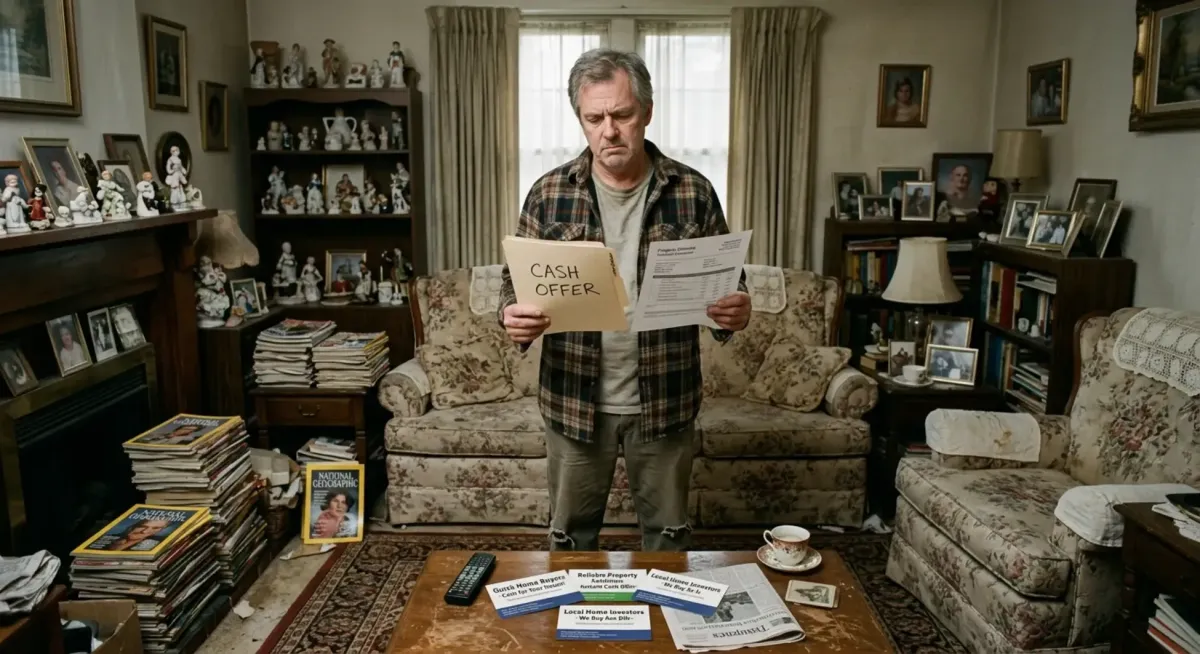
You're sitting at the kitchen table — maybe Mom's kitchen table — surrounded by decades of accumulated life. A ceramic rooster collection on the windowsill. Stacks of Reader's Digest from 1987. A refrigerator covered in grandkids' school photos. And somewhere underneath all of it is the question that brought you here: What do we do with this house?
Maybe the assisted living deposit is due in 30 days. Maybe you're already stretched thin managing Mom's care from two states away. Maybe you've started Googling "sell house fast Dallas" at midnight and now you're drowning in ads from cash buyers promising "no fees, no hassle, close in 7 days" — right next to Zillow estimates that seem wildly different from what any real person has offered you.
Here's what nobody tells you clearly: the difference between selling to a cash buyer and listing with a traditional real estate agent isn't just about speed. It's about the full picture of what you keep, what you spend, and how much stress you absorb along the way. And when you're already carrying the emotional weight of a parent's transition into care, that stress calculation matters just as much as the dollar amount.
This guide is going to walk you through exactly how cash home buyer pricing and fees compare to traditional agent commissions — not in vague generalities, but in real numbers and real scenarios — so you can make a decision that actually fits your family's situation.
Key Takeaways
- Traditional agent commissions in the Dallas-Fort Worth area typically run 5–6% of the sale price, split between buyer's and seller's agents — on a $300,000 home, that's $15,000–$18,000 before any other costs.
- Cash buyers charge no commissions, but their offers are typically 10–20% below market value — the discount reflects the convenience, speed, and certainty they provide.
- The true cost of a traditional sale includes commissions, closing costs, repairs, carrying costs, and staging — these hidden costs can add up to 8–12% of the sale price.
- For families navigating senior care transitions, the value of a fast, certain close often outweighs a higher list price that comes with months of uncertainty.
- A transparent cash buyer will always show you exactly how they arrived at their offer — if they won't, that's a red flag.
- You don't have to choose between fast and fair. The right buyer will walk you through every option before asking you to decide anything.
How Traditional Real Estate Agent Commissions Actually Work in DFW
Let's start with the model most people are familiar with, because even here, there's more nuance than most families realize until they're already in the middle of it.
When you list a home with a traditional real estate agent in the Dallas-Fort Worth area, you typically agree to pay a commission that ranges from 5% to 6% of the final sale price. This commission is usually split between the listing agent (your agent) and the buyer's agent (the agent representing whoever buys the home). So on a $300,000 home, you're looking at $15,000 to $18,000 in commission alone — before a single other expense.
It's worth noting that the real estate industry has seen some changes in how buyer's agent compensation is disclosed and negotiated following the National Association of Realtors settlement that took effect in August 2024. Buyers are now required to sign agreements with their agents before touring homes, and how the buyer's agent gets paid has become more of an open negotiation. In practice, many sellers in DFW are still offering buyer's agent compensation to attract buyers — but the exact structure varies more than it used to. This is something to discuss directly with any listing agent you're considering.
The commission itself is just the beginning. Here's what a traditional sale in the Dallas-Fort Worth market typically costs beyond the agent's fee:
- Seller's closing costs: In Texas, sellers typically pay 1–3% of the sale price in closing costs, including title insurance, escrow fees, and prorated property taxes.
- Pre-sale repairs and updates: Most listing agents will recommend at minimum a fresh coat of paint, carpet cleaning, and addressing any obvious deferred maintenance. For older homes — the kind that parents have lived in for 20–30 years — this can easily run $5,000 to $25,000 or more.
- Staging costs: Professional staging in DFW typically runs $1,500 to $3,500 for an occupied or partially furnished home.
- Carrying costs: Every month the home sits on the market, you're paying mortgage (if applicable), property taxes, homeowner's insurance, and utilities. In DFW, property taxes alone average around 2.1% of assessed value annually — one of the highest rates in the country.
- Buyer concessions: In a buyer's market or when inspection issues arise, buyers often negotiate for the seller to cover repairs or offer closing cost credits. This can add another 1–3% to your total cost.
Add it all up, and the true cost of a traditional sale can run 8–12% of the sale price — sometimes more. On that same $300,000 home, you might net $264,000 to $276,000 after all costs, assuming a smooth transaction with no major surprises. And that's before accounting for the time this takes.
What "Average Time from Listed to Sold" Really Means for Your Family
In the Dallas-Fort Worth market, homes have been averaging 30–60 days from listed to under contract in recent years — but that's for move-in-ready homes in desirable neighborhoods. Older homes that need work, or homes in areas with more inventory, can sit much longer. And once you're under contract, closing typically takes another 30–45 days. That's potentially 3–4 months from the day you decide to sell to the day you have funds in hand — all while paying for Mom's care out of pocket.
How Cash Home Buyer Pricing and Fees Actually Work
Now let's talk about the cash buyer model — because this is where a lot of families have been burned by misinformation, both from skeptical friends who've heard horror stories and from predatory buyers who actually deserve that skepticism.
A legitimate cash home buyer doesn't charge you a commission. There's no listing agent, no buyer's agent, no MLS listing fee. The buyer is purchasing directly from you, which eliminates that entire layer of cost. Most reputable cash buyers also cover their own closing costs, meaning you pay little to nothing in transaction fees. In Texas, a cash buyer typically handles the title company fees and escrow costs on their side.
What you do give up is a portion of the home's market value. Cash buyers make their offers based on what the home would be worth after any needed repairs and updates — what the industry calls the post-renovation value — minus the cost of those repairs, minus their profit margin, minus their holding and transaction costs. The result is typically an offer that's 10–20% below what you might get on the open market if everything went perfectly.
Here's how a transparent cash buyer should be able to explain their offer to you, step by step:
Step 1: Post-Renovation Value
The buyer estimates what the home would sell for on the open market after being fully updated and repaired. This is based on comparable sales in your neighborhood — what similar homes in good condition have sold for recently.
Step 2: Estimated Repair Costs
The buyer calculates what it will cost them to bring the home to that move-in-ready condition. This includes everything from cosmetic updates to structural repairs, HVAC, roof, plumbing, and electrical — whatever the home needs.
Step 3: Holding and Transaction Costs
While the buyer owns the home during renovation, they're paying property taxes, insurance, utilities, and financing costs. In DFW, with high property tax rates, this is a real number. They also factor in their own selling costs when they eventually list the renovated home.
Step 4: Profit Margin
This is the buyer's business — they need to make a profit to stay in business. A transparent buyer will acknowledge this openly rather than hiding it.
Step 5: Your Offer
Post-renovation value minus repair costs minus holding/transaction costs minus profit margin equals your offer. A good buyer will walk you through each of these numbers so you understand exactly why the offer looks the way it does.
You're Right to Be Skeptical — And Here's What That Skepticism Should Actually Look Like
If a cash buyer can't or won't explain how they arrived at their offer, that's a legitimate red flag. But skepticism about the model itself — "cash buyers always lowball" — can cause families to miss a genuinely fair option when they need it most. The question to ask isn't "is this offer high enough?" It's "does this offer make sense given what I understand about the home's condition and the market?" A buyer who can't answer that question clearly doesn't deserve your trust.
Understanding your options is the first step — and you deserve to see all of them laid out clearly before making any decision about Mom or Dad's home. Our free guide walks you through every path available to your family.
Get Our Free eBook on Paying for Long-Term CareSide-by-Side: The Real Numbers on a DFW Home Sale
Let's put some actual numbers on this comparison, because abstract percentages don't mean much when you're trying to figure out how to cover $5,000 a month in memory care costs.
Imagine a home in a suburban DFW neighborhood — Garland, Mesquite, Arlington, or similar — that was purchased in the 1980s and has been lovingly lived in but not significantly updated. The roof is 15 years old. The kitchen still has the original appliances. The carpet needs replacing. The HVAC is aging. In its current condition, the home is worth about $260,000 on the open market to a buyer willing to take on the work. Fully updated, it might sell for $320,000.
| Cost Category | Traditional Listing | Cash Buyer |
|---|---|---|
| Gross Sale Price | $260,000 (as-is) or up to $320,000 (after repairs) | $210,000–$230,000 |
| Agent Commission (5–6%) | $13,000–$15,600 | $0 |
| Seller Closing Costs (1–3%) | $2,600–$7,800 | $0–$1,000 |
| Pre-Sale Repairs/Updates | $0 (as-is listing) to $25,000+ | $0 |
| Staging | $1,500–$3,500 | $0 |
| Carrying Costs (3–4 months) | $4,000–$8,000 | $0 |
| Buyer Concessions | $2,000–$8,000 | $0 |
| Estimated Net Proceeds | $220,000–$245,000 | $209,000–$229,000 |
| Time to Funds | 3–5 months | 7–30 days |
| Certainty of Close | Moderate (financing, inspection contingencies) | High (no financing contingency) |
Look at those net proceeds numbers carefully. In this scenario, the difference between a traditional sale and a cash sale — after all real costs are accounted for — might be $10,000 to $35,000. That's real money, and we're not going to pretend it isn't. But here's the question your family actually needs to answer: Is that difference worth 3–5 additional months of uncertainty, carrying costs, and emotional energy while you're simultaneously managing a parent's care transition?
For some families, the answer is yes — and listing with a trusted agent is absolutely the right call. For others, especially when care costs are mounting and the family is already stretched thin, the certainty and speed of a cash sale is worth every dollar of that difference.
The Question Nobody Asks But Everyone Should
What is your time worth? If you're an adult child managing a parent's care transition from a distance — coordinating with doctors, placement agents, elder law attorneys, and care facilities — every additional month that the house is on the market is a month you're also paying for care out of pocket, making trips to DFW, and carrying the mental load of an unresolved situation. That cost is real even if it doesn't show up in a spreadsheet.
What "No Fees" From a Cash Buyer Actually Means — And What to Watch For
The phrase "no fees, no commissions" is used in a lot of cash buyer marketing, and it's worth unpacking what it actually means in practice — because not all cash buyers operate the same way.
A legitimate direct buyer genuinely does not charge you a commission. They're not acting as your agent — they're the buyer. So the commission structure that exists in a traditional real estate transaction simply doesn't apply. What you should confirm with any cash buyer is who pays the title and escrow fees at closing. In Texas, these are typically negotiable, but a reputable buyer will usually cover their own side of the closing costs and often the seller's as well.
What you should watch for are hidden deductions that appear at closing — fees that weren't disclosed upfront, "administrative fees," or last-minute price reductions based on inspection findings that were never communicated to you. This is where some less scrupulous buyers operate, and it's a legitimate concern that has given the cash buyer industry a complicated reputation.
⚠️ Red Flags in Cash Buyer Offers
Watch out for these warning signs when evaluating any cash buyer: An offer that arrives without a home visit or walkthrough. A buyer who can't explain how they calculated the offer. Pressure to sign quickly "before the offer expires." Fees that appear in the contract that weren't mentioned in conversation. A price reduction at the last minute based on "new information" that should have been obvious from the start. A transparent, trustworthy buyer will never do any of these things — and if you encounter them, it's okay to walk away.
The best cash buyers will visit the home in person, walk through it with you, explain exactly what they're seeing and how it affects the offer, and give you time to think. They'll put their offer in writing with clear terms and no pressure. And they'll be honest with you if they think a traditional listing might actually serve you better — because their goal is to help your family, not just to buy a house.
If you're trying to figure out how to cover care costs while managing the home sale, there are more options than most families realize — including programs and benefits that could help bridge the gap.
Get the Guide to Paying for Long-Term CareThe Hidden Costs of a Traditional Sale That Nobody Puts in the Brochure
We've touched on some of these already, but they deserve their own section because they consistently catch families off guard — especially families dealing with a parent's home that hasn't been updated in years.
Pre-Sale Repairs: The Number That Grows
In the DFW market, buyers have options. A home that shows poorly or has obvious deferred maintenance will sit longer and attract lower offers. Most listing agents will recommend addressing at least the most visible issues before going on the market — and once you start pulling on that thread, the number tends to grow. A roof that "might be okay for a few more years" becomes a negotiating point the moment an inspector flags it. An HVAC system that's 18 years old becomes a buyer's request for a credit or replacement. Plumbing that's "always worked fine" becomes a concern when a buyer's inspector finds galvanized pipes.
For families managing a parent's care transition, coordinating these repairs from a distance — getting contractors into the home, managing the work, paying for it out of pocket while care costs are already mounting — is often the piece that breaks the camel's back. It's not just the money; it's the time, the logistics, and the emotional weight of making decisions about a home that carries so much meaning.
Carrying Costs: The Clock Is Always Running
Texas property taxes are among the highest in the nation, averaging around 2.1% of assessed value annually. On a $260,000 home, that's roughly $5,460 per year — or about $455 per month, just in property taxes. Add homeowner's insurance (typically $150–$300/month for an older home in DFW), utilities to keep the home presentable for showings ($150–$250/month), and any remaining mortgage payment, and you're looking at real monthly carrying costs that accumulate for every month the home is on the market.
Three months on the market — which is not unusual for an older home in need of work — can add $2,000 to $4,000 in carrying costs alone, on top of everything else.
The Emotional Cost of Keeping the Home "Show Ready"
This one doesn't show up in any financial comparison, but it's real. When a home is listed, it needs to be available for showings — sometimes with just a few hours' notice. Someone has to manage that. Someone has to make sure the home is clean, the utilities are on, the yard is maintained. If the home still has a parent's belongings in it, those need to be dealt with before listing. For adult children who are already managing care coordination, family dynamics, and their own lives, this ongoing responsibility is genuinely exhausting.
Linda and Her Husband's Story
Linda was in the middle of cancer treatment when she and her husband realized they needed to move into a senior apartment. Their home of 30 years was cluttered and outdated — she told us she was embarrassed to let anyone see it. The idea of preparing the home for a traditional sale, managing showings, and waiting months for a close felt impossible given everything else they were carrying.
Within 30 days of reaching out, they sold directly, closed early to help with care costs, and moved into their new apartment without packing, cleaning, or making a single repair. "You made this so much easier than we expected," Linda told us afterward. "You didn't pressure us — you helped us understand." That's what this process should feel like.
When a Traditional Sale Makes More Sense — And When It Doesn't
We want to be honest with you: a cash sale isn't always the right answer. There are situations where listing with a trusted agent will put significantly more money in your family's hands, and where the additional time and effort is worth it. Here's how to think through which situation you're in.
A Traditional Listing May Be the Better Path If:
- The home is in good condition and doesn't need significant repairs — the gap between as-is value and post-renovation value is small.
- The family has time — care is already arranged and funded, and there's no urgency to access the home's equity.
- There are family members local to DFW who can manage the listing process, coordinate repairs, and handle showings without significant hardship.
- The home is in a high-demand neighborhood where well-priced homes sell quickly and above asking — the potential upside is worth the process.
- The difference between a cash offer and a likely list price is large enough to meaningfully impact the family's financial situation over the long term.
A Cash Sale May Be the Better Path If:
- Care costs are mounting now, and the family needs access to funds within 30–60 days to cover assisted living, memory care, or in-home care expenses.
- The home needs significant repairs that the family can't manage or fund upfront — and an as-is listing would likely net a similar amount after buyer concessions and carrying costs.
- The family is managing the transition from a distance and doesn't have the bandwidth to coordinate a traditional sale.
- The emotional weight of keeping the home on the market — with all of a parent's belongings still inside — is genuinely unsustainable.
- Certainty matters more than maximum price — knowing the sale will close, on a specific date, without financing contingencies, has real value when you're coordinating a care transition.
The "Multiple Paths" Conversation You Deserve to Have
Any buyer or agent worth working with should be willing to walk you through all of your options — not just the one that benefits them. At Sage Senior Support, we'll tell you honestly if we think listing with a trusted agent is the better path for your family. We'd rather you make the right decision than the fast one. And we have relationships with trusted agents in the DFW area who specialize in working with families in exactly this situation, if that's the direction that makes the most sense for you.
What Transparency Actually Looks Like in a Cash Home Buyer Offer
One of the most consistent things we hear from families who've had bad experiences with cash buyers is some version of: "They just gave us a number. We had no idea how they got there." That opacity is a problem — not just because it's frustrating, but because it makes it impossible for you to evaluate whether the offer is fair.
A transparent cash buyer should be able to show you, in plain language:
What a Transparent Cash Offer Should Include
- The estimated post-renovation value of the home, based on comparable sales in your neighborhood
- A breakdown of the estimated repair and update costs that factor into the offer
- An explanation of the holding costs and transaction costs the buyer is accounting for
- An honest acknowledgment that the buyer needs to make a profit — and what that margin looks like
- A clear explanation of what you'll net at closing, with no hidden fees or last-minute deductions
- A timeline for closing that is specific and committed, not vague
- A written offer with clear terms and no high-pressure expiration
When Darla came to us after inheriting her mother's home, she told us something that has stayed with us: "We didn't get the highest offer, but we trusted you because you took the time to explain everything." That's the standard every family deserves — not the highest number on a piece of paper, but a number they can understand and trust.
Transparency isn't just a nice-to-have. When you're making a decision about a home that represents your parent's life savings, and when that decision directly affects how you'll pay for their care, you deserve to understand exactly what you're agreeing to. If a buyer can't give you that, they're not the right buyer for your family.
Every family's situation is different, and the right path forward depends on factors that are specific to your home, your parent's care needs, and your timeline. A care plan assessment can help you see the full picture before making any decisions.
Get Clarity With a Care AssessmentThe Emotional Calculus Nobody Puts in a Spreadsheet
We've spent a lot of this article talking about numbers, and that's important. But we'd be doing you a disservice if we didn't acknowledge the part of this decision that doesn't fit in a table.
When our own family went through this in 2013 — navigating a parent's Alzheimer's diagnosis and the cascade of decisions that followed — we learned something that no financial comparison could have taught us: the cost of prolonged uncertainty is real, even when it's invisible. Every week that the house sat unresolved was a week of mental energy spent on logistics instead of on being present with the person we were losing. Every decision about repairs, showings, and offers was a decision made while already running on empty.
We went through it again in 2024, and the feelings were just as raw the second time. That experience is why we do this work the way we do — starting every conversation with "How's Mom or Dad doing?" before we ever talk about the house. Because the house is not the point. The house is a tool for supporting the people you love through one of the hardest transitions life has to offer.
When you're evaluating whether to sell to a cash buyer or list with an agent, factor in the full weight of what you're carrying. Factor in the phone calls you won't have to make, the trips to DFW you won't have to take, the nights you won't spend worrying about whether the sale will fall through. Those things have value. They don't show up in a net proceeds calculation, but they're real.
"You stepped in when I didn't know what to do. You even found benefits we didn't know existed." — Diane, Power of Attorney for a friend in crisis
That's what this is really about. Not commissions versus no commissions. Not 5% versus 15% below market. It's about finding a path through one of the hardest seasons of your family's life — with clarity, with support, and with the confidence that you made the right decision for the people who matter most.
How to Evaluate Any Buyer or Agent You're Considering in DFW
Whether you decide to list traditionally or sell directly, here are the questions you should be asking anyone you're considering working with — because the quality of the person matters as much as the model they operate in.
Questions for a Cash Buyer
- Can you walk me through how you calculated this offer, step by step? A legitimate buyer will do this without hesitation.
- What will I actually net at closing, after all fees and costs? Get this in writing.
- Will you visit the home in person before making an offer? Any buyer who makes an offer without seeing the home is guessing — and that guess will likely change later.
- What happens if you find something during due diligence that changes the offer? Understand the process before you sign anything.
- Can you provide references from other families in similar situations? Testimonials from families navigating senior care transitions specifically are more relevant than generic reviews.
- What is your timeline, and how firm is it? A committed closing date is one of the primary values of a cash sale — make sure it's actually committed.
Questions for a Traditional Listing Agent
- What do you recommend we do to prepare the home, and what will that cost? Get a realistic pre-sale cost estimate before you commit to listing.
- What's a realistic price range for this home in its current condition, and how long do you expect it to take to sell? Be wary of agents who give you an unrealistically high number to win the listing.
- Have you worked with families managing a parent's care transition before? Experience with this specific situation matters — the emotional dynamics are different from a typical home sale.
- What's your communication style, and how will you keep us informed? For families managing from a distance, regular, proactive communication is essential.
- What happens if the home doesn't sell within 60 or 90 days? Have a contingency plan before you need one.
Additional Resources for DFW Families Navigating Senior Care Transitions
- Senior placement agents: These professionals help families find the right assisted living or memory care community and are typically paid by the facility — not by you. We can connect you with trusted placement agents in the DFW area.
- Elder law attorneys: If you're navigating POA, guardianship, estate planning, or Medicaid eligibility, an elder law attorney is an essential member of your team.
- Veterans benefits: If your parent is a veteran or the surviving spouse of a veteran, the VA Aid and Attendance benefit can provide significant financial support for care costs — and many families don't know it exists.
- Bridge loans and care funding specialists: There are financing options designed specifically for families who need to fund care before a home sale closes. These can bridge the gap when timing is tight.
Frequently Asked Questions: Cash Buyers vs. Traditional Agent Commission
Is it true that cash buyers always offer lowball prices?
Not always — but the concern is legitimate, and it depends entirely on who you're working with. Cash buyers do offer less than the open market value of a fully updated home, because they're taking on the risk and cost of repairs, holding the property, and reselling it. However, a transparent and ethical cash buyer will offer a fair price relative to the home's actual condition and the local market, and they'll be able to show you exactly how they arrived at that number. The "lowball" reputation comes from predatory buyers who obscure their math and pressure families into quick decisions. The solution isn't to avoid cash buyers entirely — it's to work with one who operates with full transparency and gives you time to evaluate the offer.
How much do I actually save by not paying agent commission when selling to a cash buyer?
In the Dallas-Fort Worth market, a traditional agent commission typically runs 5–6% of the sale price. On a $250,000 home, that's $12,500 to $15,000 in commission alone — and that's before closing costs, repairs, staging, and carrying costs. A cash buyer charges no commission, and reputable buyers typically cover their own closing costs as well. However, the offer itself is lower, so the "savings" on fees are partially offset by the lower purchase price. The real financial comparison requires looking at net proceeds after all costs on both sides — which is exactly the kind of side-by-side analysis a good buyer or agent should be willing to walk you through before you make any decision.
What if we want to sell quickly but are worried about getting taken advantage of?
This is one of the most common concerns we hear from families, and it's completely understandable given the reputation some cash buyers have earned. The best protection is education and transparency — understanding how a cash offer is calculated so you can evaluate it yourself, rather than just accepting or rejecting a number without context. Ask the buyer to walk you through their math. Ask what comparable homes in the neighborhood have sold for recently. Ask what they estimate repairs will cost and why. A buyer who is operating honestly will welcome these questions. One who deflects or pressures you to decide quickly is telling you something important about how the rest of the process will go.
Can I get a cash offer and still list with an agent if I don't like it?
Absolutely — and we'd encourage you to explore all your options before committing to any path. Getting a cash offer costs you nothing and gives you a concrete data point: a real number, in writing, that you can compare against what a listing agent believes you could net through a traditional sale. Many families find that having a cash offer in hand actually gives them more confidence and clarity, regardless of which direction they ultimately choose. There's no obligation to accept a cash offer, and any buyer who tells you otherwise — or who pressures you to decide before you're ready — is not someone you should be working with.
What about the belongings in the home? Do we have to clear everything out before selling?
With a traditional listing, you'll typically need to remove most personal belongings and furniture before the home goes on the market — or at minimum, have it professionally staged. This is one of the most emotionally and logistically challenging parts of the process for families dealing with a parent's transition, especially when the home is full of decades of accumulated belongings. A cash buyer, by contrast, will typically purchase the home as-is, including any contents you don't want to take with you. Many families find this alone to be one of the most significant practical advantages of a direct sale — not having to sort, pack, donate, or dispose of everything before the home can be sold.
How do we know if the cash buyer's offer is actually fair for the DFW market?
The best way to evaluate any cash offer is to understand the local comparable sales — what similar homes in similar condition have sold for recently in the same neighborhood. You can look at recent sales on Zillow or Redfin, or ask a local real estate agent to pull a neighborhood value report for you (this is often free and comes with no obligation). Then compare that to the cash buyer's stated post-renovation value and their repair cost estimates. If those numbers are grounded in reality, the offer should make mathematical sense even if it's lower than you hoped. If the post-renovation value seems inflated or the repair costs seem exaggerated, those are signs the offer isn't being calculated honestly.
You Deserve to Understand Every Option Before You Decide What to Do With Mom or Dad's Home
Whether a cash sale, a traditional listing, or something else entirely turns out to be the right path for your family — you shouldn't have to figure that out alone, under pressure, while managing everything else this season is asking of you. We're here to walk through the full picture with you, without any pressure to decide anything before you're ready. The first conversation is just that — a conversation.
Schedule a Free Consultation