
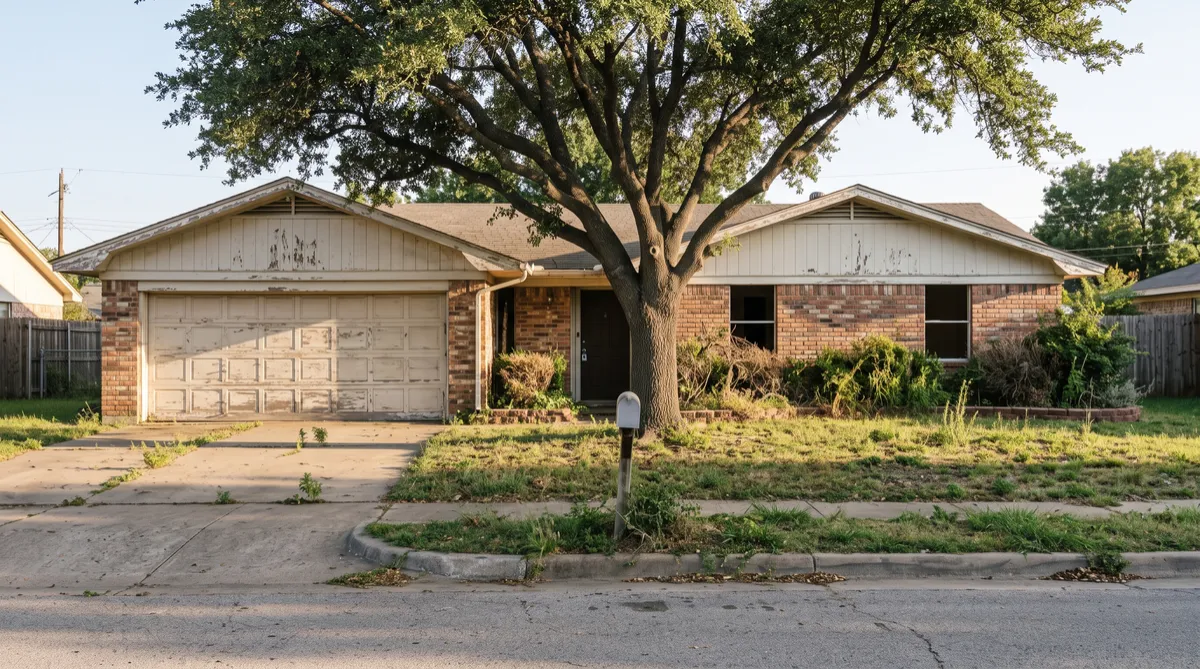
How Much Does It Cost To Keep A Vacant Home In Texas?
Key Takeaways
For a median-priced DFW home around $350,000–$400,000, out-of-pocket monthly carrying costs for a vacant property typically run $1,600–$1,900 before any mortgage payment — and the total economic impact (including lost rental income) can approach $4,000 every 30 days.
Standard homeowners insurance policies void coverage for key perils — vandalism, theft, and water damage — after just 30–60 days of vacancy, leaving families exposed to catastrophic uninsured losses if they don't secure a specialized vacant home policy.
Property taxes become delinquent on February 1st in Texas; penalties escalate to 32% of the original bill by July if left unpaid, and many DFW cities layer on additional fines and municipal liens for code violations on neglected vacant properties.
Texas's climate accelerates deterioration in vacant homes — from mold and HVAC failure in summer heat to burst pipes in winter freezes and foundation cracks from expansive clay soils — turning small problems into $15,000+ emergencies when no one is watching.
Trust Sage Senior Support for transparent cash offers, zero commissions, and compassionate guidance through every step of the care transition — visit Sage Senior Support to explore your options today.
How Much Does It Really Cost To Keep A Vacant Home In Texas Each Month?
For a median-priced DFW home around $350,000 to $400,000, the out-of-pocket monthly costs to maintain a vacant property typically range from $1,600 to $1,900—and that's before factoring in a mortgage payment or lost rental income. When you add those elements, the total economic impact can approach $4,000 every 30 days. Most families dramatically underestimate these carrying costs, focusing only on the mortgage while overlooking insurance surcharges, property tax accruals, utilities, maintenance, and the accelerating risk of deferred maintenance in Texas's climate.
Understanding the full picture of what a vacant home actually costs is the first step toward making a decision that protects both your parent's care and your family's financial stability.
Sage Senior Support
Free Consultation & Cash Offer in 24 Hours
Core Service Programs:
Cash Home Buying for families needing to sell a parent's home fast to fund senior care
Senior Care Resources with personally-vetted community partners to assist your family in the transition for your loved one
Care Funding Discovery Home sell options for Texas Medicaid, VA benefits, long-term care insurance, and bridge financing
Why Choose Sage Senior Support:
✓ Trusted by customers with a perfect 5.0-star Google rating across 26 verified reviews
✓ Founded by someone who's lived this transition — twice (2013 & 2024)
✓ 100+ DFW families guided through senior care transitions
✓ Cash offers same day — close in as few as 10 days
✓ Zero commissions, zero closing costs, no repairs needed
✓ Connection to free care placement — agents paid by the community, not your family
✓ Locally owned in Grapevine, TX — serving the entire DFW metroplex
Schedule a Free Consultation →
Breaking Down the Monthly Costs of a Vacant Texas Home
When families first realize they need to address selling a parent's home to fund senior care, the instinct is often to hold off — to wait until things settle, until emotions calm, until there's more time. But every month that passes carries a very real price tag. Here's where that money actually goes.
You're Not Alone in Feeling Overwhelmed
Many families in DFW are actively researching this exact question, trying to understand the full picture before making a decision that impacts both finances and peace of mind. The guilt, emotional weight, and logistics of a vacant parent's home are real — and you deserve support in navigating them.
Expense Category | Monthly Cost Estimate | Notes |
|---|---|---|
Vacant Home Insurance | $154–$230/mo | 50%–150% more than standard policy (~$1,842/yr vs. $1,228/yr occupied) |
Property Taxes (DFW) | ~$580/mo | Based on $350,000 home at 2.0%–2.5% annual rate |
Utilities (minimum) | $80–$350/mo | AC, water, electricity kept on to prevent damage; higher in summer |
Lawn & Exterior Maintenance | ~$150/mo | Prevents municipal liens and HOA fines; city fines can reach $500/occurrence |
Security Monitoring | $40–$60/mo | Alarm system or smart cameras |
HOA Fees (if applicable) | $150–$400/mo | Plus potential fines for code violations on neglected properties |
Total Out-of-Pocket Burn Rate | $1,600–$1,900/mo | Before mortgage, lost rental income, or emergency repairs |
Add a mortgage payment on top of this, and the numbers climb fast. Factor in the lost rental income — a comparable DFW home could generate roughly $2,400 per month — and the true economic impact of holding a vacant home approaches $4,000 every 30 days. Over six months, that's $24,000 gone. Over nine months, $36,000. These aren't hypothetical figures; they reflect what families across the metroplex are quietly absorbing right now while they wait to decide. Understanding the true cost of assisted living in DFW makes it even clearer why stopping this drain quickly matters so much.
The Hidden Costs That Accelerate in Texas's Climate
Texas is not a forgiving place for an unattended house. The same climate that makes summers brutal and winters unpredictable creates a perfect storm of accelerating damage the moment a home sits empty. These aren't distant risks — they're documented, expensive, and often invisible until it's too late.
Without continuous HVAC operation, summer heat and humidity can crack drywall, warp floors, and promote mold growth inside walls and under flooring within weeks. Maintaining the AC at 78°F or lower in a 2,000-square-foot home still runs $180–$220 per month in electricity — but skipping it entirely can mean $10,000–$30,000 in mold remediation.
Winter is equally dangerous. The 2021 Texas freeze taught every homeowner in the state what happens when pipes aren't monitored: burst lines, water flooding through ceilings, and damage that can cost tens of thousands to repair. A vacant home with no one checking in for weeks is the worst-case scenario when temperatures drop.
Then there's the ground itself. The expansive clay soils common across DFW shrink dramatically during hot, dry summers. That movement causes foundation shifts and cracks that, left unaddressed, require $15,000 or more to repair. Some families install soaker hoses on timers to maintain soil moisture — an added cost most never anticipated. Pest infiltration rounds out the picture: rodents, insects, and birds find their way into unoccupied homes quickly, and the nesting damage and contamination they leave behind is both costly and unpleasant to address.
Small problems escalate into major repairs when no one is watching. That's the defining reality of a vacant home in Texas's climate, and it's why every month of delay compounds the financial exposure.
Property Tax Delinquency and Municipal Code Violations
Property taxes in Texas are not optional, and the penalty structure for missing them is steep. Taxes become delinquent on February 1st. At that moment, a 6% penalty plus 1% monthly interest is immediately added. By July 1st, the penalty escalates to 12%, and if the taxing unit contracts an attorney for collection — which many do — an additional 15%–20% attorney fee can be tacked on. That brings the total delinquency cost to roughly 32% of the original tax bill by midsummer.
Most counties wait one to two years before filing a foreclosure lawsuit, but they have the legal right to do so the moment taxes are delinquent. Families who assume they have unlimited time to sort things out are often surprised by how quickly the legal machinery can move.
Municipal code enforcement adds another layer of financial risk. Many DFW cities have vacant property ordinances that require registration, inspection fees, and compliance with exterior maintenance standards. Dallas, for example, charges a $75 registration fee, an $185 inspection charge, and a per-square-foot fee for vacant buildings. Overgrown lawns, structural disrepair, or junked vehicles on the property can trigger fines of $500 or more per occurrence. Unpaid fines escalate into municipal liens, which complicate any future sale and must be resolved before title can transfer.
There's also the homestead exemption to consider. This valuable protection — which caps annual increases in a home's appraised value — applies only to a primary residence. When a parent moves to a care facility, the home is no longer their primary residence, and the exemption is at risk. Losing it can meaningfully increase the annual property tax bill. Families with a parent who is 65 or older or disabled may be able to defer property taxes by filing Form 50-126, but those deferred taxes accrue 5% annual interest and must be repaid when the property is eventually sold. If you're navigating these questions, understanding probate and estate settlement in Texas is a critical next step.
Insurance Gaps and Coverage Risks for Vacant Properties
This is the risk that catches families most off guard, and the consequences can be catastrophic.
The 30–60 Day Insurance Cliff
Most families don't realize that their standard homeowners insurance stops protecting them after just 30–60 days of vacancy. If a pipe bursts, vandals strike, or a fire starts during this gap, you could face tens of thousands in uninsured losses. Don't let this happen — contact your insurance agent immediately to understand your coverage and secure a vacant home policy.
Standard homeowners insurance policies contain a "vacancy clause" that reduces or voids coverage for specific perils once a home has been unoccupied for 30 to 60 consecutive days. Vandalism, theft, broken glass, and water damage — the exact events most likely to occur in an unattended home — may be entirely excluded. The policy still collects its premium, but it won't pay out when you need it most.
A specialized vacant home policy is required to maintain real coverage, and it costs 50%–150% more than a standard policy. Some insurers price it at 1.5x to 3x the standard rate. The average vacant dwelling policy runs approximately $1,842 annually compared to $1,228 for an occupied home — a meaningful difference, but far less painful than an uninsured loss.
Insurers treat vacant homes as significantly higher risks because undetected water leaks, fire, and theft — including copper stripped from AC units — are far more common in unoccupied properties. A study in Austin found that blocks with unsecured vacant buildings had 1.8 times as many theft calls and twice the number of violent calls compared to occupied blocks. Properties in higher-crime neighborhoods face premiums 30%–40% above comparable homes in safer areas. The bottom line: call your insurance agent the week a parent moves out, not months later.
Medicaid, Probate, and Legal Implications of a Vacant Home
When a parent moves to memory care or assisted living — or passes away — the home doesn't automatically become available to sell. Legal and financial structures often determine what the family can actually do with the property, and how quickly.
If the home remains in a parent's name and they have cognitive decline or have passed, probate may be required to transfer legal ownership. Texas probate can take months, during which carrying costs continue to accumulate and the family's ability to sell is limited. Amendments to the Texas Estates Code that took effect September 1, 2025 updated procedures around probate and Medicaid Estate Recovery Program (MERP) claims — making it more important than ever to work with an elder law attorney early in the process.
Texas's MERP allows the state to seek reimbursement for long-term care Medicaid costs from a deceased recipient's probate estate. The key word is "probate." Assets structured to pass outside of probate — through a Lady Bird Deed, a Transfer-on-Death Deed, or a living trust — are typically protected from MERP claims. The home is also protected from recovery if a surviving spouse, a child under 21, a blind or disabled child, or an unmarried adult child who lived there for at least a year still resides there.
Families who want to protect the home from Medicaid Estate Recovery while also navigating the sale process benefit enormously from having the right legal and financial partners in place before a crisis forces the issue. Understanding your options for paying for long-term care — including how home equity fits into the picture — is one of the most important steps a family can take early in the transition.
Your Options: From Renting to Selling — What Each Path Really Costs
The Power of Knowing All Your Options
Before making any decision about your parent's home, understand every path available to you — from renting to traditional listing to direct cash sale. Each has different costs, timelines, and outcomes. Families who take time to compare options report feeling more confident and less regretful about their choice, even if it's not the highest dollar amount.
There is no single right answer for every family. But there is a right answer for your family — and it starts with understanding what each path actually costs in time, money, and emotional energy.
Path | Timeline | Upfront Costs | Commissions & Fees | Net Proceeds |
|---|---|---|---|---|
Do Nothing / Keep Paying | Ongoing | $1,600–$1,900/mo carrying costs | None (yet) | Declining — costs compound monthly |
Rental Management | Ongoing | Repairs to make rent-ready; varies widely | 8%–12% mgmt fee + leasing fee | Uncertain; vacancy periods erase gains |
Traditional Listing (Move-In Ready) | 6–9 months | Repairs, staging, cleaning | 6% commission + 1% concessions + ~$5,000 buyer repairs | Highest gross; lower net after costs and time |
As-Is Listing with Agent | 2–4 months | Minimal | 6% commission + $8,000–$10,000 buyer repairs | ~70% of Move-In Ready value |
Direct Cash Sale (Sage) | 7–10 days | $0 — no repairs, cleaning, or staging | $0 commissions, $0 closing costs | Immediate; carrying costs stop at closing |
The rental path sounds appealing until you account for the upfront investment required to make an older DFW home rent-ready, ongoing management fees of 8%–12% of gross rent, leasing fees, repair reserves, and the ever-present risk of vacancy between tenants. For many families, the math simply doesn't work — especially when care costs of $3,200–$7,500 per month are already pressing.
A direct cash sale stops the carrying cost meter immediately. Sage also offers interest-free bridge loans — repaid at closing — to cover care-facility move-in costs when a family needs to act before the sale closes. That means you don't have to choose between getting your parent into care now and waiting for a sale to fund it. To see how home equity can be structured to fund senior care through a direct home sale, Sage walks families through every scenario with full transparency.
Red Flags: Protecting Your Family from Predatory Practices
Vacant senior homes are, unfortunately, targets. Families in the middle of a care transition are emotionally vulnerable, often under time pressure, and sometimes unfamiliar with real estate processes — a combination that bad actors exploit. Knowing what to watch for is the best protection.
Common red flags include:
Lowball offers with hidden fees: An attractive initial price that quietly erodes with unexpected charges at closing.
High-pressure tactics: Rushing families to sign before they've had time to think, ask questions, or consult an attorney.
Deed-theft schemes: Attempting to trick homeowners into signing documents that transfer property rights without a fair transaction.
Exploiting deferred maintenance: Using the home's condition to justify extreme lowball offers when the underlying value is meaningfully higher.
Lack of transparency: Vague contracts, reluctance to answer direct questions, or avoiding proper title company involvement.
Before working with any buyer, ask these questions directly:
What are all the fees — upfront and at closing?
What is the exact timeline from offer to closing?
Do I need to make any repairs or clean out the home?
How do you handle properties with code violations, liens, or probate complications?
Can you provide references from other DFW families you've helped?
What is your local reputation and accreditation?
Legitimate buyers answer every one of those questions clearly and without hesitation. They cover closing costs, have no hidden fees, offer flexible timelines, and can navigate complex situations — probate, municipal liens, squatters — without flinching. The senior transition concierge services Sage provides go well beyond a typical home purchase, because the goal is to support the family through the entire care transition, not just complete a transaction.
Why Sage Senior Support Is the Right Choice for DFW Families with a Vacant Home
Sage Senior Support was built by someone who has lived this exact situation — twice. Founder Logan Hassinger navigated his own family's care transitions in 2013 and again in 2024, and he built Sage because the support families need during these moments simply didn't exist in one place. That personal foundation is what makes every conversation at Sage different from the first call.
When you reach out to Sage, the first question isn't about the house. It's "How's Mom or Dad doing?" — because care comes first, and the home sale is a means to fund that care, not the other way around. That philosophy is reflected in everything Sage does: the transparent offer process, the zero-commission structure, the interest-free bridge loans, and the trusted network of senior living professionals, elder law attorneys, and care placement agents that Sage connects families with at no cost.
The results speak clearly. Sage holds a perfect 5.0-star Google rating across 26 verified reviews and has guided more than 100 DFW families through vacant home sales during care transitions. Cash offers are provided within 24–48 hours of a property visit. Closing happens in as few as 10 days — or on whatever timeline works for the family. Homes are purchased as-is: no repairs, no cleaning, no staging, no showings. Families take what they want and leave the rest. Zero commissions, zero closing costs, zero surprises.
Sage is locally owned and operated in Grapevine, TX, serving families across the entire DFW metroplex — from Arlington and Bedford to Addison and Allen. When you work with Sage, you're working with neighbors who understand the local market, the local care landscape, and the very real weight of what your family is carrying.
Schedule a Free Consultation with Sage Senior Support — and let's talk through your family's situation together, starting with what matters most.
Frequently Asked Questions About Vacant Home Costs in Texas
Does the homestead exemption still apply if my parent moves to a care facility and the house is empty?
No — the Texas homestead exemption applies only to a primary residence. If your parent moves out and the home is no longer occupied by them or a qualifying dependent, you risk losing this valuable protection. The financial consequence is a higher taxable assessed value and a meaningfully larger annual property tax bill, adding to the strain of an already expensive vacant property. Consult a property tax professional as soon as your parent transitions to care to understand your specific exposure and whether a deferral under Form 50-126 might apply.
What happens to my homeowners insurance when my parent's home sits vacant for an extended period?
Most standard homeowners insurance policies contain a "vacancy clause" that voids or significantly reduces coverage for key perils — vandalism, theft, broken glass, and water damage — once the home has been empty for more than 30 to 60 consecutive days. At that point, you need a specialized vacant home policy, which typically costs 50%–150% more than standard coverage and may still carry its own limitations. Failing to make this switch leaves your family exposed to potentially catastrophic, uninsured losses from the exact events most likely to occur in an unoccupied home.
How long can a house legally sit vacant in Texas before I face municipal issues or penalties?
Texas has no single statewide deadline that triggers automatic "abandoned property" status, but many individual DFW cities have their own vacant property ordinances with real teeth. These ordinances commonly require registration, impose inspection fees, and issue fines for violations like overgrown lawns, structural disrepair, or junked vehicles — fines that can reach $500 per occurrence. Left unpaid, those fines escalate into municipal liens that must be cleared before any future sale can close. The safest approach is to address municipal compliance immediately, not after penalties have already accumulated.
Is it actually profitable to rent out my parent's vacant home after factoring in all costs?
Renting can generate income, but the true profitability of an older DFW home is rarely as straightforward as it appears. Property management fees typically run 8%–12% of gross monthly rent plus a leasing fee, and older homes often require significant upfront investment to meet rental standards. Add repair reserves, the risk of tenant turnover, and periods of vacancy between tenants, and the net income can fall well below expectations — particularly when care costs of $3,200–$7,500 per month are already creating financial pressure. A careful, honest financial analysis is essential before committing to the landlord path.
What makes Sage Senior Support different from other home buyers or real estate options?
Sage Senior Support starts every conversation by understanding your parent's care situation before the home ever comes up — because care comes first. Unlike typical cash buyers who make lowball offers without explanation, Sage provides transparent offers based on property condition and location, with zero hidden fees, zero commissions, and zero closing costs. With a perfect 5.0-star Google rating across 26 verified reviews and more than 100 DFW families helped, Sage delivers cash offers within 24–48 hours and can close in as few as 10 days — immediately stopping your monthly carrying cost drain. Interest-free bridge loans are available to cover care-facility move-in costs before the sale closes, and Sage's trusted network of senior living professionals means your family receives education and support well beyond the home sale itself. Schedule a Free Consultation with Sage Senior Support to explore your options and get a fair, transparent cash offer today.
Ready to Stop the Financial Drain of a Vacant Home in DFW?
Every month a vacant home sits empty costs your family $1,600–$1,900 or more — money that could be funding your parent's care instead. You don't have to navigate this alone, and you don't have to choose between speed and fairness. Sage Senior Support provides transparent cash offers within 24–48 hours, closes in as few as 10 days, and handles everything as-is — no repairs, no cleaning, no commissions.
Let's start with a real conversation about your family's situation — and go from there.
Service availability, benefit eligibility, and home valuations depend on individual circumstances and current market conditions. This article is for informational purposes only and does not constitute medical, legal, or financial advice. Contact us for personalized guidance specific to your family's situation.