
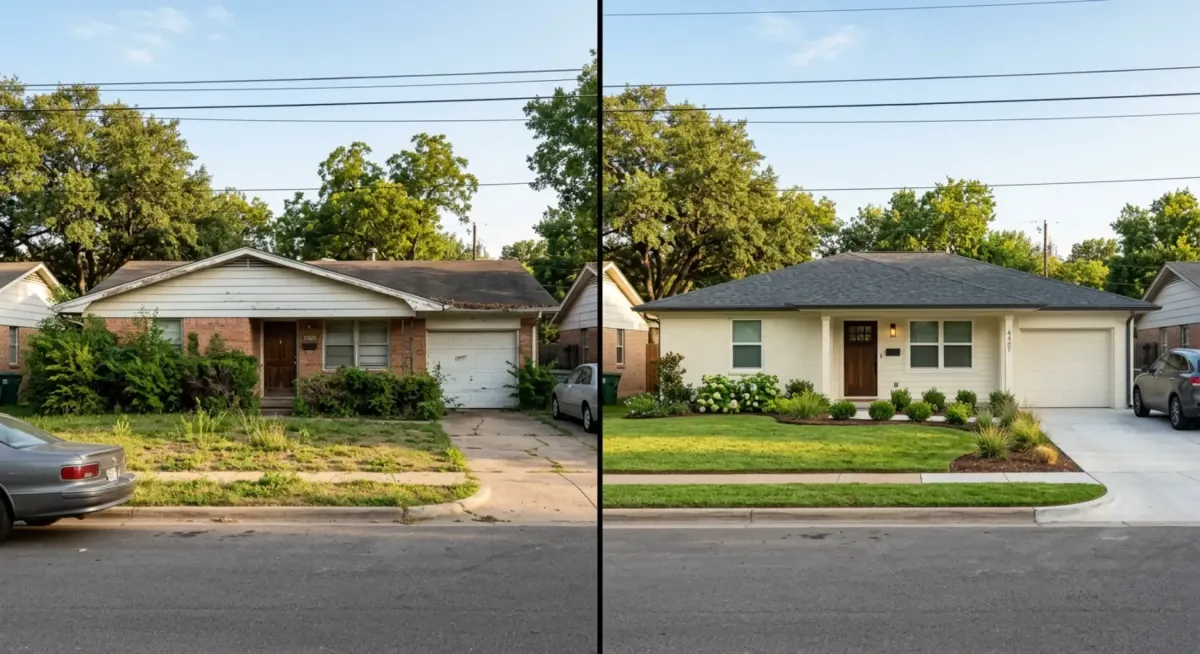
Denton, TX: What You Get Selling a House As-Is vs. Listing With an Agent
Denton, TX: What You Get Selling a House As-Is vs. Listing With an Agent
Picture this: You're standing in your mom's Denton home on a Tuesday afternoon. The carpet is worn down to the padding in the hallway. The kitchen still has the original 1987 appliances. There's a slow leak under the bathroom sink that's been "almost fixed" for two years. And somewhere in the back of your mind, you're calculating how long it would take to get all of this ready to list — while also trying to figure out how you're going to pay for the memory care facility that has a room available right now.
This house is full of decades of memories. The kitchen table where your kids did homework. The garden your mom tended every spring. The smell of her cooking that somehow still lingers in the curtains. It's not just a property — it's a piece of her life. And right now, it's also the key to getting her the care she needs.
The question sitting heavy on your chest is one we hear from families all over Denton: Do we fix it up and list it, or do we find a faster way? There's no one-size-fits-all answer. But there is a right answer for your family's specific situation — and this guide is going to help you find it.
Key Takeaways: Selling As-Is vs. Listing With an Agent in Denton
- Listing with a Denton agent can net you more money, but typically takes 2–4 months from prep to closing — and that timeline has real costs when care is urgent.
- Selling as-is to a cash buyer is typically 15–30% below market value, but closes in 7–14 days with no repairs, no commissions, and no contingencies.
- For a $280,000 Denton home needing $35,000 in repairs, the real-world difference between the two paths may be as little as $10,000 — but 80 days apart in timing.
- The right choice depends on your parent's care timeline, the home's condition, and how much emotional bandwidth your family has right now.
- Vetting cash buyers matters — always ask how they calculated their offer, and walk away from anyone who won't explain their numbers.
- Before spending any proceeds, consult an elder law attorney about Medicaid implications and how to structure funds for your parent's care.
Why Denton Families Face This Decision Right Now
Denton isn't just growing — it's aging. The city has seen significant population growth over the past decade, and with that growth comes an expanding senior population navigating the transition from independent living to assisted living, memory care, and skilled nursing facilities. Denton County has dozens of senior care options, from boutique memory care communities near the historic square to larger assisted living campuses along I-35. The care is available. The challenge is funding it quickly enough.
Here's the gap that catches most families off guard: the moment a doctor recommends a higher level of care — or a fall, a wandering incident, or a health crisis forces the decision — the clock starts ticking. Care facilities often need a deposit and first month's payment before move-in. That can mean $3,000 to $7,000 or more, depending on the community. And if you're waiting for a home sale to fund that, you're either paying out of pocket in the meantime or risking losing the placement altogether.
The home is usually the family's largest asset — and the most complicated one to liquidate. Unlike a savings account, you can't just transfer it. It takes time, decisions, and often significant money to prepare it for sale. That's why funding senior care through a home sale requires a clear-eyed look at which selling method actually matches your family's timeline — not just which one sounds best on paper.
And then there's the emotional layer. "What do we do with Mom's house?" is rarely just a logistical question. It's wrapped up in guilt, grief, and the weight of making a decision that feels permanent. We've seen families delay the sale for months — not because they didn't know what to do, but because making the decision felt like closing a chapter they weren't ready to close. That's completely understandable. And it's also something we want to help you move through, not around.
The condition of the home shouldn't be what stands between your parent and the care they need. Whether the house needs $5,000 in touch-ups or $50,000 in structural work, there is a path forward. The question is which path gets you there on your timeline — and that's exactly what we're going to break down.
The Traditional Agent Route: Timeline, Costs, and What to Expect in Denton
Listing with a real estate agent is the path most families default to — and for good reason. In the right circumstances, it can genuinely maximize what you walk away with. But "maximize" is a word that deserves scrutiny, because the agent route comes with a full set of costs and timelines that families often don't fully account for until they're already in the middle of it.
In Denton, a home in good condition in a desirable neighborhood can go under contract relatively quickly — sometimes within two to four weeks of listing. But "in good condition" is the operative phrase. If the home needs work — and most homes that have been lived in for 20 or 30 years do — you're looking at a pre-listing preparation phase that can stretch from four to twelve weeks before the sign even goes in the yard. That means hiring contractors, coordinating repairs, potentially staging the home, and paying for professional photography and marketing materials.
Once listed, the average time from listing to closing in the Denton area varies significantly by neighborhood and condition. Newer subdivisions in areas like Robson Ranch or near the University of North Texas corridor tend to move faster. Older homes — particularly those in the 1970s–1990s vintage range — can sit 60 to 90 days or longer, especially if they need updates that buyers factor into their offers. For guidance on preparing a home for sale during a senior transition, the resource on maximizing home value before a senior transition walks through what actually moves the needle versus what's not worth the investment.
Here's the full cost picture for the agent route:
- Real estate commission: Typically 5–6% of the sale price, split between the listing agent and the buyer's agent. On a $280,000 sale, that's $14,000–$16,800.
- Closing costs: Seller-side closing costs in Texas generally run 2–3% of the sale price — title insurance, escrow fees, prorated taxes, and more. Add another $5,600–$8,400.
- Pre-listing repairs and updates: This varies wildly, but even "light" prep — fresh paint, carpet, minor repairs — can run $8,000–$15,000. Major repairs push that number significantly higher.
- Staging and photography: Professional staging can cost $1,500–$3,000 for a furnished home. Photography and marketing materials add another $300–$600.
- Carrying costs during the listing period: Property taxes, utilities, insurance, and lawn maintenance don't stop while the home is on the market. In Denton, that can easily run $1,500–$2,500 per month.
After closing, funds are typically disbursed 7–10 days after the closing date. So when you add up pre-listing prep (4–12 weeks), time on market (30–90 days), and post-closing disbursement (1–2 weeks), you're looking at a total timeline of 2–4 months from decision to dollars in hand — on the optimistic end.
Hidden Costs Families Often Miss When Listing a Parent's Home
Beyond the line items above, there are costs that don't show up in any agent's listing presentation. The first is inspection surprises. A buyer's inspector will go through the home with a fine-tooth comb, and in an older Denton home, they often find things the family didn't know about — foundation movement, outdated electrical panels, HVAC systems past their useful life, or plumbing issues. Repair requests after inspection can range from a few thousand dollars to $25,000 or more, and if you can't or won't make the repairs, the buyer can walk away.
Then there's the appraisal gap. If the buyer is using a mortgage, the home has to appraise at or above the offer price. If it doesn't, you're either negotiating a price reduction, covering the gap yourself, or watching the deal fall apart. In a market where home values have shifted quickly, this is more common than families expect.
And finally — the cost that never shows up in a spreadsheet — is the emotional toll of the process. Every showing means the home has to be clean and staged. Every negotiation is another decision to make when you're already stretched thin. If your parent is in a care facility and you're managing their transition, their belongings, and the home sale simultaneously, the mental and emotional weight of the agent route is real and significant.
Selling As-Is to a Cash Buyer in Denton: Speed, Simplicity, and Trade-Offs
The as-is cash sale model is often misunderstood — and sometimes unfairly maligned. Yes, you'll receive less than market value. Yes, the buyer is making a profit. But when you understand how the math works and what you're actually trading, the picture becomes a lot clearer — and for many Denton families, it becomes the obvious choice.
"As-is" means exactly what it sounds like: you sell the home in its current condition. No repairs. No cleaning. No staging. The buyer comes in, assesses the property, and makes an offer based on what the home is worth after they fix it up — minus their repair costs and profit margin. You don't have to do a thing except show up to closing.
The timeline is where this option really distinguishes itself. A legitimate cash buyer in the Denton area can typically close in 7–14 days. Some can move faster if the situation is urgent. There are no lender timelines to wait on, no appraisals to schedule, no inspection contingencies to negotiate. The deal is straightforward: you agree on a price, sign the contract, and close. For families navigating a care transition where every week matters, this speed isn't just convenient — it's the whole point.
There's also no commission. You're working directly with the buyer, which means the 5–6% that would go to real estate agents stays out of the equation. And because cash buyers don't rely on lender financing, there's no risk of the deal falling through at the last minute because a buyer's loan didn't come through — something that happens more often than families expect in traditional sales.
For families who want to vet their options carefully, the resource on trustworthy as-is home buyers in DFW is a good place to start understanding what separates legitimate buyers from predatory ones.
What the As-Is Offer Actually Looks Like
A cash buyer's offer isn't arbitrary — or at least it shouldn't be. A transparent buyer will calculate their offer based on three factors: the home's post-renovation market value, the estimated cost of repairs, and their profit margin (which covers holding costs, financing, and business overhead). The formula looks something like this:
Offer = Post-Renovation Value − Repair Costs − Profit Margin
As a concrete example: a Denton home with a post-renovation value of $280,000 that needs $40,000 in repairs might receive an offer in the $210,000–$240,000 range, depending on the buyer's margin and local market conditions. That range exists because different buyers have different cost structures — some are more efficient, some carry higher overhead, and some are simply more competitive than others. That's why getting more than one offer matters.
The discount exists because the buyer is taking on real risk and real costs. They're fronting the money for repairs, carrying the property while work is done, and absorbing any surprises that come up during renovation. That's a legitimate trade-off — not a scam — when the buyer is transparent about how they got to their number.
The Real Advantage: Speed and Certainty When Care Can't Wait
Here's what speed and certainty actually mean in practice. Your parent has a placement at a memory care community in Denton. The move-in date is in three weeks. You need a deposit and first month's payment. With a cash sale, you can have funds in your account before that move-in date. With a traditional listing, you're looking at months of waiting — and paying out of pocket in the meantime.
Certainty matters just as much as speed. Traditional sales fall through — buyer financing falls apart, inspections uncover problems that derail negotiations, appraisals come in low. When you're already managing a care transition, the last thing you need is to be back at square one after a deal collapses. A cash sale removes that risk entirely. Once you agree on a price and sign the contract, the deal closes. Full stop.
One conversation replaces months of showings, negotiations, and open houses. For families who are already emotionally exhausted, that simplicity is worth something real — even if it doesn't show up in a spreadsheet.
Every Week Matters When Care Can't Wait
If your parent needs assisted living now but you're waiting for the house to sell, you're paying out-of-pocket for care while the home sits on the market. That's the real cost of the "highest offer" strategy — it's not just about the sale price, it's about what you're spending in the meantime. A month of private-pay memory care in Denton can run $4,000–$7,000. That changes the math on which option actually puts more money in your family's hands.
The Numbers: Agent Sale vs. As-Is Cash Sale (A Real Denton Example)
Let's stop talking in abstractions and look at actual numbers. This is the kind of side-by-side comparison we walk families through in our first conversation — because the difference between the two paths is often much smaller than people expect, and the timeline difference is much larger.
The scenario: A Denton home with a market value of $280,000 in its current condition. It needs approximately $35,000 in repairs to be competitive on the open market — updated kitchen, new HVAC, fresh flooring, and some deferred maintenance items.
| Factor | Agent Route | As-Is Cash Sale |
|---|---|---|
| Starting sale price | $280,000 (after repairs) | $215,000 (as-is offer) |
| Repair costs | −$35,000 | $0 |
| Agent commission (5.5%) | −$15,400 | $0 |
| Closing costs (3%) | −$8,400 | −$0 to −$2,000 (varies) |
| Carrying costs (2–3 months) | −$4,000–$6,000 | $0 |
| Net proceeds | ~$215,000–$220,000 | ~$213,000–$215,000 |
| Time to funds | 90–120 days | 10–14 days |
Read that again. In this scenario, the real-world difference in net proceeds between the two paths may be as little as $2,000–$7,000 — but the timing difference is 80 to 100 days. If your parent is paying $5,000 per month for memory care out of pocket while you wait for the traditional sale to close, the agent route actually costs your family more in the end.
This is why we always say: the question isn't which option gives you the highest sale price. The question is which option puts the most money in your family's hands given your parent's actual care timeline. For more on how families structure these decisions, the guide on how families are funding senior living costs walks through the full picture.
When the Agent Route Makes Sense for a Denton Home
The agent route genuinely makes sense in specific circumstances, and we'd never tell you otherwise. If your parent's home is in excellent condition — or needs only cosmetic updates like paint and landscaping — the cost of preparation is lower and the potential upside is real. Newer subdivisions in Denton, particularly those built in the last 15–20 years with updated systems and finishes, can command strong prices and move quickly with a skilled agent.
If your family has 3–6 months before care is needed, or if care is already funded through other means (VA benefits, long-term care insurance, family contributions), the time pressure is reduced and the agent route becomes more viable. And if maximizing every dollar is the priority — perhaps because your parent's care costs are high and long-term — then the extra weeks or months of waiting may be worth it.
When As-Is Cash Makes the Most Sense
The as-is cash route rises to the top when care is needed now or within 30 days. It's also the clear choice when the home needs significant repairs — anything over $20,000 — because the repair process itself takes time, money, and coordination that families in the middle of a care transition simply don't have. If the home has structural issues, foundation problems, or major system failures, traditional buyers will be scared off or will demand deep discounts anyway, narrowing the gap between the two options even further.
And if you're emotionally exhausted — if you've been managing your parent's care, their finances, their belongings, and their emotions for months — the simplicity of a cash sale is worth something real. There's no shame in choosing the path that lets you breathe again.
Comparing these two paths is one thing — knowing which one actually fits your family's care timeline and financial situation is another. That's exactly what a free consultation is designed to answer. We'll walk through your timeline, your parent's care needs, and which option gets you the funds you need without the added stress.
Schedule a Free ConsultationRed Flags: How to Spot a Bad Cash Offer and Vet Denton Buyers
Here's the honest truth: not all cash buyers are created equal. The industry has its share of predatory operators who use high-pressure tactics, opaque offers, and fast-talking to push families into deals that don't serve them. We've seen it happen, and it's one of the reasons we're so committed to transparency in everything we do. You're right to be skeptical — and that skepticism is actually your best protection.
The good news is that the red flags are usually pretty clear once you know what to look for. The comprehensive guide on cash buyer scams in DFW and how to vet them goes deep on this topic, but here are the most important warning signs to watch for:
- They won't explain how they calculated the offer. A legitimate buyer should be able to walk you through their math — post-renovation value, estimated repairs, holding costs, profit margin. If they get vague or defensive when you ask, that's a serious red flag.
- They pressure you to sign quickly. Urgency tactics — "this offer expires in 24 hours," "we have three other buyers interested" — are designed to prevent you from thinking clearly or getting a second opinion. A trustworthy buyer will give you time.
- They discourage you from consulting anyone else. Whether it's a family member, an attorney, or another buyer, a legitimate buyer has nothing to hide from a second set of eyes.
- The offer is more than 30% below comparable homes. Some discount is expected and fair. But if the offer seems dramatically low with no clear explanation, walk away and get another offer.
- They have no local track record. Out-of-state investors with no presence in Denton are harder to hold accountable. Look for buyers with verifiable local experience and references from families in the area.
On the flip side, here are the green flags that signal a buyer worth working with: they proactively explain their offer calculation, they encourage you to get a second opinion, they have references from other Denton families, and they're flexible on closing timelines if your situation changes.
Questions to Ask Any Cash Buyer Before You Sign Anything
Before you agree to anything, ask these questions directly — and pay attention to how the buyer responds, not just what they say:
- How did you calculate this offer? Ask for a written breakdown of repair estimates, holding costs, and profit margin. A transparent buyer will provide this without hesitation.
- What repairs are you planning to make? This gives you a reality check on whether their repair estimates are reasonable — and whether their offer reflects the actual condition of the home.
- How long have you been buying homes in Denton? Local experience matters. Someone who knows the Denton market will make a more accurate offer and be a more reliable partner.
- Can you provide references from other families you've worked with? Not just testimonials on a website — actual families you can call and ask about their experience.
- What happens if I need to delay closing? Life happens, especially during a care transition. A good buyer will have a clear, flexible answer to this question.
If a Buyer Won't Explain Their Offer, Walk Away
A legitimate cash buyer should be able to show you exactly how they calculated the offer — repair costs, holding costs, profit margin, everything. If they get defensive or vague when you ask, that's your signal to keep looking. You deserve transparency, especially when you're dealing with something this important. "We made those exact mistakes too" — our family learned the hard way that urgency and pressure are not the same thing. Take your time, ask your questions, and trust your gut.
The Emotional Side: Which Option Feels Right for Your Family?
We've spent a lot of time on numbers and timelines, and those things matter. But this decision isn't purely financial — and pretending it is would be doing you a disservice. Selling a parent's home is one of the most emotionally complex things an adult child can do. It's a physical act that carries enormous symbolic weight: closing a chapter, letting go of a place that holds decades of memory, and making a decision on behalf of someone who may not fully understand what's happening.
If you're already overwhelmed — if you've been managing your parent's care, their doctors, their finances, and their emotions for months — the as-is cash sale can feel like someone finally taking something off your plate. The speed isn't just convenient; it's relief. It's one less thing to manage. And that has real value, even if it doesn't show up in a net proceeds calculation.
If you have more time and emotional bandwidth, the agent route might feel more "right" — more normal, more respectful of what the home represents. There's something to be said for going through the process of preparing the home, seeing it listed, and receiving an offer from a buyer who wants to live there. For some families, that process feels like a more fitting farewell to the chapter the home represents.
If you're grieving — and many families are, even when their parent is still alive — the speed of a cash sale can feel like mercy. You don't have to spend months going back to the house, staging it, cleaning it, showing it. You can close that chapter and focus your energy on your parent and your family. For more on processing the feelings that come with this transition, the resource on navigating the emotional journey of downsizing speaks directly to what families go through.
If you're conflicted — if part of you feels guilty about selling at all — an agent might feel more comfortable because it's the "normal" way to sell a house. It's what people do. And sometimes, choosing the familiar path is the right call for your family's emotional health, even if it's not the most efficient one financially.
Here's what we know for certain: there is no wrong choice. There is only the choice that's right for your family's situation — your parent's care needs, your financial picture, your emotional capacity, and your timeline. That's the lens through which every decision in this process should be made.
What Happens After the Sale: Using Proceeds to Fund Senior Care
The sale closes. The funds hit your account. Now what? This is the part of the process that families are often least prepared for — and where the decisions you make in the first few weeks after closing can have long-term consequences for your parent's care funding.
The first thing to understand is that home sale proceeds are generally not counted as income for Medicaid purposes in Texas — but they can become a countable asset once they're in your parent's bank account, which can affect Medicaid eligibility. The rules around this are nuanced and depend heavily on your parent's specific situation, how the funds are held, and what they're used for. This is not a situation where you want to wing it. Before spending a single dollar of the proceeds, consult an elder law attorney. The guidance on Medicaid planning and protecting home assets is a helpful starting point, but it's not a substitute for personalized legal advice.
Once the legal picture is clear, the proceeds can be used in a variety of ways depending on your parent's care situation:
- Direct care funding: Proceeds can pay for assisted living, memory care, skilled nursing, or in-home care directly. Many families use the proceeds to fund 2–5 years of care while other funding sources (VA benefits, long-term care insurance, Social Security) continue in the background.
- Bridge funding: If your parent is in the process of applying for VA benefits or Medicaid, the proceeds can bridge the gap while those applications are processed — which can take months.
- Reserve fund: Some families hold proceeds in a structured account to ensure funds are available for care needs as they evolve, rather than spending everything upfront.
- Care upgrades: Proceeds can fund a move to a higher level of care — from assisted living to memory care, for example — when that transition becomes necessary.
Texas has no state income tax, which means the proceeds from a home sale aren't subject to state-level income taxation. Federal capital gains rules may apply depending on how long your parent owned the home and whether it was their primary residence — another reason to loop in a tax professional or elder law attorney before making decisions.
Questions to Ask an Elder Law Attorney Before Spending Proceeds
If you're not sure where to start with legal guidance, here are the questions that matter most:
- Will selling the home affect my parent's Medicaid eligibility? The answer depends on your parent's current Medicaid status, the timing of the sale, and how proceeds are handled.
- How should the proceeds be structured to protect my parent's assets? There are legal strategies — including certain types of trusts and annuities — that can protect proceeds while preserving care funding options.
- Are there look-back periods I need to know about? Medicaid has a five-year look-back period for asset transfers. If your parent gifted money or transferred assets in the past five years, that can affect eligibility.
- What's the best way to hold these funds for my parent's care? The answer varies — a dedicated account, a trust, or direct payment to a care facility may each have different implications.
Figuring out how to structure the sale and use proceeds without jeopardizing your parent's care funding is exactly the kind of thing we help families navigate. We work alongside elder law attorneys and care coordinators to make sure you're making the right move for your family's specific situation — not just a general one.
Read the Guide to Funding Senior Living CostsDenton-Specific Considerations: Market Conditions and Local Factors
Denton is not a monolithic real estate market. The city spans a wide range of neighborhoods, home vintages, and price points — and which selling method makes the most sense can vary significantly depending on where your parent's home is located.
Newer subdivisions — particularly those built in the last 10–15 years in areas with updated infrastructure and strong school district ratings — tend to attract buyers quickly and command prices that hold up well through the listing process. If your parent's home falls into this category and is in good condition, the agent route is worth a serious look. These homes often sell within 30–45 days of listing, which compresses the timeline enough to make the traditional process more viable.
Older homes — particularly those built before 1990 in established neighborhoods — tell a different story. These homes often have deferred maintenance, outdated systems, and cosmetic issues that require significant investment before they're competitive on the open market. Buyers in Denton are generally savvy; they know what updated homes look like and they'll factor repair costs into their offers even if you've already done some work. For these homes, the gap between the agent route and the as-is route narrows considerably — and the timeline advantage of the cash sale becomes even more significant.
Property taxes in Texas are worth noting. Texas has no state income tax, but property taxes are among the highest in the nation — and in Denton County, they're no exception. If a home sits on the market for 60–90 days, the carrying costs from property taxes alone can add up to several thousand dollars. That's money that comes directly out of your net proceeds and should be factored into any comparison between selling methods.
Local senior living costs also influence how much the proceeds actually need to cover. Assisted living in Denton ranges from roughly $3,000 to $6,000 per month depending on the community and level of care. Memory care runs higher — often $5,000 to $8,000 per month. Understanding how long the proceeds need to last — and whether other funding sources will supplement them — should inform how urgently you need the funds and which selling method makes sense. For families specifically navigating this in Denton, the resource on how to sell your Denton home as-is to fund senior care provides localized guidance on the full process.
One more Denton-specific factor: the city's proximity to Dallas and Fort Worth means there's a healthy pool of cash buyers and investors active in the market. That's good news for families considering the as-is route — competition among buyers means you're more likely to receive multiple offers and can compare them to find the most transparent and competitive option.
FAQ: Your Questions About Selling a Denton Home As-Is vs. With an Agent
How much less will I get if I sell as-is to a cash buyer instead of listing with an agent?
Typically 15–30% less than market value, depending on repair costs and the buyer's profit margin. For a $280,000 Denton home needing $35,000 in repairs, you might receive $210,000–$240,000 as-is versus $215,000–$225,000 after an agent sale (once you account for commissions, closing costs, repairs, and carrying costs). The real question isn't the percentage — it's whether the speed and certainty are worth the difference for your family's care timeline. In many cases, when you run the full numbers, the gap is smaller than families expect.
What if I list with an agent but the home doesn't sell?
You can delist and pursue a cash sale, but you'll have lost time — and possibly paid for repairs and staging that didn't help. If your parent needs care now, this delay can be financially and emotionally costly. That's why understanding your timeline upfront is so critical: if care is urgent or the home needs significant work, the risk of a failed listing isn't worth it. A home that sits on the market too long can also become stigmatized, making it harder to sell even after a price reduction.
Can I negotiate the as-is offer, or is it take-it-or-leave-it?
You can absolutely negotiate, and you should. Cash buyers calculate their offers based on repair costs and market value, but those estimates aren't always perfect — and different buyers have different cost structures and margins. If an offer seems low, ask for a breakdown of how it was calculated, then get a second offer from another buyer for comparison. Legitimate buyers are willing to discuss their numbers and may adjust based on new information. If a buyer refuses to negotiate or explain their offer, that's a red flag — not a sign that the offer is final.
Will selling the home affect my parent's Medicaid or other benefits?
It depends on your parent's specific situation, their current Medicaid status, and how the proceeds are held and used. In Texas, home sale proceeds may not immediately count as assets for Medicaid purposes, but once the money is in a bank account, it can affect eligibility depending on the amount and how it's structured. Timing matters significantly — as does whether your parent is already on Medicaid or in the application process. Always consult an elder law attorney before selling if Medicaid is part of your parent's care funding plan. This is one area where getting it wrong can have serious long-term consequences.
How quickly do I actually get the money from each option?
With an as-is cash sale, you can typically have funds in your account within 7–14 days of signing the contract — sometimes faster if the situation is urgent. With a traditional agent sale, funds are disbursed 7–10 days after closing, but closing happens 30–90 days after listing — and listing happens after weeks of preparation. So the total timeline from decision to dollars is roughly 2–3 weeks for a cash sale versus 2–4 months for an agent sale. If your parent needs care now, that difference is the whole ballgame.
What if my parent's home has significant foundation or structural issues?
Structural issues are exactly the situations where as-is cash sales make the most sense. Foundation problems, major roof damage, or significant structural repairs are expensive, time-consuming, and tend to scare off traditional buyers — or trigger deep price reductions and extended negotiations. A cash buyer factors these costs into their offer upfront, so you know exactly what you're getting without the uncertainty of how a traditional buyer will react. With an agent, you'd be required to disclose structural issues, and the home might sit on the market for months or require expensive repairs before it sells at all.
Let's Figure Out the Right Path for Your Parent's Denton Home — Together
You don't have to sort through all of this alone. Whether you're leaning toward listing with an agent, considering a cash sale, or genuinely unsure where to start — a free conversation can bring a lot of clarity. We'll walk through your parent's care timeline, the home's condition, and which option actually makes sense for your family's situation. No pressure. No sales pitch. Just honest guidance from people who've been through this themselves.
Schedule a Free Consultation