
Fort Worth, TX: How Selling a House As-Is Compares to Listing With an Agent
Fort Worth, TX: How Selling a House As-Is Compares to Listing With an Agent
Picture this: You're standing in your mom's Fort Worth home—the one she's lived in for thirty years. There's a stack of unopened mail on the kitchen counter, carpet that hasn't been replaced since the nineties, and a bathroom that needs more than a fresh coat of paint. You've just gotten off the phone with a memory care facility that has an opening, and they need an answer by the end of the week. Your phone is buzzing with texts from siblings. Your own job starts again Monday.
And somewhere in the middle of all of that, someone asks: "So what are you going to do with the house?"
That question lands differently when you're already stretched thin. Should you hire a real estate agent and try to get top dollar? Should you take a cash offer and just be done with it? What if the home needs too much work to list? What if you take the fast offer and later feel like you left money on the table—money your mom needed for care?
We've sat across the table from families in exactly this moment. And the first thing we always say is this: you have real options, and understanding them changes everything. This isn't a situation where you have to guess or rush. It's a decision you can make with clarity—once you understand what each path actually looks like.
Key Takeaways
- Selling as-is in Fort Worth typically closes in 7–30 days; listing with an agent takes 60–120 days or more from start to finish.
- As-is offers are usually 15–25% below market value, but after agent commissions and repair costs, the net difference is often much smaller than families expect.
- Your timeline—specifically when your parent needs to be in care—is the single most important factor in choosing the right path.
- The home's condition, the Fort Worth market, and your family's emotional bandwidth all matter as much as the sale price.
- Getting multiple offers (both as-is and agent estimates) is the smartest first step—it gives you real numbers to compare, not assumptions.
- You don't have to choose between fast and fair. With the right guidance, both are possible.
Why Fort Worth Families Face This Decision Right Now
If you're reading this, you're probably not in a casual research phase. You're likely in the middle of something hard—a parent's health has changed, a care facility needs a deposit, or a home that's been in the family for decades suddenly needs to become liquid. You're not alone in this, and you're not doing anything wrong by feeling overwhelmed.
Across Fort Worth and the broader DFW area, thousands of families are navigating this exact crossroads every year. Aging parents who've lived in their homes for two or three decades often have properties that haven't been updated in just as long. Deferred maintenance, outdated kitchens, aging HVAC systems, foundation quirks—these are the realities of homes that were lived in and loved, not maintained for resale.
At the same time, the financial pressure is real. Memory care in the DFW area can run $5,000–$7,000 per month or more. Assisted living communities often require a deposit before move-in. And while your parent may have equity in their home, that equity doesn't pay bills until the home sells.
What makes this especially hard is that most adult children are making this decision for the first time, under emotional duress, without a clear picture of what their options actually are. They've heard horror stories about cash buyers making lowball offers. They've also heard about homes sitting on the market for months while carrying costs pile up. The result is a kind of paralysis—not knowing which direction is actually safer.
If that's where you are right now, navigating the emotional journey of downsizing is something we write about specifically because it's something families need support with before they can make good financial decisions. The emotional weight of this transition is real, and it deserves to be named before we talk numbers.
Here's what we want you to take away from this section: the fact that you're asking "should I sell as-is or list with an agent?" is actually a sign that you're thinking clearly. You're not just reacting—you're trying to understand your options. That's exactly the right instinct. Let's give you the information you need to make this decision with confidence.
The As-Is Sale Path: Speed and Simplicity
Let's start by clearing up what "as-is" actually means, because there's a lot of confusion around it. Selling a home as-is doesn't mean you're hiding problems or doing something shady. It means the home sells in its current condition—the buyer knows what they're getting, they've priced their offer accordingly, and there are no repair contingencies, no inspection negotiations, and no demands to fix the water heater before closing.
For families managing a care transition, this is often a significant relief. You don't have to hire contractors. You don't have to stage the home or deep-clean decades of accumulated life. You don't have to coordinate showings around your parent's care schedule. The home sells as it is, and you walk away with cash—often within two to four weeks.
The buyers in an as-is transaction are typically investors or cash buyers who understand the Fort Worth market well. They know what repairs cost, they know what the home will be worth after renovation, and they price their offer to account for both. This is not a charity transaction—they're running a business—but it also doesn't have to be unfair. A transparent as-is buyer will walk you through how they arrived at their number, and that number should make sense when you look at the math.
For families asking what to do with Mom's house when moving to care, the as-is path often removes the biggest logistical barrier: the need to prepare the home before it can sell. When you're already coordinating a care transition, the last thing you need is a renovation project.
Real Timeline: As-Is vs. Traditional Sale
One of the most concrete differences between these two paths is time. Here's what a realistic timeline looks like for each:
With a traditional listing, you're looking at time to prepare the home (often 2–4 weeks), time on the market (30–60 days in a normal Fort Worth market), and then the closing process itself (another 30–45 days once you're under contract). If a buyer's financing falls through or the inspection turns up issues, you start parts of that process over again.
With an as-is cash sale, you get an offer within days, and if you accept, you close on a timeline that works for you—sometimes as fast as a week. For families who need to pay a care facility deposit or cover the first month's rent at a senior apartment, that speed has very real financial value.
What "As-Is" Really Means (And Doesn't)
There are a few misconceptions worth addressing directly. Selling as-is does not mean you're hiding defects from the buyer. Texas law still requires sellers to disclose known material defects, even in an as-is transaction. What changes is that the buyer accepts those disclosures and doesn't use them as leverage to demand repairs or price reductions after the fact.
Selling as-is also doesn't mean the home has to be empty or cleaned out before closing. Most as-is buyers will work with you on a timeline that allows you to handle your parent's belongings. That said, the home's contents are your responsibility—the buyer is purchasing the property, not the furniture—so you'll need a plan for the estate sale, donation, or cleanout before or shortly after closing.
Finally, selling as-is doesn't mean you have no negotiating power. You can still counter an offer, ask for a longer closing timeline, or request a leaseback period if your parent needs more time to transition. The "as-is" designation refers to the home's physical condition, not the terms of the deal.
The Traditional Agent Path: Market Exposure and Real Negotiation
Listing with a real estate agent is the path most families default to—not because it's always the best choice, but because it's the most familiar one. And in the right circumstances, it genuinely is the better option. Let's be honest about both sides.
When you list with an agent, your home goes on the MLS—the Multiple Listing Service—where it's visible to thousands of buyers and buyer's agents across the Fort Worth market. This broad exposure is the agent's core value proposition. More buyers competing for your home means more potential for a higher sale price, especially if the home is in good condition and the market is active.
A good agent will also handle the marketing, coordinate showings, negotiate offers, manage the inspection process, and guide you through closing. For families who have the time and emotional bandwidth to go through that process, an agent can absolutely add value.
But it's important to understand what the agent path actually costs—not just in commission, but in time, carrying costs, and the emotional energy of managing a listing while also managing a care transition.
The Real Cost of Listing With an Agent in Fort Worth
Here's where families often get surprised. The sticker price of agent commissions is well known—typically 5–6% of the sale price, split between the listing agent and the buyer's agent. On a $300,000 Fort Worth home, that's $15,000–$18,000 off the top. But that's just the beginning.
Add closing costs (title insurance, escrow fees, recording fees): typically 1–3% of the sale price, or another $3,000–$9,000. If the home needs repairs to be marketable—a new roof, updated HVAC, fresh paint, or carpet—you're potentially looking at $5,000–$25,000 or more in pre-sale investment. And then there are carrying costs: property taxes, utilities, and homeowner's insurance for every month the home sits on the market or waits to close.
It's also worth noting that the real estate commission landscape has shifted. The effects of the NAR settlement on real estate commissions have changed how buyer's agent compensation works, and it's worth having a direct conversation with any agent you're considering about exactly what you'll be paying and why.
When you add everything up—commission, closing costs, repairs, and carrying costs—the total out-of-pocket on a traditional listing can easily reach 10–15% of the sale price. That's a number most families don't see coming.
When Listing With an Agent Makes Sense for Your Family
Despite the costs, there are real situations where listing with an agent is the right call. If your parent's home is in good condition—updated kitchen, solid mechanicals, good curb appeal—it's likely to attract owner-occupant buyers who will pay closer to market value. Owner-occupants typically pay more than investors because they're buying a home to live in, not a project to flip.
If you have time—three to six months before care costs become urgent—and the Fort Worth market is active, an agent sale might net you $20,000–$40,000 more than an as-is offer on the same property. That's real money that matters for long-term care funding.
The agent path also makes sense if your parent's care is already funded through other means—savings, long-term care insurance, VA benefits—and the home sale is about maximizing an inheritance or estate value rather than covering immediate costs. In that case, you have the luxury of time, and time is the agent's greatest advantage.
⚠️ Don't Get Blindsided by the True Cost of Selling
Whether you list with an agent or sell as-is, there are always closing costs—and they add up faster than most families expect. With an agent, you're also paying commission on top of those costs, plus potential repairs to make the home marketable. With an as-is sale, you're trading a lower sale price for speed and certainty. The real question isn't which option costs more on paper—it's which option gets your parent into care faster, with less stress, and with enough proceeds to cover what matters most.
Price Comparison: What You'll Actually Net From Each Path
Let's get into the numbers, because this is where the decision often becomes clearer. Families frequently assume the gap between an as-is offer and an agent sale is enormous—and sometimes it is. But after you do the full accounting, the difference is often much smaller than expected.
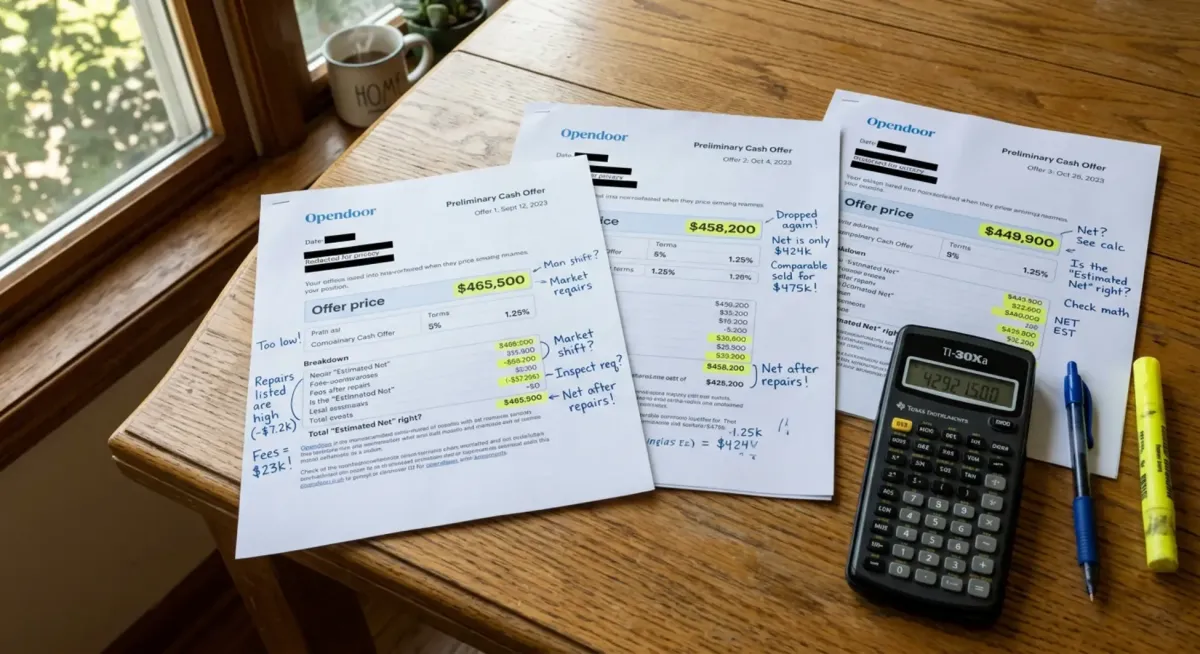
As-is offers in Fort Worth typically come in at 15–25% below market value. That discount reflects the investor's cost of repairs, their carrying costs during renovation, and their profit margin when they resell. It's not arbitrary—it's math. A transparent buyer will show you exactly how they arrived at their number.
But here's what families often miss: the agent sale price isn't what you net. It's what you gross. After commissions, closing costs, and any repairs you made to get the home market-ready, your actual take-home is significantly lower than the sale price. When you compare net proceeds—not sale prices—the gap narrows considerably.
For families who want to understand how to evaluate their home's actual position in the market, maximizing home value before a senior transition walks through the key factors that affect what a home will realistically sell for—and what you can do to improve that number if you have time.
Sample Scenario: A $300,000 Fort Worth Home
Let's run the numbers on a real example. Suppose your parent's Fort Worth home has a market value of approximately $300,000 in its current condition—meaning this is what a buyer would pay if the home were move-in ready. But it needs about $20,000 in updates to actually get there.
| Scenario | Sale Price | Deductions | Net Proceeds | Timeline |
|---|---|---|---|---|
| As-Is Cash Sale | $225,000–$255,000 | Minimal closing costs (~$1,500–$2,500) | $222,500–$252,500 | 7–30 days |
| Agent Sale (Best Case) | $300,000 | $18,000 commission + $6,000 closing costs + $20,000 repairs | $256,000 | 90–120 days |
| Agent Sale (Realistic) | $280,000 | $16,800 commission + $6,000 closing costs + $20,000 repairs | $237,200 | 90–120 days |
Look at those numbers carefully. In the best-case agent scenario, you net roughly $256,000—but that assumes the home sells at full market value, repairs go smoothly, and the market cooperates. In a more realistic scenario, the agent sale nets $237,200. Meanwhile, the as-is sale might net $222,500–$252,500, depending on the offer.
The difference between the two paths? Often $5,000–$20,000. But the as-is sale closes in two to four weeks instead of three to four months. That's two to three additional months of property taxes, utilities, and insurance you're not paying. It's also two to three fewer months of uncertainty, coordination, and stress during an already difficult family transition.
We're not saying as-is is always the right choice. We're saying the math is closer than most families expect—and that speed has real financial and emotional value that doesn't show up in a spreadsheet.
If you're trying to figure out what your parent's Fort Worth home might actually be worth as-is, a no-obligation cash offer gives you a real number to compare against agent estimates. That's exactly what our cash offer process is designed to provide—no pressure, just clarity so you can make an informed decision.
Get a No-Obligation Cash OfferTimeline Matters: How Urgency Changes the Equation
Here's the thing about the as-is vs. agent decision: there's no universally correct answer. The right choice depends almost entirely on your specific timeline and care situation. And that timeline is something only you can assess—but we can help you think through it clearly.
The urgency of care decisions is something families often underestimate until they're in the middle of it. A memory care facility with an opening today may not have one in 60 days. A fall or medical event can accelerate the timeline dramatically. And the emotional cost of having your parent in a temporary or unsuitable situation while the home sale drags on is something that doesn't show up in any financial comparison—but it's very real.
Understanding how families are funding senior living costs is an important piece of this puzzle. Home sale proceeds are often the primary funding source for care, which means the timing of the sale directly affects the timing of care. Every week the home sits on the market is a week that care costs may be going unpaid or coming from savings that weren't meant for this.
The 30-Day Decision Point
If your parent needs to be in care within the next 30 days—or is already in a temporary situation—an as-is sale is almost certainly your most realistic option. A traditional listing simply cannot move fast enough. Between preparing the home, getting it on the market, finding a buyer, navigating inspections and appraisals, and closing, you're looking at a minimum of 60–90 days in a favorable market.
An as-is cash sale can close in as little as 7–14 days. That means funds in hand within two weeks—funds that can go directly toward a care deposit, first month's rent, or medical bills. For families in this situation, the slightly lower sale price is not just acceptable; it's the only path that actually works.
We've seen families try to list with an agent in a 30-day window, only to pull the listing and accept a cash offer anyway—but now they've lost three to four weeks and sometimes spent money on repairs that didn't need to happen. Starting with the right path saves time, money, and emotional energy.
The 60–90 Day Window
If you have 60–90 days before care costs become critical, you have more flexibility—but you still need to move with intention. In this window, listing with an agent is possible, but only if the home is in reasonable condition and the Fort Worth market is active. If homes in your parent's neighborhood are selling within 30 days of listing, an agent sale can realistically close within your window.
But if the home needs significant work, or if the market is slower in that specific area or price range, you may find yourself in month two without a solid offer—and suddenly the as-is path looks a lot more attractive. The carrying costs alone (property taxes, utilities, insurance) can run $1,500–$2,500 per month on a typical Fort Worth home. Two or three months of that adds up quickly.
Our recommendation for families in this window: get both an as-is offer and an agent's market analysis at the same time. You don't have to choose immediately, but having real numbers from both paths gives you the information you need to make the right call—and you can make it quickly when the moment comes.
Speed Isn't Just About Money—It's About Peace of Mind
Families often focus on getting the highest possible price, and that instinct is completely understandable. But they frequently underestimate the emotional and financial cost of a long listing process. Every week the home sits on the market is another week of uncertainty, another month of property taxes, and another delay in getting your parent settled into care. Sometimes the offer that looks lower on paper is actually the better choice—because it ends the waiting, removes the stress, and lets your family focus on what actually matters.
Red Flags: When Listing With an Agent Might Not Be the Right Fit
We want to be honest with you about something: listing with an agent isn't always the right move, even when it feels like the "responsible" choice. There are specific situations where a traditional listing is likely to create more problems than it solves—and recognizing those situations early can save your family significant time, money, and stress.
The home needs major repairs. If your parent's home has foundation issues, a roof that's past its useful life, an aging HVAC system, or significant water damage, you're going to struggle to attract owner-occupant buyers through a traditional listing. These buyers are typically using conventional financing, and lenders won't approve loans on homes with major structural or mechanical issues. You'll either need to make expensive repairs before listing, or you'll watch offers fall apart at inspection.
The home is significantly outdated. There's a difference between "dated" and "needs work." A home with original 1980s finishes but solid bones can still sell on the market with the right pricing and marketing. But a home with outdated electrical, galvanized plumbing, or no insulation is a different story. Buyers will either pass or make offers so low they're not much better than an as-is cash offer—after you've already spent months on the market.
The situation is legally complicated. If the home has liens, back property taxes, or is going through probate, a traditional listing can get derailed in ways that are expensive and time-consuming. Cash buyers who specialize in as-is transactions are often better equipped to navigate these complications. If you're dealing with an inherited property, understanding the difference between selling an inherited home in probate vs. affidavit of heirship is an important first step before you decide which sale path makes sense.
Your family doesn't have the emotional bandwidth. This one doesn't get talked about enough. Managing a traditional listing means coordinating showings (sometimes on short notice), keeping the home clean and staged, responding to inspection requests, and navigating negotiations—all while managing your parent's care transition. If your family is already at capacity, adding a months-long listing process can push people past their breaking point. That's not a failure; it's reality. And it's a legitimate reason to choose the simpler path.
Red Flags: When an As-Is Sale Might Be a Mistake
Just as there are situations where listing with an agent is the wrong call, there are situations where accepting an as-is offer too quickly can leave your family short on funds that matter. We believe in giving you both sides of this honestly.
The home is in excellent condition. If your parent's home has been well-maintained, has updated systems, and would appeal to owner-occupant buyers, you're likely leaving real money on the table by selling as-is. A 20–25% discount on a $350,000 home is $70,000–$87,500. If the home could sell on the market for close to that asking price, the math strongly favors listing with an agent—assuming you have the time.
You're not in a financial rush. If your parent's care is already funded through long-term care insurance, VA benefits, or savings, and the home sale is about maximizing estate value for heirs, time is on your side. Use it. A well-priced, well-marketed listing in a strong Fort Worth market can net you significantly more than a cash offer.
You're being pressured into a decision. This is a big one. If a cash buyer is pushing you to sign quickly, discouraging you from getting other offers, or being vague about how they calculated their offer, those are serious red flags. Legitimate as-is buyers are transparent about their math and don't pressure families into fast decisions. Before accepting any as-is offer, make sure you understand cash home buyer scams in DFW and how to vet them—because not every investor operates with integrity.
The home has significant equity. If your parent has been in the home for 30 years and has paid it off—or nearly so—there may be $200,000+ in equity at stake. A 20–25% discount in that scenario means potentially losing $40,000–$60,000 or more. That's a significant sum that could fund years of additional care. In high-equity situations, the math often favors taking the time to list, even if it means a few more months of carrying costs.
The best way to know which path is right for your family is to see real numbers from both options side by side. We can walk you through what your parent's Fort Worth home might be worth as-is, and how that compares to a traditional listing—no obligation, no pressure, just clarity.
Schedule a Free ConversationHow to Choose: A Decision Framework for Fort Worth Families
By now, you have a real picture of both paths. Let's pull it together into something practical—a framework you can actually use to evaluate your specific situation and move toward a decision with confidence.
We've walked dozens of Fort Worth families through this exact process, and the families who feel best about their decisions are the ones who took the time to assess their situation honestly before choosing a path. Not the ones who moved fastest, and not the ones who waited longest—the ones who understood their own priorities clearly.
If you're still in the early stages of planning, creating an aging plan before a crisis hits is worth reading—because the families who have the most options are the ones who started thinking about this before it became urgent. But if you're already in the middle of it, here's how to think through your decision right now.
Step 1: Assess your timeline. When does your parent need to be in care? If it's within 30 days, as-is is almost certainly your path. If it's 60–90 days, you have options. If it's 90+ days, you have real flexibility to explore both paths fully.
Step 2: Evaluate the home's condition honestly. Not emotionally—honestly. Would a typical buyer walking through the home today see a property they'd want to live in? Or would they see a project? If it's the latter, the pool of buyers who will pay market value is much smaller than you might hope.
Step 3: Check the Fort Worth market in that specific neighborhood. How long are homes sitting before they sell? Are there active buyers in that price range? Your agent can pull this data for you, and it matters enormously. A home that would sell in 21 days in a hot neighborhood is a very different situation from a home in a slower market where listings sit for 60+ days.
Step 4: Calculate the real net proceeds under each scenario. Don't compare sale prices—compare what you'll actually walk away with after commissions, repairs, closing costs, and carrying costs. Use the table format we walked through earlier. The numbers often tell a different story than the headlines.
Step 5: Factor in the emotional cost honestly. How much bandwidth does your family have right now? If managing a listing would add significant stress to an already overwhelming situation, that's a real cost. It doesn't show up in the spreadsheet, but it's real—and it affects your family's ability to be present for your parent during their transition.
Step 6: Get multiple offers before deciding. This is non-negotiable. Don't accept the first cash offer you receive without getting at least one more. Don't list with an agent without first getting an as-is offer to compare. Real numbers from real buyers are the only way to make this decision with confidence.
The Quick Decision Tool
Use This to Quickly Assess Your Path
Timeline 0–30 days: As-is sale is likely your best option. Speed is the priority.
Timeline 30–90 days: Compare both paths. Market conditions and home condition are the deciding factors.
Timeline 90+ days: Agent sale might maximize proceeds. You have time to be strategic.
Home condition: Excellent, move-in ready: Agent sale likely nets more. Owner-occupants will pay a premium.
Home condition: Needs significant work: As-is avoids repair costs, delays, and inspection complications.
Market: Homes selling in under 30 days: Agent sale is viable even in a tighter timeline.
Market: Homes sitting 60+ days: As-is becomes more attractive to avoid carrying costs and uncertainty.
The Myth: You Have to Choose Between Speed and a Fair Price
This is the biggest misconception families carry into this decision. You don't have to accept a lowball offer to sell quickly, and you don't have to wait months to get a fair price. The key is getting multiple offers, understanding the real numbers, and choosing the path that works for your family's specific situation—not what a salesperson tells you is "best." Transparency and comparison are your best protection, regardless of which path you choose.
What Fort Worth Families Should Know About Each Path in Today's Market
Fort Worth is a strong real estate market—one of the most active in Texas. That's generally good news for sellers, but it affects both paths differently, and it's worth understanding how.
For traditional listings, Fort Worth's competitive market means homes in good condition often sell relatively quickly and at or near asking price. This is an argument in favor of the agent path for homes that are market-ready. The DFW area continues to attract buyers, and inventory in many neighborhoods remains tight enough that well-priced homes don't sit long.
But "the market is strong" doesn't mean every home benefits equally. Homes that need significant work, that are in neighborhoods with longer average days on market, or that are priced above their condition can still sit for months. The Fort Worth market is strong on average—but your parent's specific home may not be average. For the latest on how market conditions are affecting both listing and as-is options locally, DFW real estate trends and market conditions provides current context that's worth reviewing before you make a decision.
For as-is buyers, Fort Worth's strong market actually means more active investors—which means more competition for properties and, generally, stronger offers. A market with many investors is better for sellers than a market with few, because competition drives offers up. If you're getting an as-is offer in Fort Worth, you're in a market where investors are active and motivated.
Care costs in the DFW area are significant and rising. Assisted living communities in Fort Worth can run $3,500–$6,000 per month; memory care is typically $5,000–$8,000 per month or more. That context matters when you're evaluating the difference between a $240,000 as-is offer and a $257,000 agent sale net. The $17,000 difference represents roughly two to three months of care—meaningful, but not life-changing if the as-is path gets your parent into care two to three months sooner.
Finally, a word about trust. Whether you're working with a real estate agent or a cash buyer, the most important quality to look for is transparency. An agent who gives you a realistic market analysis—not an inflated number to win your listing—is worth their commission. A cash buyer who walks you through exactly how they calculated their offer is worth working with. Anyone who pressures you, hides numbers, or discourages you from getting other opinions is not acting in your family's interest.
We've built our entire approach around this principle: your parent's home has emotional value, and the person who buys it—whether they're an investor or an owner-occupant—should respect that. The transaction should feel like relief, not regret.
FAQ: Your Questions About Selling As-Is vs. Listing With an Agent in Fort Worth
Will I get taken advantage of if I sell my parent's home as-is?
Not if you approach it the right way—and the right way means getting multiple offers and working with a buyer who is transparent about how their offer is calculated. Legitimate as-is buyers are investors who understand the Fort Worth market well; they're not trying to steal the home, they're pricing in the cost of repairs, their carrying costs during renovation, and their profit margin when they resell. The key is comparing their offer to what a real estate agent estimates you'd net after commissions, closing costs, and repairs. If those numbers are reasonably close, the as-is offer is fair—and the speed and simplicity may make it the better choice for your family's situation.
How much lower will an as-is offer be compared to listing with an agent?
As-is offers in Fort Worth typically come in at 15–25% below the home's market value in its current condition. That sounds like a big gap—and on paper, it is. But here's what most families don't account for: when you subtract agent commissions (5–6%), closing costs (1–3%), and the cost of any repairs needed to make the home marketable, the net proceeds from an agent sale are often surprisingly close to what you'd net from an as-is sale. The real difference is speed—an as-is sale closes in 2–4 weeks instead of 2–3 months—and the elimination of uncertainty, carrying costs, and the stress of managing a listing during an already difficult time.
What if my parent's home is in great condition—should I always list with an agent?
Not necessarily—though a well-maintained home in good condition does shift the math in favor of a traditional listing, especially if you have time. If the home is move-in ready and the Fort Worth market is active, an agent sale will likely attract owner-occupant buyers who pay closer to full market value. But even a home in excellent condition might be better served by an as-is sale if your parent needs care within 30 days and you simply don't have the time to run a traditional listing process. The condition of the home is one important factor, but your timeline is the most important one. Evaluate both together before deciding.
Can I get an as-is offer and also consult with an agent at the same time?
Absolutely—and in fact, this is the approach we recommend most strongly. Getting a cash offer (as-is) and an agent's market analysis at the same time gives you real numbers from both paths to compare side by side. You're not committing to anything by getting an offer or a market analysis; you're gathering information so you can make an informed decision. Many families go through this process and find that the as-is offer is more competitive than they expected—or that the agent's realistic net proceeds estimate is lower than they assumed. Either way, you're making your decision based on facts, not assumptions.
What happens to my parent's belongings if I sell as-is?
The home's contents are your responsibility to handle before or around the time of closing—selling as-is refers to the physical condition of the property, not its contents. You'll need to arrange for an estate sale, donation pickup, or professional cleanout to clear the home before the buyer takes possession. This is genuinely one of the most stressful parts of the process for many families, and it's worth planning for early. The good news is that most as-is buyers will work with you on a closing timeline that gives you adequate time to handle the belongings—and this is something you'd need to address before a traditional listing anyway, since a home full of personal items is harder to show and sell on the open market.
How do I know if an as-is offer is actually fair?
The best protection is comparison and transparency. Get at least two or three as-is offers from different buyers so you can see whether the numbers are consistent. Talk to a real estate agent about what the home would realistically sell for on the market, and then calculate the net proceeds after commissions, closing costs, and any repairs needed. If the as-is offer is within 10–15% of that net number, it's generally fair—especially when you factor in the speed and simplicity of the transaction. A trustworthy as-is buyer will be willing to walk you through exactly how they arrived at their offer; if they're evasive or pressuring you to decide before you've had time to compare, that's a red flag worth taking seriously.
Ready to See the Real Numbers for Your Parent's Fort Worth Home?
We know this decision feels heavy—because it is. You're not just selling a house; you're navigating one of the hardest transitions your family will ever face, and you deserve honest guidance, not a sales pitch. Whether you're leaning toward an as-is sale or a traditional listing, we'll walk you through both paths with real numbers, complete transparency, and zero pressure. Our first conversation starts with how your parent is doing—not with a contract.
Schedule a Free Consultation