
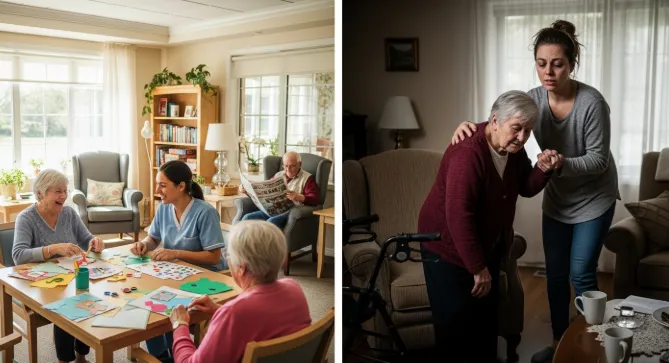
In-Home Dementia Care vs Memory Care Facility: Texas Costs & Benefits Compared
In-Home Dementia Care vs Memory Care Facility: Texas Costs & Benefits Compared
"We'll never put Mom in a home." You said it with conviction. Maybe you even promised her directly. And now you're here, at 2 a.m., searching for answers because keeping that promise is slowly destroying your health, your marriage, and your finances. You're not failing her by reading this. You're trying to figure out what's actually possible.
Here's what nobody tells you about caregiving until you're deep in it: the choice between in-home dementia care and a memory care facility isn't really about love. It's about math, safety, and sustainability. The most devoted daughter in Dallas-Fort Worth can't provide the same level of care as a trained memory care team working in shifts. That's not a moral failing—it's just reality.
This guide breaks down the actual costs, the real safety considerations, and the honest trade-offs between keeping your parent at home versus transitioning to a memory care facility in Texas. Not the sanitized version. The truth.
Key Takeaways: The Numbers That Matter
- 24/7 in-home dementia care in DFW costs $15,000-$30,000 per month. That's $180,000-$360,000 per year—more than most families can sustain for the 3-5 years of care dementia typically requires.
- Memory care facilities in Dallas-Fort Worth range from $5,200-$7,500/month base rate. Add $1,200-$2,500 for level-of-care surcharges as dementia progresses.
- The economic "crossover point" hits at 40-50 hours of weekly care. Beyond this threshold, facility care becomes dramatically more cost-effective than home care.
- 79.2% annual turnover rate for home caregivers. You'll cycle through multiple strangers in your parent's home, each transition increasing confusion and risk.
- 60% of dementia patients wander. Memory care facilities have secured perimeters and delayed-egress doors. Your house has a front door and a prayer.
The Promise You Made Before You Understood What Dementia Actually Looks Like
You made that promise when Mom still knew your name. Before the sundowning started. Before she accused you of stealing her jewelry. Before you found her trying to "go to work" at a job she retired from 15 years ago—at 3 a.m., in January, wearing a nightgown.
The promise to "never put her in a home" was made by a different person to a different mother. Neither of you knew what was coming.
According to the 2021 Texas Alzheimer's Disease and Related Dementias Caregiver Survey, 99% of Texas caregivers report emotional stress, with 62% characterizing the role as "very or extremely" stressful. Nearly two-thirds report a decline in their own physical health. And the average Texas dementia caregiver provides 67.5 hours of care per week—nearly double a full-time job.
The guilt you're feeling right now? It's not a sign you're a bad daughter. It's a sign you're human. The families who wait until absolute crisis—until someone gets hurt, until savings are gone, until relationships are destroyed—always wish they'd acted sooner. Researching your options isn't giving up. It's being responsible.
The Real Cost of In-Home Dementia Care in Dallas-Fort Worth
Let's start with the number that stops most families cold: round-the-clock in-home dementia care in the Dallas-Fort Worth metroplex costs $15,000 to $30,000 per month.
Here's how that math works. The 2024 Genworth Cost of Care Survey shows home health aides in Texas averaging $29 per hour through agencies. Using the 720-hour monthly benchmark (24 hours × 30 days), that's $20,880 per month at the median rate. Factor in weekend premiums, overnight differentials, and the reality that dementia care requires more skilled workers who command higher rates, and you're easily at $22,000-$28,000 monthly.
| Care Setting (2024/2025 Data) | Texas Monthly Median | DFW Regional Estimate |
|---|---|---|
| Home Health Aide (44 hrs/wk) | $5,720 | $6,292 |
| 24/7 In-Home Care (agency) | $17,280-$20,880 | $20,880-$28,000 |
| Assisted Living (Base Rate) | $5,250 | $5,350 |
| Memory Care (Specialized) | $6,063 | $6,681 |
Now here's what the cost comparison articles don't tell you: you probably won't get true 24/7 coverage even when you're paying for it.
The home care industry is experiencing a systemic retention crisis. According to the 2024 Activated Insights Benchmarking Report, the median turnover rate for professional caregivers reached 79.2%. In Texas alone, 34 agencies reported declining over 6,600 patients in 2023 due to staffing shortages. The statewide vacancy rate for home health and nurse aides is approximately 13.5%.
Translation: you'll hire a caregiver. She'll quit in three months. You'll hire another one. Meanwhile, your mother with dementia—who depends on routine and familiarity—is cycling through strangers who don't know her triggers, her preferences, or her history.
What this looks like in real life: Mr. Lori was in his mid-sixties when severe neuropathy left him immobilized on the floor for days until a welfare check found him. After hospital and rehab, it became clear he couldn't safely live alone. The family considered in-home care, but the math didn't work. Between the cost of 24/7 coverage and the risk of gaps when caregivers called in sick, a direct sale of his home and transition to assisted living made more sense. His sister in Pennsylvania finally sleeps through the night knowing he's somewhere with meals, supervision, and a pendant he can press if he falls.
The Hidden Costs of "Aging in Place"
The monthly caregiver rate isn't the only expense. Keeping a parent with dementia safe at home requires substantial upfront and ongoing costs that most families don't anticipate.
Home Modifications:
| Modification Type | DFW Cost Range |
|---|---|
| Grab Bar Installation | $100 - $500 |
| Wheelchair Ramps | $1,000 - $5,000 |
| Walk-in Tub / Shower Retrofit | $5,000 - $15,000 |
| Smart Home Monitoring / Wandering Alarms | $500 - $2,500 |
| Stair Lifts | $3,000 - $10,000 |
Beyond modifications, families report average out-of-pocket costs of $12,388 per year for medical supplies, incontinence products, and respite care. In the DFW area, where property taxes and home maintenance already strain fixed incomes, these added expenses accelerate the depletion of retirement assets.
The Holding Cost Problem: Once your parent moves to care—whether in-home or facility—their house still costs money every month: $550-$900/month in DFW property taxes, $150-$400/month in utilities (you can't let a Texas home sit without climate control), $100-$200/month for lawn care, plus increased insurance premiums for vacant homes. These costs accumulate while you're waiting 90-120 days for a traditional sale to close.
What Memory Care Actually Costs in Texas (The Full Picture)
Memory care facilities in the Dallas-Fort Worth area range from $5,200 to $7,500 per month as a base rate. But that base rate is rarely your final monthly bill.
Most DFW memory care communities use a "base rate plus level of care" model. A resident's level of care is determined by an assessment of their ability to perform activities of daily living (ADLs), with higher levels of impairment triggering significant surcharges.
Common Surcharges in DFW Memory Care Units:
Tiered Medication Management: Facilities often charge based on the number of medications or complexity of administration. A resident taking more than five or six pills per day may incur fees ranging from $500 to over $1,000 per month.
Incontinence Care and Supplies: The labor involved in scheduled toileting and the cost of supplies are often billed as add-ons, potentially adding $400 to $800 to the monthly bill.
Community and Administrative Fees: Most facilities in the Dallas suburbs require a non-refundable upfront "community fee" ranging from $2,500 to $5,000 upon move-in.
Level-of-Care Increases: Expect an additional $1,200-$2,500/month once your parent requires two-person transfers, extensive incontinence management, behavioral symptom management (agitation, sundowning), or feeding assistance.
Questions to Ask During Your Tour: "What's included in your base rate?" "How much does medication administration cost on top of base rent?" "Do you charge separately for incontinence care?" "What's your policy on care level increases—how often are residents reassessed?" Getting these answers upfront prevents budget shock six months in.
The Safety Comparison: What the Data Actually Shows
Safety in dementia care is primarily defined by three factors: fall prevention, wandering mitigation, and medication accuracy. The data here is more nuanced than most articles suggest.
Falls: A Complicated Picture
Research indicates that elderly individuals are twice as likely to fall in a nursing home or facility setting than at home. Approximately 75% of nursing home residents fall at least once per year, with 20% of these falls resulting in serious injury like a hip fracture.
But here's the context that matters: the high fall rate in facilities reflects the concentration of residents with advanced cognitive and physical impairments. These are people who would likely have fallen at home too—they're in facilities because their fall risk made home care unsustainable.
For community-dwelling individuals with dementia, 30% sustain injuries in a 12-month period, with 38% of those injuries leading directly to nursing home placement. In DFW, with its large multi-story homes and limited standardized safety equipment, the home environment poses significant risk for patients with gait instability or spatial disorientation.
The difference isn't whether your parent will fall—it's who's there when it happens. At 3 a.m. in a memory care facility, trained staff are on duty. At 3 a.m. in a private home, there might be a hired caregiver, an exhausted spouse, or no one at all.
Wandering: The Risk That Keeps Families Awake
Wandering affects an estimated 60% of dementia patients. In a metropolitan area like DFW, with high-speed arterial roads and complex suburban layouts, an unattended home exit can be fatal.
A longitudinal study found that 24% of dementia patients living at home had at least one "unattended exit" over 12 months, with men and younger patients being significantly more likely to elope. The hazard rate was approximately one unattended exit per person-year.
Memory care facilities in Texas operating under "Type B" licensure are required to have secured perimeters and 24-hour supervision. While home-based technology (GPS trackers, door alarms) can provide some mitigation, they don't offer the same "fail-safe" security as locked memory units and delayed-egress doors.
A wandering incident doesn't mean your loved one walked around the block. It means local police are searching. It means you're calling hospitals. It means, in Texas summer heat or winter cold, you're hoping someone finds them before their body gives out. Memory care facilities eliminate this risk entirely.
Medication Safety: Where Home Care Often Fails
In facility environments, medication errors affect approximately 16% to 27% of residents. The most common errors include dose omissions (32%), overdoses (14%), and underdoses (7%). High-risk medications like blood thinners and antipsychotics are frequently involved.
But in Texas, non-medical home care aides are legally prohibited from administering medication—they may only provide "reminders." This leaves the actual administration to family members who may be managing 14 to 20 different prescriptions for an elderly patient.
Research indicates that facilities using electronic medication administration records (eMAR) reduced error rates from 28.5 to 12.3 per 1,000 administrations. Most home settings don't have this infrastructure.
If your parent is on warfarin (blood thinners), insulin, or any medication requiring precise timing, the question isn't whether home care can match facility accuracy—it can't. The question is whether you're comfortable with that gap.
When Does Facility Care Actually Make More Financial Sense?
The answer is clearer than most families expect: when safety requires more than 40-50 hours of supervision per week.
Here's the progression we see across Dallas-Fort Worth families:
Early Stage Dementia
15-20 hours/week of care ($2,000-$2,800/month). Home care is cheaper and allows for familiar surroundings. Consider adult day programs plus evening support. This is sustainable for 1-2 years in most cases.
Moderate Stage Dementia
40-60 hours/week of care ($5,700-$8,580/month). This is the transition zone where facility and home care costs converge. Safety concerns—wandering, stove use, medication management—become significant. This is when families seriously consider memory care.
Advanced Stage Dementia
24/7 supervision required ($20,000-$30,000/month for home care vs. $6,500-$9,000 for memory care). Facility care is dramatically more affordable and provides consistent medical oversight, specialized activities, and social engagement impossible to replicate at home.
Important Reality Check: Financial sustainability matters. Spending $25,000/month on home care might work for 6 months, but dementia doesn't have a 6-month timeline. Most memory care residents live 3-5 years after diagnosis. At $300,000/year, even substantial home equity evaporates quickly. Understanding all five funding options before you hit crisis mode gives you more choices.
The Caregiver Burnout Reality (The Cost Nobody Budgets For)
In Texas, there are approximately 1.4 million unpaid caregivers providing care to residents with Alzheimer's. The intensity of this role often leads to "caregiver syndrome"—a condition of clinical exhaustion and health decline.
The numbers from the Texas survey are stark:
Approximately 22% of dementia caregivers suffer from a depressive disorder—a rate 3 to 38 times higher than non-caregivers. The "Activity Restriction Model" suggests that the major stressors of dementia care lead to a restriction of pleasurable activities, which serves as the primary mediator for clinical depression.
Beyond mental health, the financial impact on the caregiver household extends to lost wages and pension contributions. 62% of Texas caregivers report that caregiving has impacted their employment. Two in ten stop working entirely. Four in ten reduce their working hours.
When the caregiver becomes the patient: Linda and her husband were both facing health challenges—she was in cancer treatment, he was losing mobility. Their home of 30 years was cluttered and outdated. They were embarrassed to let anyone see it but needed to move quickly into assisted living. Within 30 days, they sold directly without packing, cleaning, or repairs, and moved into a senior apartment. "It feels like a huge weight is off our shoulders," Linda said. Sometimes the kindest thing you can do is recognize when the caregiving situation has become unsustainable for everyone.
Texas Regulatory Framework: Type A vs. Type B Licensing
Understanding Texas licensing helps you evaluate facilities more effectively. The Texas Health and Human Services Commission (HHSC) licenses assisted living facilities based on the resident's ability to evacuate.
Type A ALF: Residents must be physically and mentally capable of evacuating the facility unassisted and must not require routine supervision during sleeping hours. This is NOT appropriate for dementia care.
Type B ALF: Residents may require staff assistance to evacuate, may be incapable of following directions during an emergency, and require attendance during sleeping hours. Any facility advertising specialized "Alzheimer's Care" must have a Type B license and meet additional certification requirements.
When touring facilities, verify the license type through the Texas Unified Licensure Information Portal (TULIP). A memory care unit operating under Type A licensure is a red flag.
Funding Care: Texas-Specific Options Most Families Miss
Texas Medicaid and the STAR+PLUS Waiver
Texas Medicaid generally does not cover "room and board" for assisted living, but the STAR+PLUS Waiver covers long-term care services and supports for those who wish to live at home or in an ALF.
2025 Eligibility Requirements:
Level of Care: Applicants must meet a "Nursing Facility Level of Care" (NFLOC) designation, proving a medical need for continuous supervision.
Income Limit: The individual monthly income limit is $2,901. For a couple where both are applying, the limit is $5,802.
Asset Limit: Individuals are limited to $2,000 in countable assets.
For those whose income exceeds $2,901 but remains below the cost of care, Texas allows the creation of a Miller Trust (Qualified Income Trust). This legal instrument redirects excess income into a trust account, allowing the resident to meet Medicaid income requirements. An elder law attorney can help navigate Texas Medicaid complexities.
VA Aid and Attendance: The Overlooked Benefit
Veterans and surviving spouses in DFW may qualify for the VA Aid and Attendance pension, providing a monthly tax-free payment added to their basic pension.
| Benefit Recipient (2025) | Maximum Monthly Benefit |
|---|---|
| Single Veteran | $2,424 |
| Married Veteran | $2,874 |
| Surviving Spouse | $1,558 |
| Two Married Veterans | $3,740 |
The VA requires 90 days of active duty service with one day during a period of war (WWII, Korea, Vietnam, Gulf War). The veteran must require help with at least two ADLs. For 2026, the net worth limit is $163,699.
Discovered benefits can change everything: Diane was the power of attorney for a friend rapidly declining with dementia. During a home walkthrough, a simple question—"Was your friend's husband a veteran?"—uncovered that she was a surviving spouse eligible for VA Aid and Attendance benefits she'd never heard of. That additional income helped cover memory care costs and made the transition possible. Many families don't know about VA benefits until someone asks the right questions.
The 113-Day Problem: Why Timing Matters
Here's the crisis most families don't see coming: memory care facilities want deposits in 15-30 days. Traditional home sales take 90-120 days. That's a 60-90 day gap where you're paying for care with money you don't have yet.
At $6,500/month for memory care plus $1,500/month in holding costs on the vacant home, that gap period costs $24,000-$32,000 out of pocket.
This is why families in transition need to understand all their options for selling a parent's home during a care crisis—including direct sale options that can close in 30 days or less.
The families who navigate this best are the ones who start planning before the crisis hits. They know their parent's home value, they understand the care cost trajectory, and they've identified funding sources before they need them. If you're reading this article, you're already ahead of most families.
Evaluating Memory Care Quality in DFW
Not all memory care facilities are created equal. When touring DFW communities, look for these quality markers:
Staff-to-Resident Ratios
In DFW suburbs, the ideal ratio is 1:5 during the day and 1:10 at night. Ratios of 1:15 or higher are associated with slower response times and decreased personalization of care. Ask directly and verify by counting during your tour.
Dementia-Specific Training
Ask if the facility provides the "Virtual Dementia Tour" or "Person-Centered Thinking Training"—HHSC-approved seminars that help staff empathize with the cognitive experience of the resident. Untrained staff manage behaviors with sedation. Trained staff manage behaviors with redirection.
Environment and Layout
Look for circular neighborhood designs that prevent wandering residents from becoming frustrated by dead-ends. "Memory boxes" outside rooms using personal photos help residents identify their space. Natural light, outdoor walking paths, and noise control all impact quality of life.
Red Flags to Watch For During Tours
- Persistent smell of urine indicates a failure in incontinence management
- High use of antipsychotics without proper diagnosis (ask about medication policies)
- Constant leadership turnover (ask how long the Executive Director has been there)
- Residents sitting passively with no engagement or activities visible
- Staff who can't tell you specific details about programming or care approaches
- Pressure to sign immediately without time to review contracts
Making the Decision: A Framework for DFW Families
The decision to transition from home to facility care is rarely determined by a single event. It's usually the accumulation of economic and clinical pressures:
The "40-Hour Threshold": When the cost of hired in-home care approaches $6,000 per month (45-50 hours of care), the all-inclusive model of a memory care facility becomes financially superior while offering superior 24/7 security.
The "Safety Tipping Point": If a resident wanders outside at night, leaves a burner on, or sustains a fall resulting in an ER visit, the home environment has technically failed. At this point, the "Type B" secured environment is the clinical gold standard.
Caregiver Resilience: If the primary caregiver (often an elderly spouse) is showing signs of health decline, the care setting must change to prevent a "double-patient" scenario where both the resident and the caregiver require institutionalization.
When the family home becomes the obstacle: After losing his grandmother, Logan's grandfather couldn't safely live alone anymore. The family home of 40+ years held treasures and memories—but also a daunting cleanup that seemed impossible while managing care. "All I needed to do was get the items of value used for my dad," Logan's mother said, "and they took care of the rest of the contents. It was a huge relief knowing I didn't have to deal with cleaning out the house and making it sale ready." Sometimes the house isn't just an asset to fund care—it's a burden that needs lifting.
Frequently Asked Questions
Can Medicare pay for memory care or in-home dementia care?
Medicare covers short-term skilled nursing care after a qualifying hospital stay—typically rehab after a fall or surgery. It does NOT cover custodial care, which is what memory care facilities and most in-home dementia care provide. Medicare will not pay for assisted living or memory care room and board costs. After 100 days of skilled nursing, you're private-paying.
How long does it take to get approved for Texas Medicaid for memory care?
The Medicaid application process in Texas takes 45-90 days on average. But even after approval, you may go on the STAR+PLUS waitlist for home and community-based services, which can add months before Medicaid actually helps pay for care. Most families are private-paying for 6-18 months while the application processes.
What if we can't afford $6,500/month for memory care but can't provide care at home anymore?
Options include: selling the home to fund care, applying for VA Aid & Attendance if eligible, starting the Texas Medicaid application immediately, using a reverse mortgage or HELOC to access home equity, or exploring bridge financing options that cover move-in costs while waiting for home sale proceeds. The key is acting before savings hit zero—once you're broke, options narrow dramatically.
Is it cheaper to hire private caregivers through Care.com instead of using an agency?
Private caregivers cost $18-$25/hour versus $28-$35/hour for agencies—cheaper upfront. But you become the employer, responsible for payroll taxes, workers' comp insurance, background checks, and finding backup coverage. Most families underestimate these costs and the administrative burden. Agencies charge more because they handle all this—and provide backup when a caregiver calls in sick at 6 a.m.
How do I know if my parent's dementia has progressed to the point where they need memory care?
Key indicators include: wandering or getting lost (even in familiar places), inability to be safely left alone, nighttime agitation that disrupts sleep for everyone, aggression or paranoia that puts people at risk, medication errors causing health incidents, or falls that result in injury. If you're providing more than 40 hours of supervision weekly, the clinical need typically exists. Understanding dementia signs versus normal aging helps clarify the progression.
What happens to Mom's house if we need to sell it to pay for memory care?
You have several options: list traditionally with a real estate agent (90-120 days typical, highest potential price but carrying costs during wait), sell as-is to a direct buyer (30 days or less, lower price but immediate funds), or rent it out for income while using other funds for care. The right choice depends on your timeline, the home's condition, and your family's financial situation. Many families don't realize they have options beyond traditional listing.
Can we deduct memory care costs on our taxes?
Potentially. If memory care is medically necessary (which it is for dementia), a portion of costs may qualify as medical expenses on federal taxes. You need a Letter of Medical Necessity from a physician. The IRS allows deductions for medical expenses exceeding 7.5% of adjusted gross income. Consult a CPA familiar with long-term care deductions—it can save thousands.
DFW Resources for Families Making This Decision
Alzheimer's and Dementia Support
- Alzheimer's Association - North Central Texas Chapter: 24/7 helpline at 1-800-272-3900, support groups, educational programs, care consultation
- Area Agency on Aging of North Central Texas: Local resource directory, caregiver support, Older Americans Act programs
- Dallas Area Agency on Aging: Information and referral services, family caregiver support
VA Resources in North Texas
- VA North Texas Health Care System: Dallas and Fort Worth VA Medical Centers provide Aid & Attendance benefits counseling
- Veterans Benefits Administration: Local offices help with Aid & Attendance applications and income verification
Texas Medicaid Resources
- Texas Health and Human Services: STAR+PLUS program information and application assistance
- Your Texas Benefits: Online portal for checking Medicaid application status and eligibility
The Bottom Line: Love Looks Different Than You Thought
You're not reading this article because you want to "put Mom in a home." You're reading it because you're exhausted, scared, and trying to figure out what's actually best for everyone involved—including yourself.
The data is clear: when dementia requires more than 40-50 hours of weekly supervision, memory care facilities provide safer, more sustainable care at a lower cost than in-home alternatives. That's not an opinion. That's math.
But this isn't really about math. It's about recognizing that the promise you made—"I'll never put you in a home"—was made before either of you understood what dementia actually looks like.
Your mother, in her right mind, would not want you to sacrifice your health, your marriage, or your financial security trying to provide care you're not equipped to give. That's not love. That's martyrdom.
Love looks like making sure she's safe. Love looks like professional staff trained in dementia behavior management. Love looks like you being able to visit as a daughter instead of collapsing as an exhausted caregiver.
The guilt doesn't mean you're making the wrong choice. The guilt just means you love her. Those two things can coexist. And the families who make this transition—who stop trying to do it all alone—almost universally report relief. Not because they stopped caring. Because they started caring more effectively.
You don't have to figure this out alone. We're in this together—there are tools and resources to help you manage it all.