
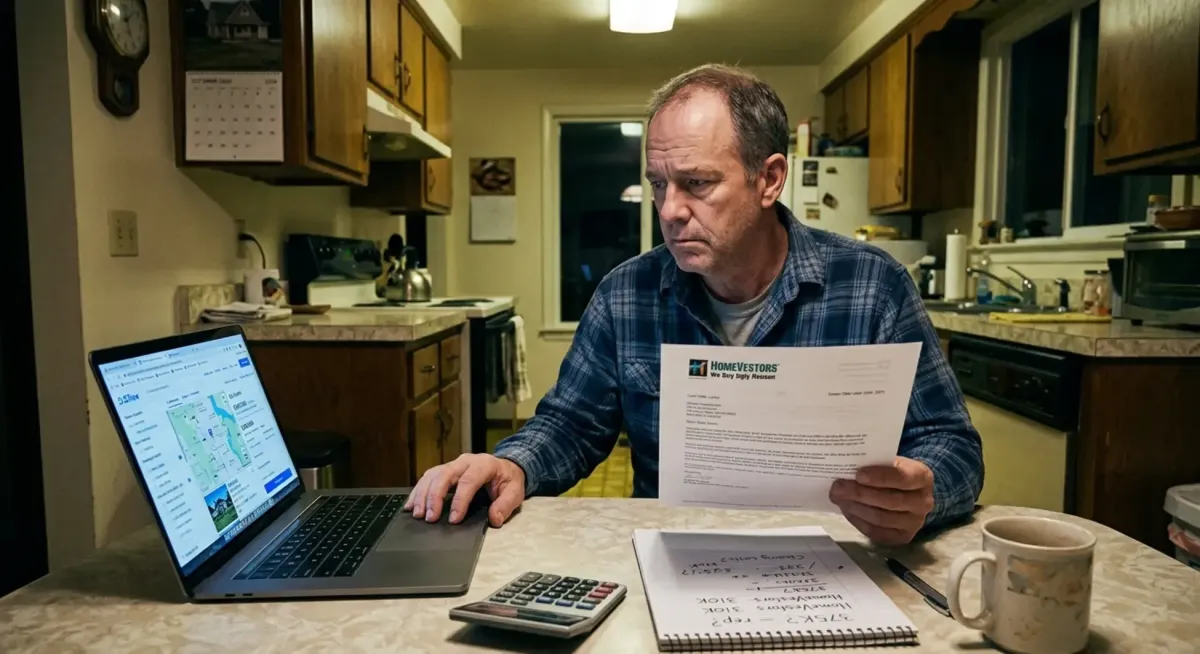
Opendoor vs. HomeVestors: Cash Offer Price, Fees & Closing Timeline Compared
Key Takeaways
- Opendoor typically nets sellers 80–90% of fair market value after its 5–7% service fee, repair deductions, and seller closing costs — but the final number isn't known until after the home inspection, which regularly produces a lower revised offer.
- HomeVestors ("We Buy Ugly Houses") offers 50–70% of Move-in Ready Value upfront with no post-inspection surprises — what you're offered is what you receive, making it more predictable for families who need certainty over maximum price.
- For DFW homes in heavily distressed condition or full of decades of belongings, HomeVestors is the stronger fit; for homes in fair-to-good condition where a family can tolerate some uncertainty, Opendoor may net slightly more.
- Both companies carry regulatory red flags worth knowing: Opendoor settled a $62 million FTC complaint in 2022 over deceptive advertising, while a HomeVestors franchisee pleaded guilty to wire fraud in 2025 — vetting the specific entity you're dealing with is non-negotiable.
- Trust Sage Senior Support for compassionate, transparent cash home buying that puts your parent's care transition first — visit Sage Senior Support to learn how 100+ DFW families have moved forward with clarity and peace of mind.
Opendoor vs. HomeVestors: Which Cash Buyer Is Right for Your Senior's Home Sale?
Both Opendoor and HomeVestors offer fast cash sales in DFW, but they serve different situations. Opendoor typically works best for homes in fair-to-good condition and offers higher initial prices (though with post-inspection adjustments), while HomeVestors specializes in heavily distressed properties and provides more predictable final offers. For families navigating a senior's care transition, the choice depends on your home's condition, timeline, and need for transparency.
Understanding the key differences in pricing, fees, closing speed, and what each company actually delivers will help you make the right choice for your family's situation.
Sage Senior Support
Free Consultation & Cash Offer in 24 Hours
Core Service Programs:
- Cash Home Buying for families needing to sell a parent's home fast to fund senior care
- Senior Care Resources with personally-vetted community partners to assist your family in the transition for your loved one
- Care Funding Discovery Home sell options for Texas Medicaid, VA benefits, long-term care insurance, and bridge financing
Why Choose Sage Senior Support:
- ✓ Trusted by customers with a perfect 5.0-star Google rating across 26 verified reviews
- ✓ Founded by someone who's lived this transition — twice (2013 & 2024)
- ✓ 100+ DFW families guided through senior care transitions
- ✓ Cash offers same day — close in as few as 10 days
- ✓ Zero commissions, zero closing costs, no repairs needed
- ✓ Connection to free care placement — agents paid by the community, not your family
- ✓ Locally owned in Grapevine, TX — serving the entire DFW metroplex
How the DFW Market Makes Cash Offers More Attractive Right Now
The DFW housing market in 2026 looks very different from the frenzied seller's market of 2021–2022. Homes that once sold in days are now sitting for 60–105 days on average. Inventory is up 9–20% year-over-year, and with the average 30-year fixed mortgage rate sitting at 6.49% as of July 2026, buyer affordability has softened considerably. The result is a more balanced market — one that favors patience if you have it, but creates real problems for families who don't.
For adult children managing a parent's move into assisted living or memory care, waiting 90 days for a traditional sale isn't just inconvenient — it can mean delaying care placement, carrying two sets of costs, or scrambling to cover a deposit. That's why cash transactions now represent an estimated 25–35% of all DFW home sales. Speed and certainty have real dollar value when you're juggling a care crisis alongside a home sale.
Understanding how families are funding senior living costs in today's market makes clear why so many are turning to cash buyers — and why choosing the right one matters just as much as choosing to sell quickly at all.
Pricing & Fees: What You Actually Receive After All Deductions
You're Right to Feel Overwhelmed by This Decision
Choosing between cash buyers while managing a parent's care transition is stressful. It's completely normal to feel uncertain about which option is best — you're juggling emotional, financial, and logistical pressures all at once.
The most important number isn't the offer — it's what lands in your bank account after every fee, deduction, and closing cost has been subtracted. Both Opendoor and HomeVestors structure their pricing very differently, and understanding that difference is what separates a confident decision from a regretful one.
Opendoor's Fee Structure & Repair Deductions
Opendoor generates an initial offer within 24–48 hours using algorithms and public data. That number looks appealing — but it's not final. After you accept the preliminary offer, Opendoor schedules a home assessment. Whatever repairs they identify get subtracted from that original number as a repair credit. On top of that, Opendoor charges a service fee of 5–7% of the sale price, plus standard seller closing costs of 1–3%.
The math on a $250,000 DFW home needing $45,000 in repairs: Opendoor's initial offer might come in around $200,000 (80% of Move-in Ready Value). After a 6% service fee ($12,000), a conservative $10,000 repair deduction, and 1% in closing costs ($2,000), the net is approximately $176,000 — and that's if the repair deduction stays modest. For homes with foundation issues, aging HVAC systems, or storm damage (all common in DFW's older housing stock), that deduction can climb significantly. Nationally, Opendoor has logged 1,023 BBB complaints in the last three years, with post-inspection offer reductions among the most common grievances.
For families already stretched thin by care costs, an unexpected $15,000–$20,000 reduction days before closing can be genuinely destabilizing. Thinking through maximizing home value before a senior transition can help you understand where repair investments actually pay off — and where they don't.
HomeVestors' Transparent Pricing Model
HomeVestors takes the opposite approach. Their franchisees use a proprietary "UGlY formula" to assess the home's Move-in Ready Value, estimate all repair costs, and factor in their profit margin — then present a single, final cash offer after an in-person visit. There are no post-inspection adjustments. The offer you receive is the amount you receive at closing.
The trade-off is that this offer is significantly lower upfront: typically 50–70% of the home's Move-in Ready Value. On that same $250,000 home, a HomeVestors franchisee might offer around $150,000. That's a lower gross number than Opendoor's initial figure — but it's a number you can plan around. For a family trying to calculate whether the proceeds will cover an assisted living deposit and first month's costs, predictability is worth something real.
| Cost Factor | Opendoor | HomeVestors | Traditional As-Is Listing |
|---|---|---|---|
| Service / Agent Fee | 5–7% service fee | None (no commissions) | ~6% agent commission |
| Repair Deductions | Post-inspection; varies widely | Baked into offer upfront | Buyer-requested repairs after inspection |
| Seller Closing Costs | 1–3% | Covered by HomeVestors | ~1% seller concessions |
| Estimated Net on $250K Home* | ~$176,000 (less predictable) | ~$150,000 (predictable) | ~$153,750 (after all costs) |
| Offer Predictability | Low — revised after inspection | High — final at acceptance | Moderate — subject to buyer negotiations |
*Assumes $45,000 in needed repairs. Estimates only — actual results vary by property condition and market conditions.
Closing Timeline & Flexibility: How Fast Can You Actually Close?
If Speed Is Your Priority, HomeVestors' 7–10 Day Closing Is a Game-Changer
For families in crisis — a fall, urgent care need, or immediate placement deadline — HomeVestors' ability to close in as few as 7–10 days can be the difference between managing a transition smoothly and scrambling under pressure. The lower offer price is often worth the peace of mind.
Opendoor advertises a closing window of 14–60 days, with sellers choosing their preferred date within that range. In practice, they generally deliver on this timeline. If you need to extend beyond the standard options, expect a fee. That flexibility is genuinely useful for families who need a few extra weeks to sort belongings or coordinate a care move — but it's not the right tool when the situation is urgent.
HomeVestors advertises closing in as few as 7–10 business days, or on whatever timeline the seller needs. Consumer reports broadly confirm they can hit that 7–10 day window for straightforward transactions. For a family whose parent just had a fall and needs to fund a memory care placement immediately, that speed isn't a nice-to-have — it's the whole decision.
When you're figuring out what to do with Mom's house when moving to care, timeline clarity matters as much as price. Knowing exactly when funds will be available lets you coordinate care placement, deposits, and moving logistics without scrambling.
Property Condition: What Each Company Will and Won't Buy
This is where the two companies diverge most sharply — and where families dealing with a parent's longtime home often find their answer.
Opendoor buys single-family homes, townhouses, and some condos in fair-to-good condition. They avoid heavily distressed properties, homes with significant foundation problems, extensive water damage, unpermitted additions, or flood zone locations. They also typically require the home to be vacant and broom-clean at closing. If your parent's home is in reasonably good shape and has been maintained, Opendoor is a viable option.
HomeVestors was built for the opposite situation. Their entire brand — "We Buy Ugly Houses" — is a promise to buy any property in any condition. Foundation issues, outdated systems, water damage, decades of accumulated belongings left inside: none of that disqualifies a home. For families dealing with an inherited property or a parent who lived in the same house for 40 years and couldn't keep up with maintenance, HomeVestors' "as-is with contents" model removes an enormous logistical burden.
If you're navigating an estate situation, understanding the full process around probate and inherited home sales in Texas will help you know what to expect before any buyer walks through the door.
Transparency & Trust: Regulatory Standing, Complaints & Red Flags
Watch Out for Post-Inspection Surprises with Opendoor
Opendoor's initial offer can look attractive, but the post-inspection repair deductions often catch families off guard. Always ask for a detailed repair list and be prepared for the final offer to be significantly lower than the preliminary one. The average downward revision ranges from 2–5%, but homes with significant undisclosed issues can see much larger reductions.
Opendoor holds a Texas real estate broker license (License #9005957, verifiable at trec.texas.gov) and carries a BBB A- rating with accreditation. That said, they settled a $62 million FTC complaint in 2022 over allegations that they misled consumers about the true costs of selling to them versus using a traditional agent. Nationally, 1,023 BBB complaints have been closed in the last three years — most involving post-inspection offer reductions and repair deduction disputes. Opendoor is a legitimate, regulated company, but the complaint pattern is consistent enough to take seriously.
HomeVestors corporate holds an A+ BBB rating, but the franchise model creates real variability. You're not dealing with the corporate entity — you're dealing with an independently owned local franchisee whose quality, professionalism, and ethics may differ significantly from the brand's promise. A 2023 ProPublica investigation found some franchisees using pressure tactics against vulnerable sellers, leading to a CEO resignation and internal policy changes. In 2025, a former franchisee pleaded guilty to felony wire fraud in a separate scheme. Common complaints against franchisees nationally include persistent unsolicited mailers and offers that sellers feel are unreasonably low.
Before committing to any HomeVestors franchisee, check their specific local BBB profile, read their Google reviews, and ask for references from recent sellers. A reputable third-party title company is non-negotiable. For a broader look at how to vet any cash buyer, the guide on cash home buyer scams in DFW and how to vet them walks through exactly what to look for.
Head-to-Head Comparison: Opendoor vs. HomeVestors for DFW Seniors
| Category | Opendoor | HomeVestors ("We Buy Ugly Houses") |
|---|---|---|
| Offer as % of Value | 80–90% of market value (net after all fees) | 50–70% of Move-in Ready Value (gross cash offer) |
| Fee Transparency | 5–7% service fee + repair deductions post-inspection + 1–3% closing costs | No fees, no commissions, covers closing costs — discount is in the offer price |
| Closing Timeline | 14–60 days (seller's choice) | As fast as 7–10 days, or seller's preferred timeline |
| Property Condition | Fair-to-good; avoids major structural issues | Any condition, including heavily distressed |
| Contents Left Behind | Typically requires vacant, broom-clean | Generally accepts properties with all contents |
| Offer Predictability | Low — revised after inspection | High — final at acceptance |
| Process Consistency | Corporate-driven; standardized nationally | Varies by independent franchisee |
| Regulatory History | $62M FTC settlement (2022); A- BBB rating | Franchisee wire fraud plea (2025); A+ corporate BBB rating |
| Best For | Homes in good condition; families who can tolerate some uncertainty | Distressed homes, inherited properties, urgent timelines, contents left behind |
The bottom line: for a home in fair-to-good condition, Opendoor may net slightly more — but with real uncertainty about the final number. For a heavily distressed home, an inherited property full of belongings, or a family facing an urgent care placement deadline, HomeVestors' predictability and speed often outweigh the lower gross offer. When you're trying to understand the full landscape of selling a parent's home to pay for senior care in DFW, knowing which buyer fits your specific situation is half the battle.
Why Sage Senior Support Is the Right Choice for Weatherford Families and All of DFW
There's a version of this decision that feels like choosing between two imperfect options — a corporate iBuyer that might surprise you at inspection, or a franchise network where quality varies by operator. For families already carrying the emotional weight of a parent's care transition, neither option feels like enough.
Sage Senior Support was built for exactly this gap. Founded by someone who navigated senior care transitions personally — twice, in 2013 and again in 2024 — Sage starts every conversation the same way: "How's Mom or Dad doing?" The home comes second. That's not a marketing line; it's the actual process. Before discussing offer price or closing timelines, Sage connects families with placement agents, elder law attorneys, and care funding resources — because the home sale only matters in the context of what it makes possible for your loved one.
With a perfect 5.0-star Google rating across 26 verified reviews and more than 100 DFW families guided through senior transitions, Sage delivers what the big players can't: transparent pricing with no post-inspection surprises, closing in as few as 10 days, zero commissions, and zero closing costs. Unlike a national iBuyer running algorithms or a franchisee operating under a brand name, Sage is locally owned in Grapevine and deeply connected to the DFW senior living network. That means the conversation you have isn't just about the house — it's about every option available to your family, whether that's selling directly to Sage, listing with a trusted agent, or exploring care funding tools like the free guide to paying for long-term care.
Ready to explore your options with someone who truly understands the senior transition journey? Schedule a Free Consultation with Sage Senior Support today.
Frequently Asked Questions
How much lower is the final offer from Opendoor after their home inspection in DFW?
Opendoor's initial offer often drops after their home assessment to account for repairs identified during inspection. The average downward revision ranges from 2–5% of the initial offer, but homes with significant undisclosed issues — foundation problems, aging HVAC, water damage — can see reductions well above that range. In some cases, sellers report the final offer coming in 10–15% or more below the preliminary number. It's critical to treat Opendoor's initial figure as a starting point, not a commitment, and to have a clear picture of your home's condition before accepting any preliminary offer.
Are HomeVestors "We Buy Ugly Houses" franchisees in DFW trustworthy, given their past issues?
HomeVestors corporate holds an A+ BBB rating, but the franchise model means you're dealing with an independently owned local operator — and quality varies significantly. The 2023 ProPublica investigation into some franchisees' pressure tactics and a 2025 wire fraud guilty plea by a former franchisee are serious red flags that underscore the need for due diligence. Before committing to any HomeVestors franchisee, check their specific local BBB profile, read their Google reviews, ask for references from recent sellers in your area, and insist on using a reputable third-party title company for closing. A written contract reviewed by a real estate attorney is worth the cost.
Can I leave all the furniture and contents in my parent's house if I sell to Opendoor or HomeVestors?
HomeVestors franchisees are generally very flexible about accepting properties with all contents left inside — their business model includes property cleanout and renovation, so decades of accumulated belongings aren't a dealbreaker. This is often one of the most meaningful benefits for families dealing with a parent's longtime home. Opendoor, by contrast, typically requires properties to be vacant and broom-clean at closing; they may offer to remove items for an additional fee or deduct the cost from the offer. Always clarify the exact policy with the specific buyer before signing anything, as individual franchisee practices can vary.
How do Opendoor and HomeVestors handle homes with major foundation issues in Dallas-Fort Worth?
HomeVestors specializes in buying homes in any condition, including those with significant foundation problems — they factor the estimated repair cost into their discounted cash offer and handle all remediation themselves. Foundation issues are common in DFW due to the region's expansive clay soils, and HomeVestors franchisees are accustomed to pricing them in. Opendoor typically avoids homes with major structural or foundation issues; if they do make an offer on such a property, the post-inspection repair deduction for foundation work would likely be substantial — potentially large enough to make the final net offer significantly lower than expected, or to result in Opendoor withdrawing the offer entirely.
What makes Sage Senior Support different from Opendoor and HomeVestors?
Sage Senior Support combines the speed of a cash buyer with the compassion of a trusted advisor. The first conversation starts with your parent's care situation — not the house. From there, Sage connects families with placement agents, elder law resources, and care funding options, and educates them on every available path: selling directly to Sage, listing with a trusted agent, or exploring other options. With a perfect 5.0-star Google rating across 26 verified reviews and more than 100 DFW families helped, Sage closes in as few as 10 days with transparent pricing and no surprise deductions — zero commissions, zero closing costs, no repairs required. Unlike a national iBuyer or a variable-quality franchise, Sage is locally owned in Grapevine by someone who has personally navigated senior care transitions twice. Schedule a Free Consultation to explore your options with someone who truly understands what your family is going through.
Ready to Get a Transparent Cash Offer for Your Parent's DFW Home?
You don't have to choose between speed and fairness — or between selling the house and getting the care support your family needs. Sage Senior Support handles both, starting with a real conversation about your loved one's situation before we ever talk numbers.
Get a no-obligation cash offer within 24 hours, close in as few as 10 days, and move forward with the clarity your family deserves.
Service availability, benefit eligibility, and home valuations depend on individual circumstances and current market conditions. This article is for informational purposes only and does not constitute medical, legal, or financial advice. Contact us for personalized guidance specific to your family's situation.