
Selling a House with Code Violations for Cash: Offers, Process & Risks Explained
Key Takeaways
- You do not have to fix code violations before selling your DFW home for cash — specialized buyers like Sage Senior Support purchase homes in any condition and factor remediation costs directly into their offer.
- Municipal liens and accumulated fines tied to code violations must be paid by the seller at closing to convey clear title; the underlying violations themselves transfer to the new owner, who assumes responsibility for bringing the property into compliance.
- Texas Property Code Section 5.008 requires sellers to disclose all known material defects and code violations — an "as-is" clause does not protect against fraud or active concealment of known issues.
- Selling a code-violation home for cash typically yields net proceeds of $225,000–$235,000 on a $300,000 Move-in Ready Value home — comparable to or better than an as-is agent sale, with none of the repair costs, commissions, or months of uncertainty.
- Trust Sage Senior Support for transparent cash offers, zero commissions, and compassionate guidance through the entire senior care transition — visit Sage Senior Support to explore your options today.
Can You Sell a House with Code Violations for Cash in DFW?
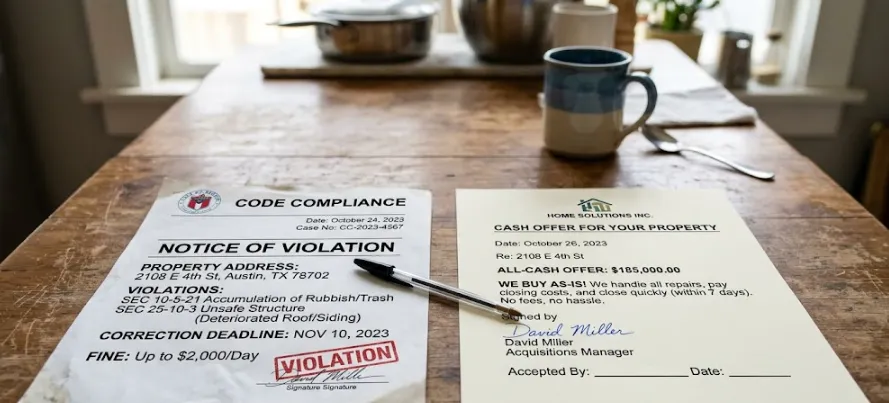
Yes, you can sell a house with code violations for cash in DFW, and you don't have to fix them first. Specialized cash buyers like Sage Senior Support purchase homes in any condition—including those with open code violations, unpermitted additions, or deferred maintenance—and factor the cost of remediation directly into their offer. This approach can save you months of stress, thousands in repair costs, and provide quick access to funds for senior care or other urgent needs.
Understanding how code violations affect your home's value, what your legal obligations are, and which selling path makes sense for your situation requires clarity on the process, costs, and risks involved.
Sage Senior Support
Free Consultation & Cash Offer in 24 Hours
Core Service Programs:
- Cash Home Buying for families needing to sell a parent's home fast to fund senior care
- Senior Care Resources with personally-vetted community partners to assist your family in the transition for your loved one
- Care Funding Discovery Home sell options for Texas Medicaid, VA benefits, long-term care insurance, and bridge financing
Why Choose Sage Senior Support:
- ✓ Trusted by customers with a perfect 5.0-star Google rating across 26 verified reviews
- ✓ Founded by someone who's lived this transition — twice (2013 & 2024)
- ✓ 100+ DFW families guided through senior care transitions
- ✓ Cash offers same day — close in as few as 10 days
- ✓ Zero commissions, zero closing costs, no repairs needed
- ✓ Connection to free care placement — agents paid by the community, not your family
- ✓ Locally owned in Grapevine, TX — serving the entire DFW metroplex
What Are Code Violations and How Common Are They in DFW?
A code violation is a municipal citation issued when a property doesn't comply with local building, safety, or property maintenance standards. In practice, that covers a wide range of issues: an unpermitted room addition built without permits, an outdated electrical panel that no longer meets current standards, overgrown vegetation that's become a nuisance, a crumbling fence, foundation problems, or plumbing that's failed after decades of use.
In DFW, cities like Dallas and Fort Worth actively enforce these codes—particularly in older housing stock built before 1980 or 1990. The City of Dallas Code Compliance Services alone receives over 200,000 service requests annually. Aging infrastructure, homeowner modifications done without permits, and years of deferred upkeep make code issues extremely common in this segment of the market. Industry estimates suggest that 20–40% or more of older DFW homes carry some form of non-compliance.
One important thing to understand: code violations are tied to the property, not the owner. If you sell without resolving them, the underlying violations transfer to the new buyer. Municipal liens and accumulated fines, however, are your responsibility to clear at closing—they don't pass to the new owner. When families are already managing a parent's care transition, this distinction matters enormously for planning the sale.
For families navigating this situation alongside a senior care transition, Sage's Senior Transition Concierge services can help coordinate the home sale alongside placement and care funding decisions so nothing falls through the cracks.
You're Not Alone—Deferred Maintenance Is Common in Senior-Owned Homes. Many DFW families face the same situation: a parent's home has accumulated years of deferred maintenance and code issues, and the thought of fixing everything feels overwhelming. This is one of the most common reasons families reach out to specialized cash buyers—not because they're desperate, but because they're smart about their time and resources.
How Code Violations Affect Your Home's Cash Offer
Cash buyers don't guess at offers—they calculate them. The formula is straightforward: Move-in Ready Value minus estimated repair costs (including full code violation remediation), minus holding costs, minus the buyer's margin. Every line item is based on real contractor costs in the DFW market.
The severity of the violation drives the size of the deduction. Minor issues—an unpermitted shed, a fence setback violation—have a relatively small pricing impact. Moderate violations carry significant costs: an electrical panel upgrade runs approximately $4,200; cast-iron plumbing replacement averages around $8,000; a new AC unit costs roughly $10,000. Major structural or habitability violations—foundation repairs ($10,000 and up), unpermitted load-bearing additions, or an official unfit-for-habitation order—result in the largest deductions because the remediation costs and risk are highest.
Municipal liens and accumulated fines add another layer. For a property with an unresolved violation active for one to five years in Dallas or Fort Worth, fines can range from hundreds to several thousands of dollars. These must be paid from your sale proceeds at closing to convey clear title—cash buyers factor this into their offer math as well.
The overall as-is discount for homes with significant code violations typically reflects a 10–20% or greater reduction from Move-in Ready Value. That sounds like a lot until you run the numbers against the alternatives—which we do in the next section. To understand how home sale proceeds can fund the care your family needs right now, the Senior Care Cost Calculator can help you map out the numbers.
Your Legal Obligations: Disclosure, Title, and Texas Law
Texas law is clear on what sellers must disclose. Under Texas Property Code Section 5.008, you are required to complete a Seller's Disclosure Notice (Form OP-H) that covers known structural defects, plumbing problems, electrical issues, and any notices of violations from governmental ordinances. The key word is known—you are not liable for defects you were genuinely unaware of. But if a condition is obvious enough that you should have known, or if you actively concealed it, an "as-is" clause will not protect you.
That "as-is" protection is commonly misunderstood. Selling as-is means the buyer accepts the property in its current condition without relying on your representations about its state—it shifts the burden of discovery to the buyer through their own inspections. What it does not do is shield you from claims of fraud or active concealment of known material defects. Families sometimes believe an as-is sale eliminates all disclosure obligations. It doesn't.
On the title side, any recorded municipal liens for unpaid code fines or nuisance abatement costs will surface during the title search and must be cleared before a clean policy can be issued. Unpermitted additions are a different matter—they don't automatically create a title defect, but they are material physical defects that must be disclosed and can cause serious problems with financed sales (lender appraisal and underwriting issues). For cash buyers, unpermitted work is simply factored into the offer.
If the home is part of an estate or inherited situation, the legal picture gets more complex. Understanding how probate affects the home sale process is an important parallel step for many families in this situation.
Cash Buyers vs. Traditional Agents: Timeline, Costs, and Net Proceeds
The three main selling paths for a code-violation home each carry very different financial and time profiles. Using a $300,000 Move-in Ready Value as the baseline, here's how the numbers actually compare:
| Selling Path | Timeline | Key Costs | Estimated Net Proceeds |
|---|---|---|---|
| Renovate & List | 6–9 months | $20K–$30K renovation + $18K commission + $3K concessions + $5K buyer repairs + $8K–$12K carrying costs | $232,000–$246,000 |
| As-Is with Agent | 2–4 months | $18K commission + $3K concessions + $8K–$10K repairs + $2.5K–$5K carrying costs (on 70% value = $210K) | $174,000–$178,500 |
| Cash Buyer (Sage) | 7–10 days | $0 commissions, $0 closing costs, $0 repairs by seller | $225,000–$235,000 |
The renovation path might yield the highest gross number, but it requires $20,000–$30,000 upfront, six to nine months of carrying costs, and the constant risk that a buyer's financing falls through or an inspection triggers another round of renegotiation. When your family needs funds now to cover assisted living at $4,500 per month or memory care at $5,625 per month in DFW, a six-month delay doesn't just cost time—it costs real money.
The as-is agent path is often worse than families expect. At 70% of Move-in Ready Value minus commissions and repair concessions, net proceeds frequently land well below a direct cash sale. For a deeper look at how these paths compare in real-world terms, this breakdown of selling Mom's house for cash vs. using an agent walks through the full cost picture.
The Real Cost of Delay: Fines, Care Funding Gaps, and Lost Equity. Waiting to sell a code-violation home can cost far more than you realize. Accumulated municipal fines (often hundreds to thousands per month), ongoing property taxes, insurance complications, and delays in accessing funds for senior care (average $4,500–$5,625/month in DFW) can easily total $20,000–$40,000 or more over 6–12 months. A quick cash sale eliminates these hidden costs and gets funds to your family when they're needed most.
Types of Cash Buyers and How to Evaluate Them in DFW
Not every "cash buyer" operates the same way, and the differences matter significantly when you're selling a home with code violations.
Fix-and-flip investors are highly active in DFW. They understand code issues, factor them into offers, and manage remediation post-closing. They're generally experienced with exactly the kind of property you're selling. iBuyers like Opendoor and Offerpad are a different story—their algorithmic models prefer lighter repairs, and they frequently decline homes with significant violations or apply heavy deductions that make their offers uncompetitive.
Direct buyers like Sage Senior Support specialize in any-condition purchases. They buy the home themselves, manage remediation after closing, and provide full transparency on how the offer was calculated. This is the category most relevant to families navigating a senior transition alongside a home sale.
When evaluating any cash buyer, ask for proof of funds specific to your transaction, request a written explanation of how the offer was calculated, and confirm whether they are the end buyer or a wholesaler assigning the contract to someone else. For a detailed guide on vetting credentials and track records, this resource on trustworthy as-is home buyers in DFW covers what to look for and what to avoid.
Watch Out for Wholesalers Disguised as Direct Buyers. Some "cash buyers" are actually wholesalers who put your home under contract but don't close themselves—they assign the contract to another investor. Red flags include vague ownership language, very quick contract timelines (2–3 days) but long closing dates (30–60 days), and refusal to show proof of funds for your specific transaction. Always ask: "Are you the end buyer, or are you assigning this contract?"
Why Sage Senior Support Is the Right Choice for DFW Families Selling Code-Violation Homes
Sage Senior Support holds a perfect 5.0-star Google rating across 26 verified reviews—not because the process is easy, but because the team shows up differently than a typical cash buyer. Every conversation starts with "How's Mom or Dad doing?" before it ever gets to the house. That's not a sales tactic. It's how Sage was built, born from the founder's own experience navigating Alzheimer's and caregiving—twice, in 2013 and again in 2024.
For families dealing with a code-violation home, that experience translates into something practical: Sage has helped 100+ DFW families work through exactly this kind of situation. They understand that a home with deferred maintenance, unpermitted additions, or open municipal citations isn't a problem to be ashamed of—it's a common reality for senior-owned homes, and it doesn't have to stand between your family and the care your loved one needs.
Sage provides cash offers within 24–48 hours and can close in as few as 10 days. With assisted living averaging $4,500 per month and memory care at $5,625 per month in DFW, that speed isn't just convenient—it's often the difference between a family managing the transition calmly and scrambling to cover a care gap. Unlike wholesalers or iBuyers, Sage directly purchases homes in any condition with zero commissions, zero closing costs, and no repairs required from the seller. The offer math is explained openly, so families understand exactly what they're receiving and why.
Beyond the transaction, Sage connects families with placement agents, elder law attorneys, and care funding resources—because selling the house is only one piece of what families are navigating. Locally owned in Grapevine and serving the entire DFW metroplex, Sage brings the kind of accountability and community knowledge that national platforms simply can't match.
Schedule a free consultation with Sage Senior Support today—no pressure, just honest guidance on what your home could be worth and how the proceeds can support your family's care transition.
Frequently Asked Questions About Selling Code-Violation Homes for Cash
Do I have to fix all the code violations on my DFW house before I can sell it for cash?
No, you do not have to fix code violations before selling for cash. Specialized cash buyers like Sage Senior Support purchase homes in any condition—including those with open violations—and factor remediation costs directly into their offer. You avoid the time, expense, and stress of repairs entirely, and the buyer takes on the responsibility of bringing the property to code after closing. This is one of the primary reasons families in a senior care transition choose the cash sale path.
Will the code violations transfer to the new owner if I sell my DFW house as-is for cash?
Yes, the underlying code violations themselves—such as unpermitted additions or structural issues—generally transfer with the property to the new owner, who inherits the responsibility to bring it into compliance. However, any municipal liens or accumulated fines must be paid off by you, the seller, at closing to convey clear title. Cash buyers factor all of these costs and responsibilities into their offer price, so there are no surprises at the closing table.
How do I know if my DFW house has code violations, and will they show up on a title report?
You can check for active code enforcement cases by contacting your city's code compliance department directly—the City of Dallas Code Compliance and Fort Worth Code Compliance both maintain online databases and accept phone inquiries. Code enforcement liens or judgments for unpaid fines will appear on a Texas title report as recorded encumbrances. However, an active violation that hasn't yet resulted in a recorded lien may not appear on a title report—but you are still legally obligated to disclose any violations you know about under Texas Property Code Section 5.008.
How much less will a cash buyer offer for my DFW home if it has significant code violations?
Cash buyers calculate their offer by subtracting the full estimated remediation cost, holding costs, and their margin from the home's Move-in Ready Value. The specific discount depends on the type and severity of the violations—minor issues have a smaller impact, while major structural or habitability violations result in the largest reductions. Homes with significant code issues typically receive offers reflecting a 10–20% or greater reduction from Move-in Ready Value, but this discount replaces what you would have otherwise spent on repairs, commissions, and carrying costs through a traditional sale.
What makes Sage Senior Support different from other cash home buyers in DFW?
Sage Senior Support stands out with a perfect 5.0-star Google rating across 26 verified reviews, direct cash purchases of homes in any condition including those with code violations, and offers delivered within 24–48 hours with closing in as few as 10 days. Unlike wholesalers or iBuyers, Sage is locally owned in Grapevine, founded on personal caregiving experience, and provides transparent offer calculations alongside connections to senior care resources, placement agents, and financial advisors. Sage has helped 100+ DFW families access funds quickly for care while feeling confident they received fair value. Learn more about how Sage can help your family by scheduling a free consultation today.
Ready to Sell Your DFW Home with Code Violations for Cash?
You don't have to fix a thing, spend months waiting, or wonder whether you're being treated fairly. Sage Senior Support buys homes in any condition across DFW—code violations, deferred maintenance, unpermitted additions and all—with full transparency on every offer and zero pressure to decide before you're ready.
If your family is navigating a senior care transition and needs to move quickly, we're here to help you understand every option and make the choice that's right for your situation—not just the one that's fastest for us.
Service availability, benefit eligibility, and home valuations depend on individual circumstances and current market conditions. This article is for informational purposes only and does not constitute medical, legal, or financial advice. Contact us for personalized guidance specific to your family's situation.