
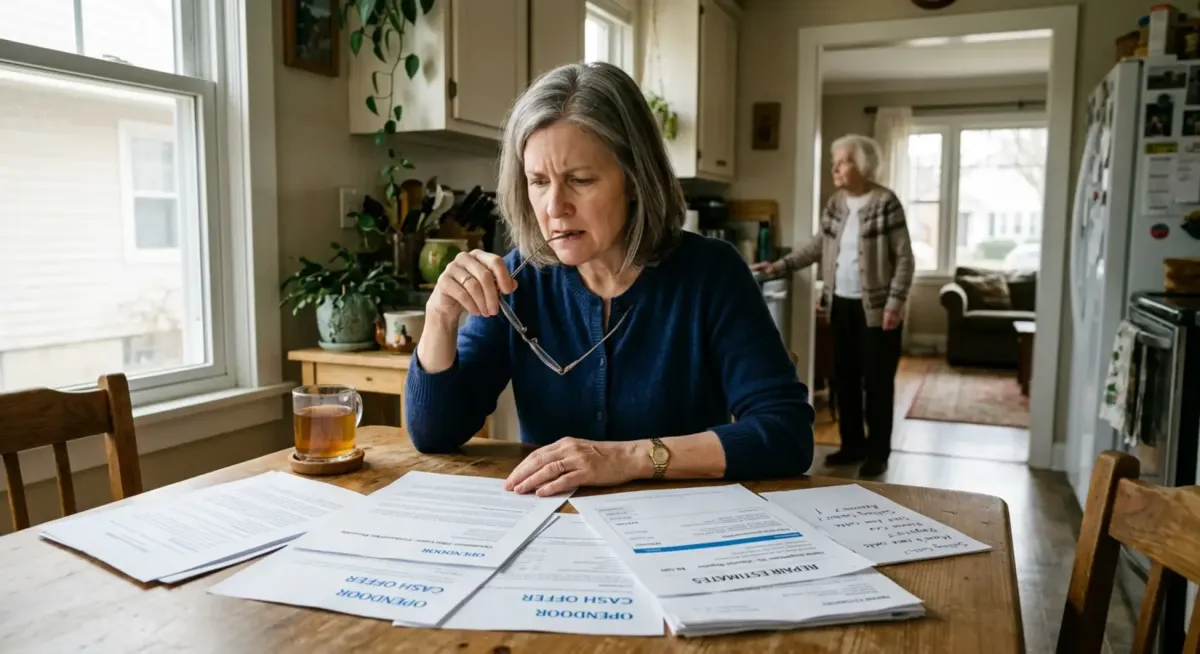
What Happens If I Wait Too Long to Sell My Parents' House? — The Costly Mistake Most Families Make
What Happens If I Wait Too Long to Sell My Parents' House? — The Costly Mistake Most Families Make
Key Takeaways
- Waiting to sell your parents' home rarely makes things easier — it almost always makes them harder, more expensive, and more emotionally draining.
- Vacant homes in Dallas-Fort Worth lose value fast through maintenance neglect, vandalism, insurance complications, and rising carrying costs.
- A health crisis — a fall, a stroke, a sudden decline — can force you into urgent decisions with fewer options and less negotiating power.
- You don't have to choose between selling fast and selling fair. Transparency and education change everything.
- Starting the conversation early, even before you're "ready," gives your family the clarity and breathing room you deserve.
The Phone Call That Changes Everything
It usually starts with a phone call you weren't expecting.
Maybe it's a neighbor telling you the gutters on Mom's house are hanging off. Maybe it's a notice from the HOA about the overgrown yard. Or maybe — and this is the one that hits hardest — it's the hospital calling to say Dad fell again, and this time he can't go back home.
Suddenly, you're standing in the middle of a house full of forty years of memories, a stack of bills you didn't know existed, and a decision you've been putting off for months. Maybe years.
You're not alone. This is the exact moment we hear about in almost every conversation we have with families across Dallas-Fort Worth. And the one thing they almost always say is: "I wish we hadn't waited so long."
We understand that feeling deeply. In 2013, our own family faced it with Alzheimer's. And again in 2024. Both times, the weight of "what do we do with the house" sat on top of everything else — the grief, the guilt, the logistics of care. We know what it's like to be in your shoes because we've worn them.
So let's talk honestly about what happens when families wait too long to sell a parent's home — and what you can do right now to protect yourself, your parents, and your peace of mind.
Why Most Families Delay Selling a Parent's Home in Dallas-Fort Worth
First, let's be fair to you. There are real, human reasons families put this off. None of them make you a bad son or daughter.
Guilt. Selling the house feels like erasing your parent's life. The kitchen where Mom made Thanksgiving dinner. The garage where Dad spent every Saturday. It's not just a property — it's a piece of your family's story.
Hope. Maybe Dad will get better. Maybe Mom won't need memory care after all. Maybe things will stabilize and you won't have to make this decision yet.
Overwhelm. You're already managing doctor's appointments, medication schedules, family dynamics, and maybe your own kids and career. Adding "figure out what to do with the house and all the stuff" to that list feels impossible.
Skepticism. You've heard stories about cash buyers making lowball offers. You don't trust the process. You figure it's better to wait and list it properly when you have more time.
Every one of these reasons makes sense. But here's what we've seen, family after family: waiting doesn't make any of these things easier. It makes all of them harder.
The Real Cost of Waiting to Sell Your Parents' House
When we say "costly mistake," we're not just talking about money — though the financial impact is real. We're talking about the toll on your time, your health, your relationships, and your ability to get your parent the care they need.
Carrying Costs That Add Up Every Single Month
An empty house is not a neutral asset. It's a monthly expense. In the Dallas-Fort Worth area, property taxes alone can run $5,000 to $12,000 or more per year depending on the neighborhood and home value. Texas has some of the highest property tax rates in the country — averaging around 1.8% of assessed value — and those bills don't pause because Mom moved to assisted living.
Then add homeowner's insurance (which often increases for vacant properties), utilities you're keeping on to prevent pipe damage, lawn care, and basic upkeep. Families we work with are often spending $800 to $1,500 a month just to keep a house they're not living in from falling apart.
That's money that could be going directly toward your parent's care.
Deferred Maintenance Turns Small Problems Into Big Ones
A small roof leak in January becomes water damage and mold by summer. A minor foundation crack shifts further during Texas heat. HVAC systems that sit idle develop issues. Pest infestations go unnoticed for months.
We've walked through homes where families waited 12 to 18 months, and what started as a house that needed cosmetic updates turned into a property requiring $30,000 or more in repairs. Every month of delay chips away at the home's value and adds to the eventual cost of selling.
Insurance Gaps and Liability Risks
Here's something many families don't realize: most standard homeowner's insurance policies have vacancy clauses. If a home sits unoccupied for 30 to 60 days, coverage can be reduced or voided entirely. A vacant home is a higher risk for break-ins, vandalism, and weather damage — and if your policy has lapsed or been modified, you could be on the hook for everything.
In the DFW metro, where summer storms and hail are a regular occurrence, this is not a hypothetical risk. It's a very real one.
If your parent has moved to assisted living or memory care, their home may already be considered "vacant" under their insurance policy — even if you visit regularly. It's worth calling the insurance company now to check your coverage status.
The Emotional Cost Compounds Too
Every time you drive past the house, every time you get a bill in the mail, every time a sibling asks "so what are we doing about the house?" — it adds weight. The decision doesn't get lighter with time. It gets heavier.
We've talked with families who spent two years avoiding the conversation, and by the time they called us, they were exhausted. Not just logistically — emotionally. The house had become a source of tension between siblings, a reminder of guilt, and a financial drain that was quietly making everything harder.
When a Health Crisis Forces Your Hand — And Why That's the Worst Time to Sell
This is the pattern we see most often, and it's the one that breaks our hearts.
A parent has been managing at home — maybe with some help, maybe barely. The family knows a transition is coming eventually but keeps pushing it off. Then something happens. A fall. A wandering episode. A hospitalization. And suddenly, you're not planning a transition — you're managing a crisis.
When you're in crisis mode, your options shrink dramatically:
- You need funds fast to cover a deposit at an assisted living community or memory care facility, which in Dallas-Fort Worth can range from $4,000 to $8,000+ per month.
- You don't have time to prep the house, list it traditionally, wait 45 to 90 days for a buyer, and then navigate a 30-day closing process.
- You're making decisions under stress, which means you're more likely to accept the first option that comes along — even if it's not the best one.
- Family disagreements intensify when there's no plan and everyone's scared.
Compare that to a family who starts the conversation early — before the crisis. They have time to explore all their options. They can talk through what the process looks like, step by step. They can make a calm, informed decision instead of a panicked one.
"It's not just about the house — it's about helping Mom or Dad safely through this transition. The house is one piece of a much bigger puzzle, and when you have time to see the whole picture, every piece falls into place more easily."
How to Know It's Time to Sell Your Parents' Home
You might not feel "ready." That's okay. Most families don't. But there are clear signals that it's time to at least start the conversation:
- Your parent has moved or is actively planning to move into assisted living, memory care, or in with family.
- The house is sitting empty or is only being visited occasionally.
- You're paying to maintain two households — your parent's care and their former home.
- The home needs significant repairs that no one has the time, energy, or budget to handle.
- You've inherited the home and aren't sure what to do with it.
- Care costs are mounting and the home's equity could help cover them.
- Family tension is building around the "what do we do with the house" question.
If even two or three of these resonate, it's worth having a no-pressure conversation about your options. Not to commit to anything — just to understand what's possible.
The Dallas-Fort Worth housing market remains active, but homes that need significant updates or repairs can sit longer on the traditional market. The longer a home sits, the more buyers wonder what's wrong with it — and the more leverage they have to negotiate down. Acting while you have options is always better than acting when you're out of them.
What Selling a Parent's Home Actually Looks Like (When It's Done Right)
Here's what most people picture when they think about selling: staging, open houses, strangers walking through Mom's bedroom, negotiations, inspections, repairs, and months of uncertainty. No wonder families put it off.
But it doesn't have to look like that.
When we work with a family, the first thing we do is ask: "How's Mom or Dad doing?" Before we ever talk about the house, we want to understand the care situation. Because the house isn't the starting point — your family is.
From there, we walk through every option available to you:
- Listing with a trusted real estate agent — if the home is in good shape and you have time, this might net the highest price. We can connect you with agents who specialize in senior transitions in DFW.
- Making updates and selling to a traditional buyer — if the home has good bones but needs cosmetic work, this could be worth exploring.
- A direct purchase — if you need speed, simplicity, and certainty, selling directly means no repairs, no showings, no waiting. You choose the closing date, and we handle the rest — including the belongings left behind.
- Renting the property — in some cases, keeping the home as a rental can provide ongoing income to help cover care costs.
The point is: you deserve to see all the paths before you choose one. And you deserve someone who will explain why an offer looks the way it does — not just hand you a number and hope you don't ask questions.
As one family told us: "We didn't get the highest offer, but we trusted you because you took the time to explain everything." That trust matters more than a few thousand dollars when you're navigating something this personal.
A Real Family's Story: From Fear and Guilt to Confidence and Relief
Linda and her husband had lived in their Dallas-Fort Worth home for over 30 years. She was going through cancer treatment. He was losing mobility. Their home was full of decades of belongings, and honestly? They were embarrassed to let anyone see it.
They knew they needed to move into a senior apartment, but the thought of packing, cleaning, making repairs, and listing the house — all while managing serious health challenges — felt completely impossible.
When we first spoke with Linda, she said something we hear all the time: "I don't even know where to start."
We started with a conversation. No pressure. No pitch. Just listening. We connected them with resources for their care transition and then, when they were ready, we talked about the home.
Within 30 days, they sold directly. No packing. No cleaning. No repairs. They closed early so they could access funds for their care costs, and they moved into their new senior apartment with one less burden on their shoulders.
Linda later told us: "You made this so much easier than we expected. You didn't pressure us — you helped us understand."
That's what it looks like when the process is built around people, not property.
The Biggest Mistake Families Make When Selling a Parent's Home
It's not choosing the wrong buyer. It's not pricing too low. It's not even waiting too long — though that's a close second.
The biggest mistake is chasing every last dollar at the expense of everything else.
We understand the instinct. You want to honor your parent's investment. You want to make sure they're taken care of. You don't want to leave money on the table.
But here's what we've seen happen when families chase the highest possible price at all costs:
- They spend $15,000 to $25,000 on renovations that only increase the sale price by $10,000.
- They list the home and wait four months while paying carrying costs that eat into the profit.
- They deal with buyer financing falling through, inspection demands, and closing delays.
- They burn out emotionally — and the family relationships suffer.
Meanwhile, their parent's care needs aren't waiting. Memory care costs in the DFW area average $5,500 to $7,500 per month. Every month of delay is real money — and real stress.
You don't have to choose between fast and fair. A direct purchase can be honest, transparent, and compassionate when it's done by people who take the time to show you exactly how they arrived at the number — and who genuinely want you to make the best decision for your family, even if that means not selling to them.
Steps You Can Take Right Now (Even If You're Not Ready to Sell)
You don't have to make a decision today. But you can take small steps that will make everything easier when the time comes:
1. Start the Conversation With Your Family
Even a brief, honest discussion about "what's the plan for Mom's house?" can prevent a lot of conflict later. You don't need all the answers — you just need to open the door.
2. Understand the Home's Current Value
Not what Zillow says (those estimates can be off by 10-20% or more, especially for older homes that need work). Get a real sense of what the home would sell for in its current condition. We provide what we call a Neighborhood Value Report — a straightforward look at what similar homes in the area have actually sold for.
3. Check Insurance and Legal Documents
Make sure the homeowner's insurance is current and covers a vacant property. Confirm that someone has power of attorney if your parent can no longer manage financial decisions. If you're not sure where to start with the legal side, we can connect you with elder law attorneys in the DFW area who specialize in exactly this.
4. Don't Try to Clean Out the House Alone
This is where so many families get stuck. Decades of belongings, sentimental items mixed with clutter, and no idea where to start. You don't have to sort through everything before selling. Many direct purchase options — including ours — allow you to leave belongings behind. We handle it.
5. Reach Out for a No-Pressure Conversation
Whether you're six months away from a decision or six days, understanding your options early gives you power. It turns "I don't know what to do" into "I know exactly what my choices are, and I'll decide when I'm ready."
Schedule a Free Consultation — No Pressure, Just Clarity
Frequently Asked Questions About Selling a Parent's Home
What if my parent's house is outdated or in poor condition — will anyone even want it?
Yes. This is one of the most common fears we hear, and it's almost never as bad as families think. Homes in any condition have value — especially in the Dallas-Fort Worth market. A direct purchase option means you don't need to make any repairs or updates. We buy homes as-is, and we'll walk you through exactly how we determine a fair price based on the home's current condition and neighborhood values.
How fast can we actually sell if we need to move quickly?
In many cases, families we work with close within 14 to 30 days. You choose the timeline that works for your situation. If you need to close quickly to access funds for care, we can make that happen. If you need a little more time to coordinate the move, that's fine too. The schedule is yours.
What about all the stuff in the house? Do we have to clean everything out first?
No. This is one of the biggest relief points for families. When we purchase a home directly, you can leave behind whatever you don't want to take. Furniture, clothing, boxes in the attic — all of it. We handle the cleanout so you can focus on what matters most: your parent's care and your family's well-being.
How do I know I'm getting a fair offer and not being taken advantage of?
This is exactly the right question to ask — and any buyer who gets defensive about it isn't someone you should work with. We walk every family through how we arrive at our offer, including comparable sales data, estimated repair costs, and our process. We also encourage you to explore all your options, including listing with an agent. If a direct sale isn't the best fit, we'll tell you that honestly.
Can I sell my parent's house if I have power of attorney but my parent is still alive?
In most cases, yes — but the specifics depend on the type of power of attorney and your parent's situation. This is an area where having the right legal guidance matters. We work with elder law attorneys in the DFW area and can connect you with someone who can review your documents and confirm your authority to sell. It's one less thing for you to figure out alone.
What if my siblings disagree about what to do with the house?
Family disagreements around a parent's home are incredibly common — and they usually come from a place of love and grief, not malice. Having clear information about the home's value and all available options often helps bring everyone to the same page. We're happy to have a conversation with multiple family members so everyone feels heard and informed.
You Don't Have to Figure This Out Alone
If you've read this far, chances are you're carrying something heavy right now. Maybe it's the weight of a decision you've been avoiding. Maybe it's guilt about a parent's home sitting empty. Maybe it's the fear that you're running out of time.
We want you to know: you're not failing. You're not too late. And you don't have to navigate this by yourself.
Whether you end up selling your parent's home to us, listing it with a trusted agent, or deciding to hold onto it for now — we're here to help you see every option clearly so you can make the choice that feels right for your family.
Because at the end of the day, it's not about the house. It's about making sure Mom or Dad is safe, cared for, and that you can finally breathe again.
We're in this together. There are tools and resources to help you manage it all. Let's talk through what this could look like, step by step.
Ready to talk? No pressure. No obligation. Just a real conversation about your family's situation and what options make sense.
Schedule Your Free ConsultationWe'll start by asking how Mom or Dad is doing — because that's what matters most.