
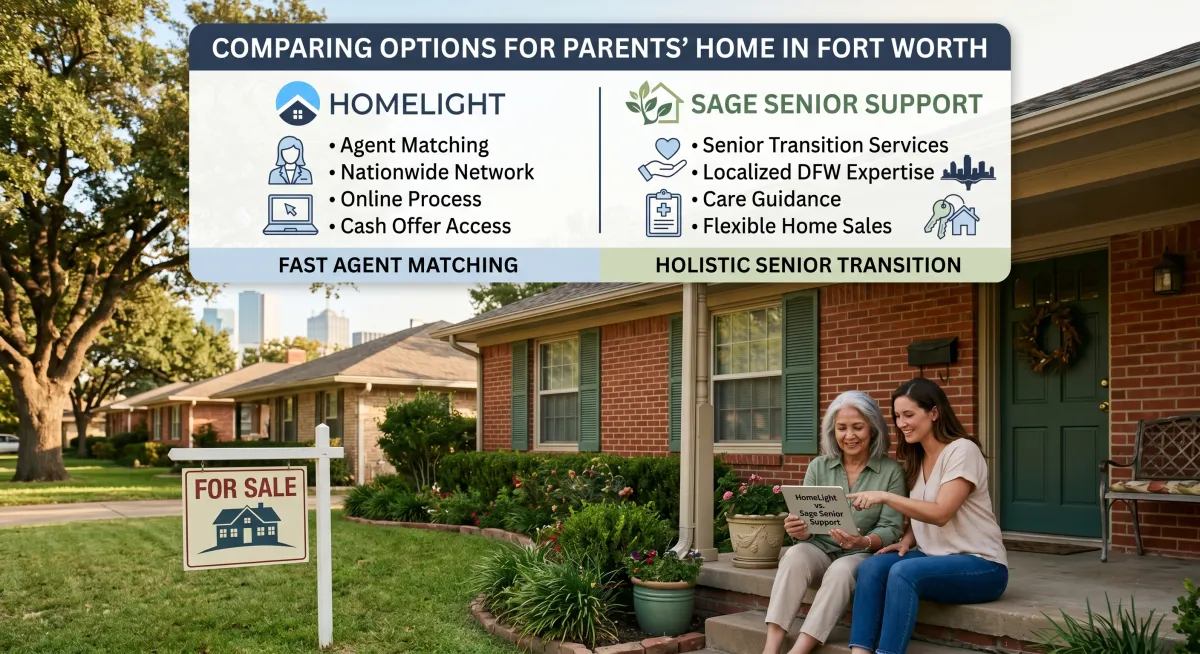
Companies Like HomeLight That Help Families Sell a Parent's Home Quickly
You're standing in your mom's Fort Worth home — the one she's lived in for thirty years. The carpet is the same shade of gold it was in 1988. The kitchen hasn't been touched since the Clinton administration. Every room holds a decade of belongings, and somewhere in the back of your mind, the clock is ticking because she moved into assisted living three weeks ago and the bills have already started arriving. You're not a real estate investor. You're not a seasoned home seller. You're a son or daughter trying to do right by your parent while keeping your own life from falling apart at the seams.
You've done some searching and two names keep coming up: HomeLight and Sage Senior Support. Both promise speed. Both say they buy homes as-is. But which one is actually right for your family's situation — and how do you know you're not leaving tens of thousands of dollars on the table or signing something you'll regret?
This guide is a transparent, honest comparison of both options. No sales pitch. No fluff. Just a clear breakdown of how each company works, what you'll actually net from the sale, and how to decide which path makes the most sense for your family's care transition in 2026.
Key Takeaways
- HomeLight connects sellers with a network of investors through its Simple Sale marketplace — offers typically come in 10–25% below market value, with a 5–8% service fee and closing timelines of 17–30 days.
- Sage Senior Support is a local DFW company that starts with your parent's care situation before discussing the home — offering direct purchases, transparent pricing, and holistic support including care referrals and legal guidance.
- Assisted living costs in DFW run $4,800–$7,800+/month in 2026, making the speed and net proceeds of a home sale critically important to funding care.
- Carrying costs on an unsold Fort Worth home run $1,500–$5,000+ per month — every month you wait is money that could be going toward care.
- Neither option is universally "better" — the right choice depends on your family's priorities: speed, fair pricing, emotional support, or a combination of all three.
- Always get multiple offers, verify credentials, and consult a Texas real estate attorney before signing anything.
Why Fort Worth Families Are Selling Parent's Homes Faster Than Ever
Fort Worth isn't just one of Texas's fastest-growing cities — it's also home to one of the largest concentrations of aging homeowners in the state. Tarrant County has more than 400,000 residents aged 65 and older, and the vast majority of them own their homes. As that generation moves into assisted living, memory care, or passes away, their adult children are left managing properties that are often decades behind in updates, full of belongings, and tied to care costs that start the moment a placement happens.
The financial pressure is real and immediate. Understanding how families are funding assisted living costs in the DFW area makes clear why so many families are turning to fast sale options — the monthly bills don't pause while you figure out the house. Memory care communities in Fort Worth and surrounding areas routinely run $6,000–$7,800 per month. Assisted living starts around $4,800. That's not a bill you can defer while waiting for the perfect buyer.
The Fort Worth Market in 2026: Opportunity and Challenge
Fort Worth's median home prices are currently in the $400,000–$450,000 range, according to 2025 projections from the Texas A&M Real Estate Center and CoreLogic. But that number tells only part of the story. Move-in ready homes in established neighborhoods can command $430,000–$500,000+. Homes that are cosmetically dated — the kind most seniors have lived in for decades — typically land in the $350,000–$420,000 range. Homes with significant deferred maintenance, foundation issues, or outdated systems can drop to $280,000–$350,000 in estimated value.
Cash sales now represent roughly 20–25% of Fort Worth's transaction volume, reflecting a growing appetite for speed and certainty in a market where higher interest rates have made traditional financing less attractive for some buyers. For families selling a parent's dated home, the cash buyer market is often the most practical path — but navigating it without getting taken advantage of requires knowing what to look for. Reviewing the Fort Worth housing market conditions can help you calibrate your expectations before you start getting offers.
The Care Transition Timeline: Why Speed Matters More Than You Think
Here's something most real estate guides don't tell you: care transitions rarely happen on a convenient schedule. A fall, a cognitive decline event, a hospitalization — these are the moments that force families into action. And once your parent is placed in a care facility, the financial clock starts running immediately.
An unsold Fort Worth home carries $1,500–$5,000+ per month in holding costs — mortgage payments (if any), property taxes, homeowner's insurance, utilities, and basic maintenance. Families who wait six months before selling can easily lose $9,000–$30,000 to carrying costs alone, money that could have gone directly toward care. That context is everything when you're evaluating a cash offer that comes in slightly below what a traditional listing might achieve.
Understanding the Two Paths: HomeLight vs Sage Senior Support
Before diving into the specifics, it helps to understand that these two companies are fundamentally different in how they're built and what they're trying to do for you.
HomeLight is a technology company. Founded in 2014 and venture-backed, it operates as a marketplace — a platform that connects home sellers with a network of investors and institutional buyers. It's large, it's fast, and it's designed for efficiency. The experience is largely digital, the offer is calculated by an algorithm, and the transaction is primarily about moving the property.
Sage Senior Support is something different. Founded in 2013 out of a personal family experience with Alzheimer's and caregiving, it's a local DFW company whose first conversation with you isn't about the house — it's about how Mom or Dad is doing. Their model is built around the reality that selling a parent's home when moving to care is never just a real estate transaction. It's a life transition that involves grief, guilt, financial complexity, and logistical overwhelm — and the home sale is just one piece of it.
Neither company is inherently better. The right choice depends on what your family actually needs. Some families need maximum speed and a simple process. Others need guidance, transparency, and a partner who understands the full picture. Most families need a little of both — which is why understanding each option clearly before you call anyone is worth your time.
Wondering What Your Parent's Fort Worth Home Is Actually Worth?
Before you accept any offer, it helps to understand your home's fair market value and how different sale methods compare. Sage Senior Support offers a free, no-pressure consultation to walk you through your options — no obligation, just honest guidance from someone who knows both the Fort Worth market and senior care transitions.
HomeLight's Simple Sale: How It Works and What to Expect
HomeLight's cash offer product is called Simple Sale. The name is accurate — the process is streamlined and relatively fast. But understanding exactly how the offer is calculated, and what you'll actually walk away with, requires a closer look than the website's marketing copy provides.
The HomeLight Process Step-by-Step
Step 1: Submit Your Property Information
You provide basic details about your parent's home online or by phone — address, condition, approximate size, and any known issues.
Step 2: HomeLight Analyzes and Generates an Offer
HomeLight's algorithm calculates an After Repair Value (ARV) — what the home would be worth in move-in ready condition — and then deducts estimated repair costs and their service fee to arrive at an offer. This process typically takes a few days.
Step 3: Review the Offer
You receive the offer, which includes the ARV estimate and the deductions applied. This is a take-it-or-leave-it offer — there's limited room for negotiation on repair deductions.
Step 4: Accept and Choose a Closing Date
If you accept, you select a closing date — typically 17–30 days from offer acceptance. This is one of HomeLight's genuine strengths: the timeline is fast and predictable.
Step 5: Close and Receive Funds
Closing happens through a title company. You receive your net proceeds — the offer price minus the service fee and any closing costs.
One important clarification: HomeLight does not buy your home directly. They act as a marketplace connecting you with investors and institutional buyers in their network. The actual purchaser is one of those investors, not HomeLight itself. This distinction matters because it affects who you're ultimately negotiating with and how the repair estimates are calculated.
Pricing and Fees: What You Actually Net from a HomeLight Offer
HomeLight's service fee typically runs 5–8% of the sale price — comparable to traditional real estate commissions, but structured differently. This fee is deducted from the offer before you receive funds. On top of that, the investor's profit margin and repair costs are already baked into the offer price through the ARV calculation.
Here's what that looks like in practice for a typical Fort Worth home. Say your parent's house has an estimated move-in ready value of $400,000, but it needs $40,000 in repairs (foundation work, HVAC replacement, kitchen updates). HomeLight's algorithm might deduct $40,000 in repairs plus a 7% service fee ($28,000), leaving you with roughly $332,000. That's a 17% discount from the post-renovation value — which, depending on your situation, may or may not be acceptable.
For a home in poor condition, the net proceeds after all deductions typically land at 75–85% of estimated market value. Understanding the true cost of assisted living in DFW helps put these numbers in context — when care is running $6,000/month, the difference between netting $320,000 and $360,000 represents six months of care funding.
⚠️ The Repair Deduction Reality
HomeLight's repair estimates are calculated by their algorithm and investor network — not by a licensed inspector who has walked through your parent's home. Independent analyses suggest these estimates can be aggressive, sometimes higher than actual market costs for the same repairs. Always get a second opinion from a local contractor or a trusted real estate professional before accepting any cash offer. You have no negotiation power on repair deductions once you're in the HomeLight process — it's take-it-or-leave-it. A few phone calls to local contractors can tell you quickly whether the deductions are reasonable or inflated.
Sage Senior Support: The Compassionate Alternative Built for Fort Worth Families
Sage Senior Support was founded in 2013, and the story behind it matters. The founders didn't come from the real estate investment world — they came from a family that navigated Alzheimer's and the overwhelming complexity of a parent's care transition. That personal experience is woven into every part of how they operate, from the first phone call to the day of closing.
When you call Sage, the first question isn't "What's the address?" It's "How is Mom or Dad doing?" That's not a sales technique — it's a genuine orientation toward understanding your situation before talking about the home. They listen for signs of what you're struggling with: urgent care decisions, memory issues, financial strain, emotional overwhelm. And before the conversation ever turns to the property, they often share local resources — trusted placement agents, elder law attorneys, care funding options you may not have known existed.
For families who feel like they're drowning in the complexity of a parent's transition, that approach is worth more than a few thousand dollars on the sale price. Navigating the emotional journey of downsizing is something Sage genuinely understands — not as a talking point, but as lived experience.
The Sage Senior Support Difference: Starting with Care, Not Commissions
Sage's process is consultative by design. The first conversation focuses on your parent's health, care needs, and your family's situation. Only once they understand the full picture do they begin discussing the home — its condition, what needs to happen, and what options are realistically available to you.
Critically, Sage doesn't just offer one path. They educate families on all available options — direct purchase, listing with a trusted agent, coordinating a sale around care placement timing, or even exploring whether the home should be rented temporarily. Their goal is solving the entire transition puzzle, not just closing a transaction. They can connect you with assisted living placement agents, elder law attorneys, financial advisors, and other professionals who are part of their trusted DFW network.
If you're also trying to understand the full scope of care options available to your parent, Sage can help you think through the Fort Worth assisted living decision alongside the home sale — because those two decisions are deeply connected.
Sage's Direct Purchase Process
When a direct purchase makes sense, Sage visits the home in person. A real person walks through the property, assesses its condition fairly, and builds an offer based on a comparative market analysis and transparent repair estimates — not an algorithm that's never seen the inside of the house.
Offers from Sage are explained in detail. You'll understand what the estimated post-renovation value is, what repairs are being factored in and why, and how the final number was reached. There's no black box. Closing timelines are typically 2–4 weeks, with flexibility to coordinate around care placement needs — a meaningful advantage when you're trying to time the home sale with a facility move-in date or a Medicaid spend-down plan.
After closing, Sage handles all belongings, cleanup, and logistics. You don't have to organize an estate sale, rent a dumpster, or coordinate junk removal. For families who are already stretched thin managing a parent's care, that logistical relief is genuinely significant.
You're Not Just Selling a House — You're Managing a Life Transition
Many families underestimate how much support they need during a parent's move to care. The guilt, the grief, the uncertainty about whether you're making the right call — those feelings don't disappear just because you've found a buyer. Sage's approach recognizes that the home sale is one piece of a much larger, emotionally complex puzzle. A company that understands senior care can provide guidance on care options, funding strategies, and legal considerations that a purely transactional buyer simply cannot offer. Sometimes the emotional support and education are worth more than saving a few thousand dollars on the sale price.
Head-to-Head Comparison: Speed, Price, and Support
Let's put both options side by side across the dimensions that actually matter to Fort Worth families in the middle of a care transition. Before diving into the details, reviewing strategies for maximizing your home's value before a senior transition can help you understand what levers you actually have to pull.
| Category | HomeLight Simple Sale | Sage Senior Support |
|---|---|---|
| Speed to Close | 17–30 days from offer acceptance | 2–4 weeks; flexible for care coordination |
| Offer Basis | Algorithm-based ARV minus repair deductions | Market analysis with in-person assessment |
| Typical Discount | 10–25% below market value | Fair market value minus transparent repair costs |
| Fees | 5–8% service fee (bundled) | Transparent; explained in detail |
| Negotiation | Limited; take-it-or-leave-it | Consultative; options discussed openly |
| Belongings Handling | Purchased as-is; investor handles after closing | Sage handles all cleanup and logistics |
| Senior Care Support | Not offered; transactional focus | Core offering; care referrals, legal guidance |
| Local DFW Focus | National platform; limited local depth | Deeply local; DFW-rooted since 2013 |
| Best For | Families prioritizing speed and simplicity | Families needing guidance, fair pricing, support |
Speed to Close
HomeLight's 17–30 day timeline is a genuine strength. If pure speed is the priority — perhaps your parent's care facility requires a deposit immediately, or you're managing from out of state and need this resolved — HomeLight's process is hard to beat on raw timeline. Sage Senior Support is comparable at 2–4 weeks, but the added flexibility to coordinate timing with a care facility move-in date or a legal process is something HomeLight's standardized timeline doesn't accommodate as naturally.
Offer Transparency and Pricing
This is where the two companies diverge most significantly. HomeLight's offers are generated by an algorithm and presented as a package — ARV minus repair deductions minus service fee. You can ask questions, but the repair deductions are not negotiable. Sage's offers come with a full explanation of how the number was reached, what repairs are being factored in, and why. That transparency allows you to evaluate whether the offer is fair rather than just accepting a number you don't fully understand.
Emotional and Logistical Support
HomeLight is a transaction platform. It does that transaction efficiently. But if you're trying to figure out how to pay for memory care, whether your parent qualifies for any benefits, how to navigate probate if the home is part of an estate, or simply how to get through the next thirty days without completely falling apart — HomeLight isn't built for that. Sage is. Their network of placement agents, elder law attorneys, and care coordinators exists precisely because the home sale is never the only thing families are dealing with.
Suitability for Dated or Poor-Condition Homes
Both companies handle dated and as-is homes well — that's core to both of their models. The difference is in how repair costs are calculated and communicated. HomeLight's algorithm-based estimates can be aggressive for older Fort Worth homes with foundation issues, outdated systems, or significant deferred maintenance. Sage's in-person assessment tends to produce repair estimates that are more grounded in what local contractors actually charge. If you're unsure whether a direct sale or a coordinated listing is the better path, reviewing options for selling a Fort Worth house as-is versus using an agent can help you think through the tradeoffs.
Get Clarity Before You Decide
A 15-minute conversation with someone who understands both your parent's care needs and the Fort Worth market can save you thousands of dollars and months of stress. If you're trying to figure out whether a direct cash offer or another approach makes more sense for your family's situation, that's exactly what Sage Senior Support is designed to help you work through — no pressure, just honest guidance.
The Real Cost of Selling: Fort Worth Pricing Breakdown
One of the most common mistakes families make is comparing only the headline offer price across different sale methods without accounting for all the costs involved. A traditional listing might produce a higher gross sale price, but by the time you subtract commissions, closing costs, repairs, and two to three months of carrying costs, the net proceeds can be surprisingly close to — or even lower than — a well-structured cash offer.
Understanding After Repair Value (ARV) and Repair Deductions
Both HomeLight and Sage estimate what a home will be worth after repairs (ARV), then deduct repair costs from that value to arrive at an offer. The difference is in how transparent and negotiable those deductions are. HomeLight's deductions are algorithm-generated and fixed. Sage's deductions are explained in detail and based on an in-person assessment. Always ask any cash buyer to walk you through their ARV estimate and repair deductions line by line — a reputable buyer will do this without hesitation.
Traditional Listing: The Full Cost Picture
Following the 2025 NAR settlement, real estate commissions are now negotiated more openly, but total commission costs still typically run 4–6% of the sale price for a full-service transaction. Understanding the effects of the NAR settlement on real estate commissions is worth doing before you assume you know what you'll pay an agent.
Here's the full cost picture for a traditional listing on a dated Fort Worth home:
- Realtor commissions: 4–6% of sale price ($16,000–$24,000 on a $400K home)
- Closing costs: 1–3% ($4,000–$12,000)
- Repairs and staging: $5,000–$50,000+ for dated homes (foundation, HVAC, cosmetics)
- Carrying costs (60–90 days): $3,000–$9,000+ (mortgage, taxes, insurance, utilities)
- Total cost range: 10–15% of sale price, sometimes higher for homes needing significant work
A $400,000 traditional sale might net $340,000–$360,000 after all costs — and that's before accounting for the emotional and logistical burden of managing a listing while also managing a parent's care transition.
Cash Offer (HomeLight): Speed vs. Price
HomeLight's Simple Sale eliminates commissions and carrying costs, but the discount built into the offer and the service fee replace them. For a $400,000 home in poor condition:
- Service fee: 5–8% ($20,000–$32,000)
- Repair deductions: $10,000–$50,000+ for dated homes
- No carrying costs or commissions
- Net proceeds: Often 75–85% of estimated market value
- Best for: Families who prioritize speed and certainty over maximum price
On a $400,000 home needing significant work, HomeLight might net you $300,000–$340,000. That's a meaningful discount, but it comes with the certainty of a fast close and no repair headaches.
Sage Senior Support Direct Purchase: Fair Value with Transparency
Sage's direct purchase model aims to produce net proceeds in the 85–95% of market value range, depending on condition — better than HomeLight's typical range, and comparable to or better than a traditional listing when you factor in all costs. The key differences are in how the offer is calculated (in-person, market-based, transparent) and what else you get alongside the transaction (care referrals, logistical support, emotional guidance).
For families who want to understand all their options before deciding, reviewing a DFW home buyer cost breakdown and reviews can give you a fuller picture of what different buyers in this market actually offer.
Licensing, Regulations, and Protecting Yourself in Texas
Selling a home to a cash buyer in Texas involves fewer regulatory guardrails than a traditional agent-assisted sale — which means the responsibility for protecting your family's interests falls more heavily on you. Understanding your rights before you sign anything is not optional; it's essential.
The Texas Deceptive Trade Practices Act (DTPA) applies to all home sales, including direct cash purchases. It protects consumers against false, misleading, or deceptive acts. If a buyer misrepresents their offer, conceals material information, or engages in pressure tactics, the DTPA provides a legal remedy. If you're dealing with an estate or navigating the probate process when selling an elderly parent's home, the legal complexity increases significantly — and consulting an elder law attorney becomes even more important.
How to Verify Credentials Before You Sign Anything
If you're working with a licensed real estate professional — agent, broker, or company operating under a broker's license — you can verify their credentials at trec.texas.gov using the Online License Verification tool. Search by company name or individual license number. Disciplinary actions and complaints are publicly accessible. Licensed professionals must carry Errors and Omissions (E&O) insurance, which provides an additional layer of consumer protection.
Unlicensed cash buyers — individuals or companies purchasing homes directly without acting as agents — are not subject to TREC oversight, but they are still bound by the DTPA and all applicable Texas property law. The absence of TREC oversight doesn't mean they're untrustworthy, but it does mean you need to do more due diligence on your own.
Red Flags to Watch For When Working with Any Cash Buyer
- Pressure to sign quickly without adequate time to review the contract — a reputable buyer will give you time to consult an attorney
- Vague or bundled fees that aren't clearly itemized or explained
- Unwillingness to provide written documentation of the offer, repair estimates, or fee structure
- Unsolicited offers or aggressive marketing tactics — especially targeting families known to be in a care transition
- Repair deductions that seem unusually high without a clear explanation of what work is being estimated
Top Cash Home Buyers in Fort Worth: Compared and Reviewed
The Fort Worth market has no shortage of cash buyers — from large national platforms to local investors operating out of a pickup truck. Quality, transparency, and customer service vary enormously. Here's an honest look at the primary options, including both companies we've been discussing throughout this guide. For a broader comparison of trustworthy as-is home buyers in DFW, that resource goes deeper on vetting local options.
HomeLight: The Tech-Forward National Marketplace
HomeLight — Quick Profile
- Founded: 2014 | Venture-backed, privately held
- Service model: Marketplace connecting sellers with investor network
- Typical offer: 10–25% below market value
- Closing timeline: 17–30 days
- Strengths: Speed, technology, broad service offerings (agent matching, mortgage services)
- Weaknesses: Lower offers, algorithm-based repair estimates, limited personalized support, less senior-specific expertise
- Best for: Families who prioritize speed and simplicity over maximum price or holistic support
HomeLight has significant scale and technology infrastructure. Their Simple Sale product works well for sellers who know what they want (speed and simplicity) and are comfortable with a lower offer in exchange. Their BBB profile shows mixed reviews — praise for speed, complaints about offer prices and service fees. DFW-specific reviews are harder to isolate from their national profile, but the pattern of feedback is consistent: fast and easy, but the price reflects it.
Sage Senior Support: The Compassionate Local Expert
Sage Senior Support — Quick Profile
- Founded: 2013 | Local DFW company rooted in personal family experience with Alzheimer's
- Address: 1452 Hughes Rd #200, Grapevine, TX 76051
- Service model: Direct purchase with holistic senior transition support
- Typical offer: Fair market value minus transparent repair costs; often 85–95% of market value
- Closing timeline: 2–4 weeks, flexible for care coordination
- Strengths: Transparency, local DFW expertise, holistic support (care referrals, legal guidance, emotional understanding), consistently high Google ratings (4.8+ stars)
- Weaknesses: Slightly slower than HomeLight at maximum speed; smaller scale than national platforms
- Best for: Families who need guidance, want fair pricing, and value emotional support during a difficult transition
Sage's Google reviews consistently reflect the same themes: patience, trustworthiness, transparency, and a genuine understanding of what families are going through. "You didn't just buy the house, you helped us through this whole transition" is the kind of feedback that shows up repeatedly — and it reflects a fundamentally different approach to this work. If you're specifically dealing with a parent who has dementia, the guide on selling mom's home fast after a dementia diagnosis addresses the unique legal and logistical considerations involved.
Other Local Fort Worth Investors
Beyond HomeLight and Sage, Fort Worth has a range of local cash buyers — some legitimate and transparent, others less so. Pricing and service quality vary significantly. If you're considering a local investor, apply the same verification steps: check TREC credentials, request a detailed written offer with itemized repair deductions, and get at least two to three competing offers before deciding. The Fort Worth cash home buyer landscape has options at every price point and service level — knowing how to evaluate them protects your family.
Common Mistakes Families Make When Selling a Parent's Home
After working with families through hundreds of senior care transitions, certain patterns emerge in the mistakes that cost people the most — financially and emotionally. These aren't failures of intelligence; they're the predictable results of making complex decisions under enormous stress. Recognizing them in advance is the best protection against repeating them.
The guilt and emotional weight of this process are real, and they affect decision-making in ways that are hard to predict. If you're struggling with the emotional side of moving a parent to care, the resource on overcoming guilt when moving a parent to senior living addresses those feelings directly and honestly.
Mistake #1: Waiting Until It's a Crisis
The most expensive mistake families make is waiting. Waiting for the market to improve. Waiting for their parent's situation to stabilize. Waiting until they feel emotionally ready. The problem is that care transitions rarely stabilize on their own — they escalate. A fall or a cognitive event forces an urgent decision with limited options, maximum stress, and minimum negotiating power.
Meanwhile, carrying costs compound. A home sitting empty for six months while a family decides what to do can easily consume $9,000–$30,000 in holding costs — money that could have funded five months of assisted living. The solution isn't to rush into a bad deal; it's to start the conversation early, even if a sale isn't imminent. Understanding your options before you need them changes everything about how you navigate the moment when you do.
Mistake #2: Accepting the First Offer Without Comparison
One offer tells you nothing about whether you're getting fair value. Different buyers have different repair estimates, different profit margins, and different fee structures. Getting two or three offers takes minimal time — a few days, not weeks — but can reveal significant differences in what you'll actually net. A family that accepts HomeLight's first offer without getting a Sage Senior Support comparison, or vice versa, may be leaving $10,000–$30,000 on the table without knowing it.
This is especially true for Fort Worth homes with unusual characteristics — large lots, non-standard floor plans, or location-specific factors that an algorithm might not price accurately. An in-person assessment from a buyer who knows the local market can produce a meaningfully different number than a remote algorithmic estimate.
Mistake #3: Chasing the Highest Dollar Instead of the Best Fit
This one runs in the opposite direction. Some families become so focused on maximizing the sale price that they choose a path that costs them more in stress, time, and logistical burden than the extra money was worth. A traditional listing that produces $20,000 more on paper but requires three months of managing showings, repairs, and negotiations while simultaneously managing a parent's care transition may not be the better choice for your family's actual situation.
The "best" choice is the one that serves your family's priorities — not just the price. Speed, certainty, emotional support, and logistical relief all have real value. A slightly lower offer from a buyer who handles everything, closes in three weeks, and helps you navigate the care transition alongside the home sale may be worth more in total than a higher offer that leaves you managing everything alone.
Frequently Asked Questions About Selling Your Parent's Fort Worth Home
How does HomeLight's cash offer actually work, and who buys my house?
HomeLight's Simple Sale acts as a marketplace, not a direct buyer. They analyze your home, calculate an After Repair Value (ARV), deduct estimated repair costs and their service fee, and present you with an offer. The actual purchase is made by investors and institutional buyers in HomeLight's network — not HomeLight itself. This distinction matters because it affects who ultimately owns your home and how repair estimates are generated. You can accept the offer and close in 17–30 days, which is genuinely fast — but understanding that you're selling to an investor through a platform, not to HomeLight directly, helps set accurate expectations about the process.
Are cash buyers like HomeLight or Sage Senior Support trustworthy when selling a parent's home in Fort Worth?
Both are legitimate companies, but they operate very differently. HomeLight is a large, venture-backed national platform with a transactional model — their reviews are generally positive for speed but mixed on offer pricing and personalized service. Sage Senior Support is a local DFW company with consistently high ratings (4.8+ stars) built on a reputation for transparency and genuine care for families in transition. Trust in any cash buyer should be earned through transparency, credential verification, and clear communication — not assumed. Always verify licensing through TREC where applicable, get multiple offers, and consult a Texas real estate attorney before signing any contract.
How can I get a fair price for my parents' dated home in Fort Worth from a cash buyer?
The single most effective thing you can do is get multiple offers — from HomeLight, Sage Senior Support, and at least one other local investor. Research recent as-is sales in your parent's neighborhood to understand what comparable homes have actually sold for. When you receive an offer, ask every buyer to walk you through their ARV estimate and repair deductions line by line — a reputable buyer will do this without hesitation. Sage Senior Support is particularly known for this kind of transparency, often providing a detailed explanation of how their offer was calculated and what options are available to maximize your net proceeds.
What happens to the belongings left in my parents' house when selling to HomeLight or Sage Senior Support?
Both HomeLight (through its investor network) and Sage Senior Support typically purchase homes as-is, meaning they handle the removal of all personal property, furniture, and debris after closing. For families who are already overwhelmed managing a parent's care transition, this is a significant practical benefit — no estate sale coordination, no dumpster rental, no cleaning crew to hire. That said, the specifics can vary, so confirm in writing before signing that the buyer will handle all belongings and cleanup as part of the transaction. Sage Senior Support is particularly known for handling this logistical piece with care and thoroughness.
How quickly can I get funds from selling my parents' home to pay for assisted living?
HomeLight's Simple Sale can close in as little as 17–30 days from offer acceptance, making it one of the faster options in the market. Sage Senior Support also offers fast closings in the 2–4 week range, with the added ability to coordinate timing around care facility needs — which can be important if you're trying to align the home sale with a Medicaid spend-down plan or a specific move-in date. Both options are significantly faster than a traditional listing, which typically takes 60–90 days from listing to close in the current Fort Worth market. If speed is your primary concern, either cash buyer option will get you funds far faster than a conventional sale.
Do I need a real estate attorney when selling directly to HomeLight or Sage Senior Support in Texas?
While Texas law does not require a real estate attorney for a direct cash sale, consulting one is strongly recommended — especially for large transactions involving a parent's primary asset. A Texas real estate attorney can review the purchase contract, explain your rights under the DTPA, flag any unusual terms or missing disclosures, and ensure the transaction is structured correctly if probate or a power of attorney is involved. The cost of a contract review — typically $300–$600 — is minimal compared to the protection it provides on a transaction that may represent your parent's entire financial foundation for years of care.
Making Your Decision: Which Option Is Right for Your Family?
By now, you have a clear picture of both options. The question is which one fits your family's specific situation — and that depends on being honest with yourself about what you actually need, not just what sounds best in theory.
For families navigating the full complexity of a senior care transition, understanding the essential tools for a senior care transition can help you see the home sale in its proper context — as one important piece of a larger puzzle that includes care planning, legal preparation, and financial coordination.
Questions to Ask Yourself Before You Decide
- How urgent is the need to sell? If you need funds within three weeks and have no flexibility, HomeLight's speed advantage matters. If you have four to six weeks, both options are comparable.
- How much support does your family need beyond the real estate transaction? If you're also navigating care placement, legal issues, or financial planning, Sage's holistic approach has real value that HomeLight can't provide.
- Is fair pricing or maximum speed more important? If you need every dollar possible for care funding, Sage's typically higher net proceeds matter. If certainty and speed outweigh price, HomeLight may be the better fit.
- Are you comfortable with an algorithm-based offer, or do you want a human who has walked through the home? For older Fort Worth homes with unique characteristics, an in-person assessment often produces a more accurate and fairer offer.
- Do you want a transactional experience or a consultative partnership? Both are valid — just be honest about which one your family actually needs right now.
Next Steps: Getting Started
Your Action Checklist
- Gather basic information about your parent's home: address, approximate condition, any known repair issues
- Research recent as-is sales in the neighborhood to establish a baseline for fair value
- Request offers from both HomeLight and Sage Senior Support — and at least one other local buyer
- Ask each buyer to walk you through their ARV estimate and repair deductions in detail
- Compare offers side-by-side, including all fees, deductions, and net proceeds
- Consult a Texas real estate attorney to review any contract before signing
- Make your decision based on your family's actual priorities — not just the highest number
If the home is part of an inherited estate or involves probate, the process has additional legal layers worth understanding before you engage any buyer. The guide on selling an inherited home through probate vs. affidavit of heirship in Texas walks through those distinctions clearly.
And if you're wondering whether there are any property tax considerations that could affect your net proceeds, the Fort Worth property tax exemption guide covers what senior homeowners may be entitled to — information that can affect your financial planning before and after the sale.
Frequently Asked Questions About Selling Your Parent's Fort Worth Home
See the FAQ section above for detailed answers to the most common questions families ask when comparing cash buyers and sale options in Fort Worth.
You Don't Have to Figure This Out Alone
We know you're carrying a lot right now — the care decisions, the logistics, the guilt, the grief, and now a house full of decades of memories that needs to be sold. You deserve honest guidance from someone who has been through this personally and helped hundreds of other families find their way through it.
A free conversation with Sage Senior Support won't pressure you into anything. It will help you understand all your options, see what fair value looks like for your parent's home, and walk away with clarity — whether you choose to work with us or not. That's what we're here for.
No pressure. No obligation. Just honest guidance from people who understand what your family is going through.