
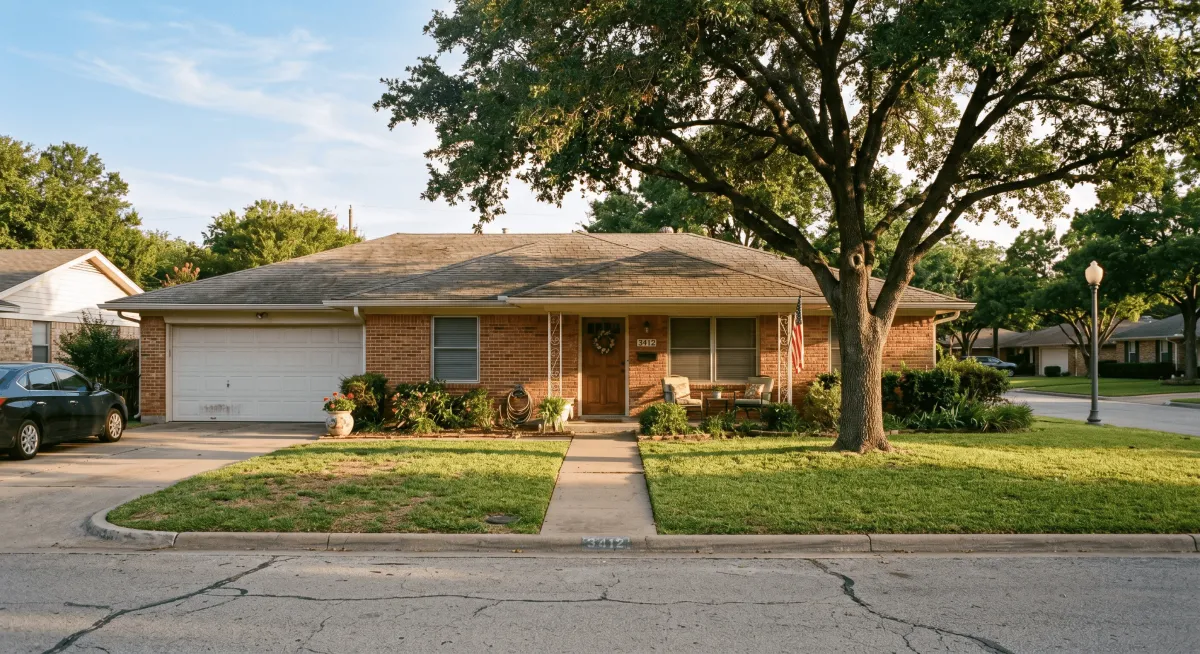
How Long Will Mom's House Pay for Assisted Living? The Math Behind Sell vs. Rent vs. Stay Home
How long will Mom's house actually pay for assisted living? Should we sell it now, or rent it out to offset the monthly bill? Is it cheaper to just keep her home with a caregiver? What happens when the money runs out — does Medicaid take the house? Will we owe a fortune in capital gains taxes if we sell? Do we need to fix it up first, or will a cash buyer rip us off?
If you're sitting at the kitchen table with three browser tabs open trying to make this math add up, you're not alone. You're asking the right questions — they just don't have one tidy answer. The truth is, you don't have one decision to make. You have three. And the math is different for each.
This guide walks through what each door actually costs in Dallas-Fort Worth dollars, where most families lose money without realizing it, and how to run your specific numbers in about five minutes. By the end, you'll know which path the math actually supports — not which one feels less scary.
What This Post Will Show You
- Net home sale proceeds typically cover 1 to 4 years of assisted living in DFW — but the range depends on equity, care level, and income offsets like Social Security
- Renting Mom's house sounds smart, but DFW vacancy hit a 20-year high at 12.2% in early 2026 — many families net less than zero in Year 1 after all costs
- 24/7 in-home care in DFW runs $15K–$30K per month, often 2–3× more than memory care
- The real cash-vs-traditional sale gap is usually $5K–$15K, often consumed by 2–3 months of care costs during a traditional sale timeline
- The biggest financial mistake families make isn't picking the wrong door — it's waiting until a crisis forces the decision
Let's Say the Quiet Part Out Loud
Before we dive into numbers, let's acknowledge what nobody wants to admit out loud: you're not making this decision in a calm boardroom. You're making it at 11pm after another phone call from Mom's neighbor. You're making it three days after a fall, or a week after a hospital discharge, or six weeks into watching Dad get lost on the way home from the grocery store.
And the house? It's not just an asset. It's 40 years of Christmases. It's the room your kids slept in. It's the kitchen where Mom learned to cook. The fact that a calculator is about to spit out a number for it can feel offensive to all of that.
You're not betraying anyone by running the numbers. The opposite is true — doing this math is how you make sure the money lasts long enough to keep Mom safe. We've sat with hundreds of families doing exactly what you're doing right now. The guilt is normal. So is the exhaustion. So is the feeling that no decision feels right.
The good news: this is one of the few parts of caregiving where you can actually get clear. You can't fix Mom's diagnosis. You can't undo what Dad said at Thanksgiving. But you can know — in actual dollars — what each path costs, and how long the money lasts. That clarity doesn't make the rest of it easy. It just makes one big piece of it manageable. If the guilt is what's stopping you from even running the math, this might help: Overcoming the Guilt of Moving a Parent to Senior Living.
The Real Answer: 1 to 4 Years (But Three Things Change It)
If you Google "how long will Mom's house pay for assisted living," you'll get a quick answer: roughly 1 to 4 years. That's not wrong. It's just unhelpfully vague for your actual family.
Three variables move the needle dramatically:
1. How much equity is actually in the house
Federal Reserve data shows median home equity for homeowners 65+ hit $250,000 — a 47% jump from pre-pandemic levels. But here's the part most families don't realize: nearly 30% of homeowners aged 75 and older are still carrying an active mortgage, with an inflation-adjusted median balance over $106,000. The "net proceeds" number — what actually hits the bank after commissions, closing costs, and any mortgage payoff — is often very different from the appraisal.
2. Which level of care
Care costs in DFW have climbed steeply since 2023. Here's where the 2025–2026 numbers land:
| Care Setting (DFW Metroplex) | Monthly Median | Annual Cost |
|---|---|---|
| Assisted Living (base rate) | $5,350 | $64,200 |
| Memory Care (base rate) | $6,681 | $80,172 |
| Memory Care (with care tier surcharges) | $8,181 | $98,172 |
| Skilled Nursing (semi-private, Texas) | $5,323 | $63,876 |
| Skilled Nursing (private, Texas) | $7,178 | $86,136 |
And remember: most DFW communities also charge a non-refundable community fee of $2,500–$5,000 upfront. Care-level surcharges add $500–$2,500 per month as needs increase (medication management, two-person transfers, behavioral interventions for sundowning). Annual rate increases run 3–5%.
3. What income is already coming in
This is the variable most families forget to factor. Social Security, a pension, RMDs, VA benefits — every dollar of fixed income reduces what the house has to cover. A senior with $3,000/month in income only needs the house to bridge a $2,350 monthly gap for assisted living, not the full $5,350.
Here's what that looks like across different equity levels, assuming a typical $3,000/month income offset:
| Net Home Sale Proceeds | Assisted Living Coverage | Memory Care Coverage |
|---|---|---|
| $200,000 | ~7.0 years | ~3.2 years |
| $300,000 | ~10.6 years | ~4.8 years |
| $400,000 | ~14.1 years | ~6.4 years |
| $500,000 | ~17.7 years | ~8.0 years |
Without any income offset — if every dollar of care has to come from home equity alone — those timelines roughly cut in half. $200,000 covers about 3.1 years of AL or 2 years of memory care.
The math gets specific to your family fast. Rather than guess where you fall, you can plug your actual numbers into our calculator and see your exact runway in under five minutes:
If you want a deeper read on why DFW care costs run where they do, our breakdown of assisted living costs in Dallas-Fort Worth walks through the full picture.
Door #1: Selling the Home
Most families walk into this conversation with one big fear: if we sell to a cash buyer, we're getting lowballed. Then they hear "we'll buy your house in 7 days" and assume they're losing $100,000 versus listing it traditionally.
Here's the math that proves the gap is almost always smaller than it looks — and sometimes nonexistent once you factor in everything.
The 75-80% reality nobody mentions
An outdated, deferred-maintenance home owned by an aging parent does not sell for the same price as a move-in-ready comp down the street. The market discounts it — typically to 75–80% of what an updated version would fetch. That's not a cash-buyer trick. That's what a traditional buyer's agent will tell you when they walk through and start calculating concessions.
Texas A&M Real Estate Research Center data confirms the lower-mid market segment ($250K–$350K) — exactly where most senior-owned homes sit — saw transaction volume decline 2.8% year-over-year, with active listings up nearly 30% and a 4.5-month inventory supply (a 10-year high). Translation: a dated home in DFW is sitting longer and competing harder than it was two years ago.
The honest side-by-side
| Cost Component | Traditional Sale (MLS) | Cash Sale |
|---|---|---|
| Gross price | ~100% of FMV (outdated comps) | 70–80% of After-Repair Value |
| Agent commission | 5–6% | 0% |
| Seller closing costs | 1–2% | 0% (buyer absorbs) |
| Inspection concessions | Variable (foundation, roof, plumbing) | None — sold as-is |
| Time to closing | 90–120 days | 7–14 days |
| Parallel care costs during sale | $16,000–$32,000 out of pocket | $0 |
When you actually run the comparison on the same outdated home, the difference in net proceeds usually lands between $5,000 and $15,000 — often fully consumed by 2 to 3 months of care costs paid out of pocket while waiting for the traditional sale to close. Add the risk of buyer financing falling through after the inspection comes back ugly, and that "extra money" disappears entirely.
This doesn't mean selling to a cash buyer is always the right call. If the home is in decent shape, has a sound foundation (always a question in DFW with our expansive clay soil), and the family has time to wait, listing traditionally can absolutely be the better play. Our piece on whether to renovate before selling the family home walks through when repairs make financial sense — and when they're throwing money at a problem.
The point isn't "always sell for cash." The point is: when you compare apples-to-apples (an outdated home, sold as-is, versus an outdated home, sold traditionally with all the real costs included), the math is far closer than the marketing on either side suggests. Read more on what you actually lose — and don't lose — in The Truth About Selling Mom's House For Cash.
Door #2: Renting the Home
This is the option that looks smartest on paper. Keep the asset. Generate monthly income. Cover Mom's care from rent instead of touching the principal. It sounds like having your cake and eating it too.
And in some markets, in some years, it works. In DFW in 2026, the math has shifted hard against this strategy for most families. Here's why.
The DFW rental market reality
As of February 2026, the DFW metro-wide rental vacancy rate hit 12.2% — a 20-year high. Realtor.com data shows single-family rental vacancy at 10.5%, with year-over-year rent growth at negative 2.5%. Landlords in outlying suburbs are offering 6–12 weeks of free rent to fill units. Average asking rent for a 3-bedroom single-family home sits at $2,173/month.
Losing a single month to vacancy eliminates more than 8% of your gross annual rental income. In a soft market, that month can stretch to three.
What actually eats the gross rent
The $2,173 looks great on paper. Here's what happens to it in real life:
- Property management: 8–12% of gross rent (most families need this if they're managing care simultaneously)
- Tenant placement fee: 50–100% of first month's rent each time you change tenants
- Lease renewal fees: $200 to a full month's rent
- Maintenance reserves: Industry benchmark is 1.5× monthly rent annually (roughly $3,300 on a $2,200 rental)
- Property taxes and insurance: Often $7,000–$10,000+ annually in DFW
- Turn costs to bring a 30+ year-owned home up to rentable code: Routinely $15,000+ (outdated electrical, dated plumbing, HVAC replacement, paint, flooring, code compliance)
- Catastrophic tenant damage: Average $3,800 per incident in DFW
The tax trap most families don't see coming
Converting Mom's primary residence into a rental property can quietly disqualify her from the IRS Section 121 capital gains exclusion ($250K single / $500K married). If she doesn't satisfy the "lived in the home 2 of the last 5 years" test at the time of eventual sale, the exclusion phases down based on how much of the ownership period was "nonqualified use." On top of that, any depreciation you claim during the rental period is subject to a flat 25% recapture tax that can't be excluded.
The legal landmines in Texas
Texas Property Code carries real teeth. Mishandling a tenant security deposit can expose the estate to penalties of three times the deposit plus attorney fees. Federal Fair Housing violations top $19,787 for a first offense. Many DFW suburbs also require formal rental property registration and city occupancy inspections. The remote-landlord-during-a-care-crisis scenario is where most families get caught off guard.
What this actually looks like
Scenario: The rental that lost money
A Tarrant County family declines a $255,000 cash offer on Mom's outdated $340,000 Fort Worth home. They list it for rent at $2,200/month. The property needs $15,000 in upfront updates to meet landlord insurance standards. Once on the market, it sits vacant for three months due to the 12.2% regional vacancy rate. When a tenant is finally placed, the management company takes 10% ($220/month), and the placement fee consumes a full month's rent.
By year-end, the family collected $19,800 in gross rent — but spent $15,000 on renovations, $1,980 on management fees, $2,200 on placement, $7,638 on taxes and insurance, and $3,300 on maintenance reserves. Net Year 1 operating result: negative $10,318. Meanwhile, they were still funding Mom's $4,681 monthly memory care gap out of personal savings.
Renting can work — for a senior-owned home in pristine condition, with a spouse still living in it, or in a tight rental market. The detailed playbook for when it does work (and how to set it up properly) is in our piece on transforming a parent's home into care-funding rental income. Just don't default into it because selling feels too final. The math is rarely on your side in DFW right now.
Door #3: Keeping Mom or Dad at Home
This is the door most families want to walk through. The house is paid off. Mom built her life there. She doesn't want to leave. Surely it's cheaper to bring care to her than move her into a facility — right?
Sometimes. Often, no. Here's the math.
DFW in-home care rates (2025–2026)
Non-medical home care agencies in DFW currently bill $25–$27 per hour — actually below the national median of $35. That looks affordable on paper.
The trouble starts when you stack the hours:
| Care Schedule | Monthly Cost (DFW) |
|---|---|
| Part-time (20 hrs/week) | ~$1,950 |
| Daytime support (44 hrs/week) | ~$4,700–$5,720 |
| Extended (60 hrs/week) | ~$6,500 |
| 24/7 agency coverage | $15,000–$30,000 |
The Texas average for comprehensive 24/7 specialized clinical home care lands around $20,385 per month — meaning round-the-clock in-home care typically costs two to three times more than a dedicated memory care facility.
The 40–50 hour tipping point
Geriatric care research and our own family data converge on the same number: somewhere around 40 to 50 hours of weekly care, a community becomes more economically efficient than home care. At 60 hours/week, the in-home invoice hits $6,500 — already exceeding the $5,350 DFW assisted living median, which includes room, board, meals, activities, and 24/7 staff presence.
For a side-by-side specific to dementia care, see In-Home Dementia Care Costs in DFW: $15K–$30K/Month vs. Memory Care ($5K–$7K).
The hidden costs of staying home
The agency invoice isn't the whole bill. The house keeps generating fixed costs whether or not Mom is mentally there to enjoy them:
- Property taxes: Among the highest in the nation across DFW counties (more on that below)
- Homeowners insurance: Premiums climbing fast in Texas
- Utilities: Texas climate extremes mean serious cooling and heating bills
- Maintenance: A senior-owned home still needs roof, plumbing, HVAC, and exterior upkeep
- Home modifications: Ramps, doorway widening, roll-in showers, grab bars, stairlifts — typically $5,000 to $20,000+
The risks that aren't on a spreadsheet
Three operational realities families underestimate:
1. Caregiver turnover runs 79.2% annually. That means a revolving door of new people walking into Mom's home — confusing for anyone with cognitive decline.
2. 60% of dementia patients wander. Standard door locks don't compare to a memory care community's delayed-egress doors and secure perimeters.
3. Fall rates are higher at home. Un-modified single-family homes with stairs, tile floors, and aged bathrooms remain the most common scene of senior falls.
Scenario: The tipping point caught a family off guard
An 82-year-old Dallas County father with moderate Alzheimer's starts at 30 hours of in-home care per week — about $3,250/month. Manageable. Over 12 months, his cognitive decline accelerates. Sundowning starts. He begins trying to leave the house at 2am. The family bumps care to 60 hours/week ($6,500/month) — already more than memory care would cost.
Then five different caregivers rotate through in a single quarter due to industry turnover. The agitation worsens. One night, he falls in the un-modified hallway. Emergency hospitalization. Skilled nursing transfer. The family ends up placing him in the only facility with same-day availability — not the one they would have chosen with even two weeks of planning.
Staying home works beautifully for the right situation: stable health, manageable care needs under 40 hours/week, an accessible home, and family within reach. For most progressing dementia cases, the math (and the safety calculus) eventually flips. For a deeper look at the cost comparison, see Memory Care vs. In-Home Care: The True Cost Comparison Guide for Families.
The Funding Stack Most Families Don't Know Exists
Here's the part of the conversation that changes the math dramatically: the house isn't the only source of funding. Most families who navigate this well end up stacking 2 to 4 income streams. The same $300,000 in net home proceeds that lasts 4 years for one family can last 15 for another — purely because the second family found benefits the first didn't know existed.
VA Aid & Attendance — the most-missed benefit in DFW
If Mom or Dad served in the military during a wartime period — even one day of active duty during a defined wartime window qualifies — they may be entitled to a tax-free monthly pension specifically designed to help pay for long-term care. For December 2025 through November 2026, the maximum benefits are:
| Beneficiary Status | 2026 Max Monthly Benefit |
|---|---|
| Single wartime veteran | $2,424 |
| Married wartime veteran | $2,874 |
| Surviving spouse of wartime veteran | $1,558 |
| Two married veterans (both qualifying) | $3,845 |
Care costs (assisted living, in-home care, memory care) count as Unreimbursed Medical Expenses, which means many seniors with what looks like "too much income" still qualify after the medical expense deduction. The VA enforces its own 36-month look-back on asset transfers — separate from Medicaid's 5-year window. Full breakdown: Can't Afford Assisted Living? This Overlooked VA Benefit Could Help.
Bridge financing — the timing solution nobody mentions
The most common funding crisis we see isn't "we don't have enough" — it's "we don't have it yet." Mom needs to move into memory care this week. The house won't sell for 60–90 days. The community wants $4,000–$8,000 in non-refundable move-in fees plus the first month's rent today.
Senior care bridge loans solve exactly this gap. Short-term (1 to 18 months), funds disburse directly to the care community, deferred payment options, and the principal gets repaid from the home sale proceeds at closing. They allow co-borrowers, so adult children can stack credit profiles to make the math work even when the senior's individual profile won't. More detail: How Families Actually Move Into Senior Living This Week.
Reverse mortgages — useful, but watch the trap
Home Equity Conversion Mortgages (HECMs) let homeowners 62+ convert equity into cash, monthly tenure payments, or a line of credit with no monthly payment due. They work well in split-care situations — one spouse needs memory care, the other stays in the home. They do not work if both homeowners vacate the home. Federal rules treat the home as vacant after 12 consecutive months of non-occupancy, triggering loan acceleration. The whole balance becomes due immediately.
Medicaid — with the honest framing
This is where the most damaging myths live. Texas Medicaid does not "take the house" while a senior is alive. The home is exempt as long as a spouse, dependent child, or disabled child resides in it, or as long as the senior files an "intent to return" statement. For 2026, the home equity ceiling is $752,000.
What you do need to know: Texas enforces a strict 60-month look-back period on asset transfers, with a penalty divisor (as of September 2025) of $262.37 per day. Translation: gifting $19,000 to a grandchild within five years of needing Medicaid creates a 72-day ineligibility window. Texas Medicaid Estate Recovery (MERP) can file post-mortem claims, but surviving spouses, disabled children, and hardship cases are protected. Selling the home too early can actually disqualify Mom from Medicaid by converting an exempt asset into countable cash she has to spend down. More: Texas Medicaid, Medicare, and Long-Term Care: Clearing the Confusion.
Texas senior property tax tools
Often overlooked: Texas allows homeowners 65+ to lock in a school district property tax ceiling that never increases. They can also defer property taxes entirely — the unpaid amount accrues as a 5% compounding lien against the home, settled at sale. This can free up $200–$500/month for care without selling. Details: Senior Property Tax Deferral: A Guide to Lowering Living Expenses.
Three Myths That Cost Families Real Money
Myth #1: "Medicaid will take Mom's house if we don't sell it now."
Reality: Texas treats the primary home as an exempt asset during the senior's life, as long as she files an intent-to-return statement (or a spouse/disabled child lives there). MERP claims happen post-mortem with major exceptions. Selling too early can actually disqualify Mom from Medicaid by converting protected real estate into countable cash. Real strategy comes from sequence, not panic. See How to Avoid Texas Medicaid Estate Recovery: MERP Protection Strategies That Work.
Myth #2: "If we sell, we'll owe huge capital gains taxes."
Reality: IRS Section 121 excludes the first $250,000 of capital gains for single filers, $500,000 for married couples. And there's a little-known carve-out under Section 121(d)(7): when a senior moves to a state-licensed care facility due to physical or mental decline, the residency requirement drops to just 12 months out of the prior 5 years. That means Mom can be in assisted living for 3+ years with the house sitting empty, and the full exclusion still applies. Texas has no state income tax. For most families, the tax owed is $0.
Myth #3: "Renting is always smarter than selling — you keep the asset."
Reality: In a 12.2% vacancy DFW market with falling rents, an outdated property requiring $15K+ in turn costs often loses money in Year 1 before factoring care expenses. Renting works for specific situations — pristine homes, surviving spouse still residing, healthy rental submarkets. It's not a default win.
Myth #4 (bonus): "We should fix it up first to get top dollar."
Reality: For a 30+ year-owned senior home with significant deferred maintenance, repair-to-sale-price ROI is usually negative. Outdated homes sell for 75–80% of move-in-ready comps either way. The question becomes: how long do you want to wait, and how much capital do you want to deploy?
Running Your Numbers: What the Calculator Actually Shows You
Everything in this post comes together in one place — our Senior Care Financial Options Calculator. It's free, no email required to use, and walks through all three doors side-by-side. What you'll see:
- How much real net equity exists in the home after mortgage payoff, selling costs, and any repair concessions
- Monthly out-of-pocket for each path after your specific income offsets
- How long the proceeds last under each scenario, with adjustable family contribution
- The selling path that fits your timeline — fast cash, as-is market sale, or traditional move-in-ready
Here's what stacking the funding actually looks like in practice:
Scenario: How $400,000 in equity turned into 50+ years of care
A 76-year-old wartime veteran in Collin County needs to move into a Southlake-area assisted living community at $5,500/month. He receives $2,200/month in Social Security. His home is appraised at $500,000 with a $100,000 mortgage — leaving $400,000 in raw equity.
Rather than wait, the family uses a 12-month bridge loan to fund initial care fees while the home is professionally listed. The property sells within 90 days for full appraised value. After 6% commission ($30,000), $7,500 in closing costs, and the $100,000 mortgage payoff, they net $262,500 in clean liquid proceeds.
Simultaneously, an elder law attorney files for VA Aid & Attendance. Because the $5,500 monthly care invoice counts as an Unreimbursed Medical Expense, his countable income drops to $0 — qualifying him for the maximum benefit of $2,874/month.
Stacked monthly income: $2,200 (Social Security) + $2,874 (VA A&A) = $5,074. Monthly care gap: $426. At that draw rate, $262,500 lasts more than 50 years. Same house. Same diagnosis. Completely different outcome — because the funding was stacked.
The Sequencing That Prevents the Crisis Trap
The single most expensive financial mistake families make in this entire process isn't picking the wrong door — it's picking any door while in crisis mode. When a fall, a hospital discharge, or a wandering incident forces a same-week decision, families consistently land at worse facilities, lower sale prices, and missed benefits.
Here's the order that protects both Mom and the math:
Step 1: Clinical assessment first
What level of care does Mom actually need? A professional geriatric care assessment — not a guess based on how she seemed at Thanksgiving — establishes the care setting. The setting determines monthly cost. Monthly cost determines funding strategy. Skip this step and you'll over- or under-spend by tens of thousands of dollars per year.
Step 2: Legal architecture second
Durable Power of Attorney with explicit Texas Estates Code language must be executed while Mom still has full cognitive capacity. Without it, families face slow, expensive court-supervised guardianship proceedings — frozen bank accounts, blocked real estate transactions, and months of delay during a healthcare crisis. More: Can You Sell Mom's House If She Has Dementia? Power of Attorney vs. Guardianship Options.
Step 3: Income stacking third
Map every source of monthly income before the house even comes into the conversation: Social Security, pensions, RMDs, VA Aid & Attendance, long-term care insurance, life settlement potential, Texas property tax deferral. This step alone has changed care timelines from "we'll run out in 18 months" to "we're fine for a decade" for dozens of families we've worked with.
Step 4: Asset liquidation last
With the first three locked in, the home sale becomes a strategic decision instead of a panic move. You know exactly what gap you're covering, exactly when you need the funds, and exactly which selling path fits the timeline. The "should we sell or rent" question answers itself once steps 1–3 are clear.
Families who'd love a roadmap for this whole process should read Why Every Family Needs an Aging Plan (and How to Make One). It's the single piece we wish every family had read three years before they actually needed it.
For the Person Doing This Math: A Word
You've spent the last few hours — or weeks, or months — running numbers, taking calls, scheduling tours, and Googling things like "how long will Mom's house pay for assisted living." That's caregiving work, even if it doesn't feel like it. It's invisible, it's exhausting, and nobody is going to thank you for the spreadsheet you built at midnight.
The math we've walked through here doesn't replace the grief of watching a parent change. It doesn't undo a sibling who isn't helping. It doesn't make the phone calls easier. What it does do is take one piece of this — the financial one — off your shoulders. You don't need to hold the whole picture in your head. You don't need to be your own financial planner, real estate agent, elder law attorney, and home care manager all at once.
If you're past tired and into something that feels more like collapse, please read Taking Care of My Mom Is Killing Me. You're not weak. You're carrying something most people will never have to carry, and you're allowed to ask for help.
Put the calculator down for tonight if you need to. It'll be there tomorrow.
Frequently Asked Questions
Do I have to sell my mom's house to pay for her care?
No — but waiting can limit your options. The home is typically exempt under Texas Medicaid rules during her lifetime, and renting, reverse mortgage, or bridge financing can sometimes cover the gap. That said, most families ultimately do liquidate the home, because rental math rarely works in the current DFW market and reverse mortgages have a 12-month occupancy trap. The right answer depends on her specific care timeline, income, and the home's condition.
How long will $300,000 in home equity actually pay for assisted living?
With a typical $3,000/month income offset from Social Security, $300,000 covers roughly 10.6 years of DFW assisted living or 4.8 years of memory care. With zero income offset, those drop to about 4.7 years AL and 3.1 years memory care. The calculator will show your exact number based on income, care level, and burn rate.
What happens when Mom runs out of money in assisted living?
The transition typically goes one of three directions: (1) Medicaid spend-down and qualification for the Texas STAR+PLUS waiver, which covers some care services but not room and board; (2) family financial contribution to maintain her current placement; or (3) relocation to a Medicaid-accepting facility, which may be a downgrade in setting. Planning for this transition years in advance is the difference between a smooth shift and a forced move during an already difficult time.
Is it cheaper to keep Mom at home or move her to assisted living?
It depends almost entirely on how many hours of care she needs. Under about 40 hours per week, home care usually wins on raw cost. Beyond 40–50 hours per week, assisted living becomes more economically efficient because facility pricing bundles 24/7 staff coverage, meals, housekeeping, and activities into a single rate. For most progressing dementia cases, the math eventually tips toward a community.
Will I owe capital gains tax when I sell Mom's house?
Probably not. IRS Section 121 excludes the first $250,000 of gain for single filers and $500,000 for married couples. A special carve-out under Section 121(d)(7) drops the residency requirement to just 12 months out of the prior 5 years when the senior moves to a state-licensed care facility — meaning the exclusion still applies even after Mom has been in assisted living for 3+ years. Texas has no state income tax. The vast majority of families owe zero federal tax on a parent's home sale.
Should we sell to a cash buyer or list with an agent?
For an outdated home with deferred maintenance, the real net difference between a cash sale and a traditional sale is usually $5,000 to $15,000 — often fully consumed by 2–3 months of care costs paid out of pocket during the traditional sale timeline. For a home in good shape with no foundation, plumbing, or roof issues, traditional listing often wins. The honest answer requires walking through your specific home, current market conditions, and care timeline.
Can Medicaid or a nursing home "take" Mom's house?
Not during her lifetime. Texas Medicaid exempts the primary home as long as she files an "intent to return" statement, or as long as a spouse, minor child, or disabled child lives there. After her death, Texas Medicaid Estate Recovery (MERP) can file a claim against the estate for long-term care costs paid after age 55 — but there are major exceptions (surviving spouse, disabled child, hardship waivers). Selling too soon can actually disqualify her from Medicaid by converting protected real estate into countable cash.
Whichever Door You Walk Through, You Deserve to See the Numbers First
You Don't Have to Choose Between Fast and Fair
Three doors. Different costs. Different timelines. Different right answers depending on your family's specific math. The worst thing you can do is guess — or let a crisis pick the door for you.
Use the calculator to run your specific numbers. Or, if you'd rather talk through what you're seeing with someone who's sat with hundreds of families in exactly this spot, the Care Plan Assessment is a starting place.