
How to Pay for Memory Care With No Money: 7 Real Options DFW Families Use
How to Pay for Memory Care With No Money: 7 Real Options DFW Families Use
No long-term care insurance? No fat savings account? Social Security barely covers a third of the bill? Mom is wandering the neighborhood at 3am and you need placement this month — not in six months after you've "figured out the finances"?
You're not the only one staring at a $6,500 monthly memory care invoice wondering where on earth the money is supposed to come from. Most families land here. Dementia doesn't wait for financial readiness, and nobody budgets for a disease that can require five to ten years of round-the-clock specialized care.
Here's the truth nobody in senior living marketing wants to say out loud: there's rarely a single solution that covers everything. The families who make this work — who get their parent into a safe, quality memory care community without going bankrupt — almost always combine two or three funding sources. And the sooner you understand what those sources are, the more options you actually have.
This guide walks through seven real strategies that DFW families are using right now. Some you've probably heard of. A few might surprise you. And at least one is probably sitting right under your nose.
Key Takeaways
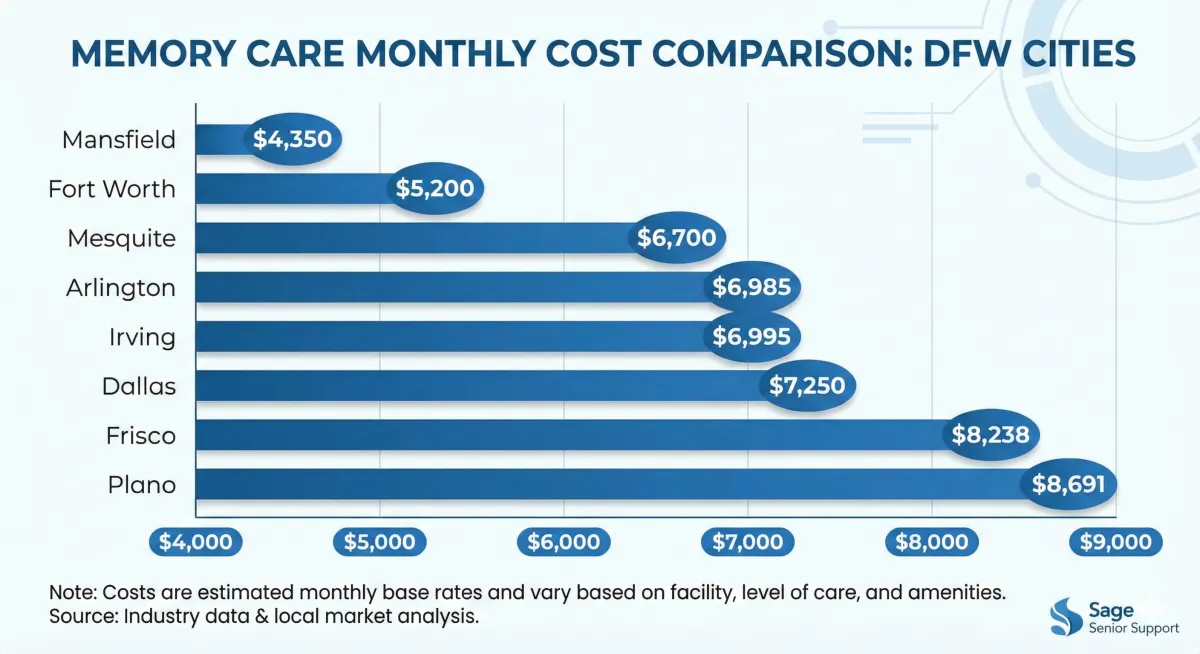
- Memory care in Dallas-Fort Worth ranges from $4,350 to $8,691 per month depending on location — and that's before "level of care" add-ons
- Most families combine two or three funding sources because there's rarely one silver bullet
- Your parent's home is likely their largest asset and can fund three or more years of care if handled correctly
- VA Aid & Attendance pays up to $2,424 per month, and fewer than one-third of eligible families are claiming it
- Texas Medicaid can cover memory care, but the timing of a home sale can make or break eligibility
- You don't have to figure this out alone — and you don't have to choose between fast and fair
If you're reading this at midnight doing math on the back of an envelope — trying to figure out how your mom's $2,071 Social Security check is supposed to cover a $6,746 memory care bill — you're not bad at money. You're dealing with an impossible equation that millions of families face. The gap between what your parent has and what memory care costs is not your fault. And there are more paths forward than you think.
The Reality Check: What Memory Care Actually Costs in DFW
Before we talk about funding, you need to know exactly what you're up against. Memory care is more expensive than standard assisted living because it requires lower staff-to-resident ratios, specialized dementia training, secure building designs to prevent wandering, and structured programming that standard communities don't offer.
Nationally, the median cost of memory care sits between $6,450 and $8,019 per month depending on the source. Texas runs slightly below the national average, with a statewide median of $6,063 to $6,684 per month for 2026. But within the DFW metroplex, the range is dramatic.
| DFW City | Avg. Monthly Memory Care Cost |
|---|---|
| Dallas | $8,691 |
| Southlake | $8,165 |
| Midlothian | $7,915 |
| Plano | $7,500 |
| Irving | $6,995 |
| Arlington | $6,985 |
| Fort Worth | $6,746 |
| Haltom City | $6,625 |
| Weatherford | $5,456 |
| Burleson | $5,455 |
| Carrollton | $5,195 |
| Mansfield | $4,350 |
Those numbers are the base rate. Many families get blindsided by "level of care" charges — extra monthly fees for medication management, incontinence care, or assistance with physical transfers. A community quoting $6,000 per month can quickly climb to $8,000 or more once these add-ons are factored in. Always ask what's included in the base rate and what's billed separately before signing anything.
You should also budget for move-in costs. Roughly 58% of Texas memory care communities charge a non-refundable community fee ranging from $1,000 to $5,000. This covers administrative intake, initial nursing assessments, and unit preparation.
If you're trying to understand why assisted living costs so much in Dallas-Fort Worth, these same dynamics apply — memory care just adds another layer on top. The typical premium for memory care over standard assisted living runs 15% to 25%, which translates to an additional $650 to $1,338 per month in Texas.
Want to see how these costs compare to keeping your parent at home with in-home care? Our Home Care vs. Senior Facility Calculator can help you compare the real numbers side by side.
Not sure what level of care your parent needs? Our free assessment walks you through the decision — no pressure, no sales pitch.
Option 1: Social Security and Pension Income — The Foundation
Let's start with what your parent likely already has. As of 2026, the average Social Security retirement benefit is approximately $2,071 per month. Against a $6,746 memory care bill in Fort Worth, that leaves a gap of over $4,600 every single month. Social Security covers roughly 30% of the average DFW memory care bill.
Think of it as the foundation you build everything else on top of — not the ceiling. For parents with very low income, Supplemental Security Income (SSI) at approximately $967 per month often serves as a gateway to full Medicaid eligibility, which opens up significantly more coverage.
Don't look at Social Security in isolation and assume you can't afford care. The families who make this work stack multiple income sources together.
Option 2: VA Aid & Attendance — The Benefit Most Families Miss
If your parent or their late spouse served in the military, stop everything and read this section carefully. The VA Aid & Attendance benefit is one of the most powerful — and most underused — funding sources for memory care in America. Fewer than one-third of eligible veterans and surviving spouses are claiming it.
To qualify, the veteran needs 90 days of active duty service with at least one day during a recognized wartime period — World War II, Korea, Vietnam, or the Gulf War era. They do not need to have been in combat. They do not need a service-connected disability. And critically, surviving spouses of veterans are also eligible, even decades after the veteran has passed.
The clinical requirement is straightforward: the applicant needs help with activities of daily living like bathing, dressing, or protection from hazards in their environment. Virtually every memory care resident meets this standard.
| Recipient Type | 2025 Max Monthly Benefit | 2026 Max Monthly Benefit |
|---|---|---|
| Single Veteran | $2,358 | $2,424 |
| Married Veteran | $2,795 | $2,874 |
| Surviving Spouse | $1,515 | $1,558 |
| Veteran with Ill Spouse | $1,851 | $1,903 |
Here's what makes Aid & Attendance especially powerful for families with "no money": the VA uses a net worth limit of $163,699 for eligibility. But they deduct unreimbursed medical expenses — including the full cost of a memory care facility — from the applicant's income. A veteran with $6,000 in monthly income but $7,000 in monthly memory care costs may be viewed as having zero income for eligibility purposes.
The application process typically takes four to six months, which feels like forever when you're paying out of pocket. But benefits are retroactive to the first day of the month following the application. So if your parent qualifies, you'll receive a lump-sum back payment covering those waiting months.
One important caution: the VA enforces a three-year look-back period on asset transfers. Gifting money to family members or selling a home below fair market value within 36 months of applying will trigger a penalty. Plan accordingly.
A DFW family we worked with was helping a friend who had been abandoned by her family and was rapidly declining with dementia. During our home walkthrough, we asked a simple question: was her late husband a veteran? He was. She had never heard of Aid & Attendance surviving spouse benefits. We connected her with a local attorney who helped secure the benefit — additional monthly income that directly reduced her memory care costs. Sometimes the biggest financial wins come from asking the right questions.
For a deeper look at how this benefit works and how to apply, read our guide on VA Aid & Attendance: the overlooked benefit that could help your family afford care. And if your parent is a surviving spouse, our post on the two income tests most widows miss walks through the specific eligibility details.
Want to understand all your funding options in one place? Our free eBook breaks down every path to paying for long-term care.
Option 3: Texas Medicaid — The Safety Net (With Strings Attached)
Medicaid is the program most families eventually land on. It's the financial safety net for seniors who have exhausted their resources. But in Texas, which has not expanded Medicaid under the ACA, the rules are among the strictest in the country. Understanding how Medicaid works — and the mistakes that can cost you eligibility — is critical.
Two Pathways to Medicaid-Funded Memory Care
Texas offers two routes for Medicaid to cover memory care, and they work very differently.
Nursing Facility Medicaid is an entitlement. If your parent meets the clinical and financial criteria, the state must provide coverage. There is no waitlist. The catch: it covers care in a skilled nursing home, not a standalone memory care community.
STAR+PLUS HCBS Waiver allows Medicaid to pay for care in an assisted living or memory care facility. But it is not an entitlement — it has a capped number of slots. Texas has approximately 24,000 slots statewide, and once they're full, additional applicants go on an interest list. Wait times can range from a few months to several years depending on legislative funding cycles. Add your parent to the interest list as soon as possible, even if they don't need care yet.
A critical detail: the STAR+PLUS waiver covers services only, not room and board. Your parent's Social Security and pension income will go toward paying the facility's room and board costs. Medicaid covers the care services on top of that.
Financial Eligibility — The Numbers That Matter
| Eligibility Criteria | 2025 Limit | 2026 Limit |
|---|---|---|
| Monthly Gross Income (Single Applicant) | $2,901 | $2,982 |
| Countable Assets (Single Applicant) | $2,000 | $2,000 |
| Monthly Income (Married, Both Applying) | $5,802 | $5,964 |
| Countable Assets (Married, Both Applying) | $3,000 | $3,000 |
If your parent's income exceeds the limit — which many do, especially with pension income — Texas allows a Qualified Income Trust (also called a Miller Trust). This legal instrument channels the excess income into a trust that pays toward care costs, making your parent eligible for Medicaid. An elder law attorney can set one up relatively quickly and affordably.
The Homestead Exemption — This Is Critical
Here's the part that trips up almost every family: your parent's home is generally exempt from Medicaid's asset count as long as they intend to return home (even if that return is unlikely). To preserve this exemption, your parent must sign Form H1245, "Statement of Intent to Return Home." If a spouse or dependent relative still lives in the home, it's exempt regardless of value. For single applicants, the home is exempt up to $752,000 in equity for 2026.
Critical Warning: If you sell your parent's home, the proceeds immediately become a countable asset. This will disqualify your parent from Medicaid until the funds are spent down to $2,000 on care or other exempt items. Before selling a parent's home, talk to an elder law attorney about the Medicaid implications. The timing of a home sale can make or break eligibility.
After your parent passes, Texas has a right to recover Medicaid costs from the estate through the Medicaid Estate Recovery Program, known as MERP. However, Texas law provides protections — most notably through Lady Bird Deeds (Enhanced Life Estate Deeds) or Transfer on Death Deeds. These instruments transfer the property outside of probate, and since MERP currently only targets probate assets in Texas, the home can often be protected from the state's claim.
For the full breakdown of how this works, including the specific protections available under Texas law, read our guide on Texas Medicaid Estate Recovery and protecting your home. And if you're confused about the difference between Medicaid and Medicare, our post on clearing the confusion between Medicaid, Medicare, and long-term care in Texas is worth your time.
Option 4: Selling the Family Home — Unlocking Your Parent's Largest Asset
For most DFW families, the equity in Mom or Dad's home is the single largest financial resource available to pay for memory care. It's also the option that carries the most emotional weight. This is the house where holidays happened, where kids grew up, where decades of memories live in every room.
We understand that. We've been through it ourselves — with our own family.
But here's the math: a $280,000 home can fund more than three years of memory care at $6,500 per month. For many families, the home is the difference between quality care and running out of options.
The Timeline Problem
A traditional home sale in the DFW area can take 90 days or longer from listing to closing. When you're paying $6,500 per month or more for memory care while waiting for the house to sell, a four-month process represents over $26,000 in out-of-pocket costs before you see a dime from the sale.
This is what we call the timeline gap. And it's the reason many families explore a cash sale — closing in 7 to 14 days instead of three to four months.
The Real Cost Comparison
Here's where the math gets honest, and where most online guides get it wrong. They compare a cash offer to the full move-in-ready value of a home, making the gap look enormous. That's not a fair comparison.
The real comparison is between what you'd actually net from a traditional sale of an outdated home (after commissions, closing costs, holding costs, and repairs) versus what you'd net from a cash sale. For a typical DFW home in the $300,000 range that needs updating, the actual difference in net proceeds is usually $5,000 to $15,000.
Now factor in the care costs you're paying during the three to four months a traditional sale takes. At $6,500 per month, three months of care while waiting costs $19,500 — which completely consumes that difference and then some.
That doesn't mean a cash sale is always the right choice. For homes in good condition in desirable neighborhoods, listing with an agent might make more sense. The point is that families deserve to see the real numbers for both paths, not a misleading comparison that steers them in one direction.
You can run the numbers yourself with our Cash Offer Comparison Calculator to see what both options look like for your specific situation.
A family we worked with in Burleson was in exactly this position. Sherwood and his wife were both facing health challenges — he was recovering from a stroke, and she was receiving in-home care. They needed to move into an assisted living community but couldn't cover the $4,000 to $8,000 in upfront move-in deposits. We purchased their home directly AND covered the non-refundable move-in costs, getting them situated within 30 days. For them, it wasn't about getting the absolute highest price — it was about removing the financial roadblock that stood between them and safe care.
Power of Attorney — The Legal Piece You Can't Skip
If your parent has advanced dementia and can no longer sign legal documents, you must have a Statutory Durable Power of Attorney that specifically authorizes the sale of real estate. Without it, the family may need to pursue court-ordered Guardianship — a process that can cost $5,000 to $15,000 in DFW and take months to complete. This is one of the strongest arguments for advance planning: a POA costs a few hundred dollars and takes an afternoon. Guardianship costs a fortune and takes months your parent may not have.
Bridge Loans — Buying Time Without Selling Short
If your family wants to list the home traditionally but can't afford to pay for memory care during the waiting period, bridge loans are worth exploring. Companies like Elderlife Financial offer short-term loans specifically designed for seniors transitioning into care. These loans can be approved in as little as 24 hours, typically have no upfront out-of-pocket costs, and "bridge" the gap between moving into a facility and the eventual sale of the home or the start of VA benefits.
For a deeper dive on this topic, our complete guide covers everything families need to know about selling a parent's home to pay for senior care — including taxes, timing, and your options. And if you're weighing the real costs of a cash sale versus listing with an agent, this honest breakdown of what you actually gain and lose will help.
Wondering what your parent's home could be worth? We'll walk you through the market, explain your options — and if listing with an agent makes more sense, we'll tell you that too.
Option 5: Life Insurance Conversions — The Policy Sitting in a Drawer
Many families don't realize that a life insurance policy — the one that's been sitting in a drawer for decades — can be converted into immediate cash for memory care. There are two main approaches.
Life settlements involve selling a life insurance policy when the insured is typically over 65 and not terminally ill. The policyholder receives more than the cash surrender value but less than the full death benefit. Think of it as selling the policy to a third party who continues paying the premiums and eventually collects the benefit.
Viatical settlements apply when the insured has a chronic or terminal illness — which can include advanced Alzheimer's disease. Because the insured has a shorter life expectancy, viatical settlements typically pay a higher percentage of the face value, often 50% to 80%, and the proceeds are usually tax-free.
To put this in perspective: a $100,000 life insurance policy could unlock $50,000 to $80,000 for memory care. That's 8 to 12 months of coverage in a DFW facility.
Texas has recently passed laws promoting the use of life settlements in connection with Medicaid planning. Under certain conditions, a Medicaid applicant can sell their policy and use the proceeds for long-term care without the policy counting as a disqualifying asset. An elder law attorney can advise on whether this strategy works for your family's situation.
Our guide on using life settlements to fund care in North Texas walks through the process in more detail.
Option 6: Reverse Mortgages — When They Work (And When They Don't)
A reverse mortgage (HECM) allows homeowners 62 and older to tap their home equity without monthly payments. It sounds ideal — but the occupancy requirement creates a major problem for memory care. The home must remain the borrower's primary residence. If the borrower moves out permanently, lenders typically allow a 12-month medical absence before calling the loan due in full.
This makes reverse mortgages a poor long-term solution for a single individual moving into memory care. Where they can work: couples where one spouse stays home while the other moves to care, or families funding in-home care to delay a facility move. Our post on what DFW families should know about reverse mortgages covers the details. For most families facing memory care placement, selling the home outright is more straightforward.
Option 7: Family Contributions and Creative Strategies
When no single funding source is enough — and it rarely is — families get creative.
Pooling resources among siblings. If four siblings can each contribute $1,000 per month, that's $4,000 toward closing the gap. Formalizing this with written agreements prevents resentment and unclear expectations down the road.
Caregiver agreements. If an adult child has been providing care at home, they should have a formal written Caregiver Agreement paying the child a market rate. Without a written contract, Medicaid may view those payments as "gifts," triggering a penalty period that delays eligibility by months.
Renting the family home. This sounds smart on paper, but there are significant Medicaid implications. Net rental income counts toward Medicaid income, and in Texas, nearly all of a Medicaid recipient's income must go to the facility as "patient liability." The rental income may simply reduce what Medicaid pays rather than saving the family money. Talk to an elder law attorney before choosing this path.
Local nonprofit resources. The DFW area has several organizations that provide financial navigation, care coordination, and sometimes direct assistance. We've listed the most useful ones below.
What Actually Happens When the Money Runs Out
This is the question nobody wants to ask out loud: What happens when a memory care resident runs out of money mid-stay?
Under Texas law, a memory care facility can discharge a resident for non-payment. But they must provide 30 days' written notice and a safe discharge plan. They cannot remove a dementia patient without ensuring transfer to a safe location.
The most common path when private funds run out is transitioning to Medicaid. The question you must ask before your parent ever moves in: "Do you have Medicaid-contracted beds, and will you allow a resident to transition from private pay to Medicaid without moving out?" Not all memory care facilities accept Medicaid, and some that do require residents to move to a different wing. Asking upfront prevents a devastating second move later.
The Integrated Strategy: How DFW Families Actually Make It Work
In practice, most families we work with don't rely on a single funding source. They stack multiple income streams to cover the monthly bill. Here's what an integrated strategy often looks like for a DFW family facing a $7,000 monthly memory care bill with limited savings.
With Social Security and VA benefits combined, a family can cover roughly $4,500 of a $7,000 monthly bill. The remaining $2,500 gap is then covered through home equity — either by selling the home outright or by using a bridge loan while the home is listed traditionally.
The five-step playbook:
Step 1: Apply for VA Aid & Attendance immediately if the veteran or surviving spouse qualifies. Benefits are retroactive, so every month of delay is money left on the table.
Step 2: Apply Social Security income toward the care bill.
Step 3: Use home equity to bridge the gap for the first four to six months — either through a quick sale, bridge loan, or family contributions.
Step 4: Initiate a Medicaid spend-down by paying for the facility until countable assets reach $2,000.
Step 5: Transition to the STAR+PLUS waiver (if a slot is available) or to a Medicaid-certified nursing facility. Protect the home from estate recovery with a Lady Bird Deed before or during this process.
This isn't hypothetical. It's the strategy that families across Dallas and Tarrant County are using every week. The key is starting the process early — especially the VA application and the Medicaid interest list — because both have processing delays that can cost families thousands.
Our Senior Care Cost Calculator can help you map out the real numbers for your specific situation, so you're not guessing at what the gap looks like.
Legal Essentials You Cannot Skip
Financial planning for memory care doesn't work without legal planning. And the cost of not planning is always higher than the cost of planning.
Power of Attorney vs. Guardianship. A Durable Power of Attorney costs a few hundred dollars and takes an afternoon with an attorney. If your parent loses the mental capacity to sign documents before a POA is in place, you're looking at court-ordered Guardianship — $5,000 to $15,000 in legal fees in DFW, months of waiting, and ongoing court supervision. Get the POA done now. Today. Before it's an emergency.
Elder law attorneys specialize in exactly these situations. They use tools like irrevocable trusts (to move assets outside the five-year Medicaid look-back), Lady Bird Deeds (to protect the home from estate recovery), and Qualified Income Trusts (to solve the "over-income" problem for Medicaid). A single consultation can save a family tens of thousands of dollars in avoidable mistakes.
The 5-year Medicaid look-back. If your parent has given away money or assets within the past five years, Medicaid will impose a penalty period during which they're ineligible for coverage. This doesn't mean you should panic — it means you should talk to an attorney who can help structure a plan. The sooner you start, the more options you have.
DFW Resources That Can Help Right Now
You don't have to navigate this alone. These North Texas organizations provide free or low-cost support for families dealing with memory care placement and funding.
| Organization | What They Offer |
|---|---|
| Area Agency on Aging — Dallas County | Benefits counseling, care coordination, legal assistance referrals |
| Area Agency on Aging — Tarrant County | Ombudsman services, REACH caregiver support, nutrition programs |
| ADRC of Tarrant County | Long-term care planning, housing assistance, veteran resource specialists |
| Alzheimer's Association — DFW Chapter | 24/7 helpline, support groups, dementia training programs |
| Dementia Friendly Fort Worth | Education and social engagement opportunities for residents and families |
| James L. West Center (Fort Worth) | Specialized dementia care and free family training programs |
| UNT Health Science Center — GILDS Program | Dementia resource specialists providing education and community referrals |
| Sixty and Better (Fort Worth) | Empowerment services and resources for older adults |
The Area Agencies on Aging offer free benefits counseling that can help your family understand the transition from Medicare to Medicaid. If you don't know where to start, calling them is a strong first step. For a broader list, our essential North Texas caregiving resources guide covers even more options.
Feeling overwhelmed by the options? You don't have to sort through this alone. Our care assessment helps you figure out what matters most — and which next step makes sense for your family.
Frequently Asked Questions
What happens when a dementia patient runs out of money in memory care?
The facility must provide 30 days' written notice and a safe discharge plan — they cannot simply remove a resident. Most families transition to Medicaid at this point. The critical step is asking before move-in whether the facility has Medicaid-contracted beds and will allow a resident to convert from private pay to Medicaid without relocating. If the facility doesn't accept Medicaid, your parent will need to transfer to one that does, which means a second disruptive move during an already vulnerable time.
How do you pay for memory care if you have no money?
Most families with limited resources combine multiple funding sources: Social Security income (averaging $2,071 per month), VA Aid & Attendance benefits if the veteran or surviving spouse is eligible (up to $2,424 per month), home equity from selling the parent's house, and ultimately Medicaid once assets are spent down to $2,000. Life insurance conversions, bridge loans, and family contributions can fill gaps along the way. The key is stacking these sources rather than relying on any single one.
Does Medicaid pay for memory care in Texas?
Yes, but through specific pathways. Nursing Facility Medicaid covers care in skilled nursing homes without a waitlist. The STAR+PLUS HCBS Waiver can cover services in an assisted living or memory care facility, but it has limited slots and a waitlist that can range from months to years. Under the STAR+PLUS waiver, the resident's Social Security and pension income goes toward room and board, while Medicaid covers the care services. Financial eligibility requires assets under $2,000 and income under $2,982 per month for 2026 (though a Qualified Income Trust can solve the income issue).
Can I sell my mom's house if she has dementia?
Yes, but only if you have the legal authority to do so. If your mother signed a Statutory Durable Power of Attorney that authorizes real estate transactions while she was still competent, you can sell the home on her behalf. If no POA exists and she is no longer mentally competent to sign one, you'll need to petition the court for Guardianship — a process that costs $5,000 to $15,000 in DFW and can take several months. This is one of the strongest arguments for getting legal documents in order early.
How will Medicaid know if I sell my house?
Medicaid verifies assets during the application process and through periodic reviews. They require bank statements, tax returns, and property records. Proceeds from a home sale appear in bank accounts, which Medicaid reviews. Selling the home isn't inherently disqualifying — but the proceeds become a countable asset that must be spent down on care before Medicaid eligibility can be established. The home itself is generally exempt as long as your parent files an intent to return. The timing of a sale relative to a Medicaid application is something an elder law attorney should guide.
Who is financially responsible for a person with dementia?
In Texas, adult children are not legally required to pay for a parent's care. The individual themselves is primarily responsible. However, a spouse may be financially responsible under Texas community property law. As a practical matter, someone typically needs to manage the financial logistics — applying for benefits, selling assets, coordinating with facilities — even if they're not personally paying the bill. A Durable Power of Attorney or Guardianship gives the designated person the legal authority to manage financial affairs on behalf of someone who can no longer do so themselves.
Does Social Security pay for memory care?
Social Security benefits can be applied toward memory care costs, but they rarely cover the full amount. The average Social Security retirement benefit of approximately $2,071 per month covers about 30% of the typical DFW memory care bill of $6,746. Social Security is best understood as one piece of a larger funding strategy — the base that other sources build upon. When combined with VA benefits, home equity, or Medicaid, the total package can cover the full cost of care.
My mom has dementia and we need money from her house to pay for memory care. Where do we start?
Start with the legal authority, not the house. If your mom can no longer sign for herself, you need a durable power of attorney executed while she still had capacity — or a guardianship, which runs 60–90 days and $3,500–$7,000 in Texas. Families routinely lose two months finding this out late.
Then you're managing two clocks. The facility wants a deposit now; a traditional sale takes three to six months once repairs are in the mix. Families bridge that gap three ways — a cash sale that closes in two to three weeks, a bridge loan against the equity, or a deferred deposit negotiated with the community. Most end up using two of them together.
One caution before you list: if Medicaid is likely within five years, selling the homestead turns a protected asset into countable cash. Ask an elder law attorney about the order of operations first — it's the most expensive mistake we see, and it's entirely avoidable.
You're Not Supposed to Have This Figured Out Already
If you've read this far, you're probably feeling either slightly less panicked because you can see a path forward, or more overwhelmed because there are more moving parts than you expected. Both are normal.
The families who navigate this successfully don't do it because they had more money. They do it because they understood their options early enough to combine them effectively. VA benefits plus Social Security plus home equity plus Medicaid planning — that combination is how real families pay for real care.
Nobody expects you to manage all of this alone. Elder law attorneys handle the legal complexity. Placement agents help find the right community. Your Area Agency on Aging provides free guidance. And when it comes to the house — what to do with it, how to get a fair price, and how to make the timing work — that's where we come in.
We start every conversation the same way: "How's Mom doing?" Because the home sale is never really about the house. It's about making sure your parent is safe, cared for, and comfortable — and making sure you don't lose yourself in the process.
Ready to explore your options? Start with the resources that match where you are right now.