
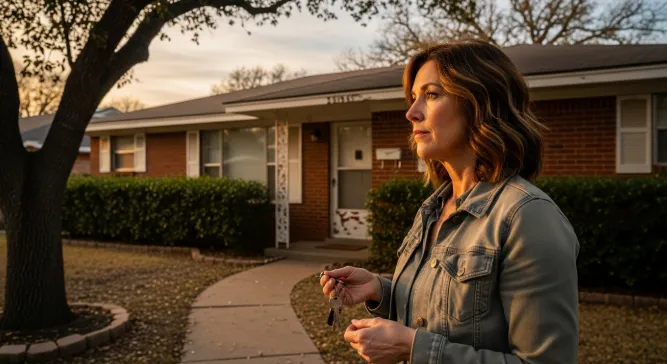
I Inherited a House in Dallas-Fort Worth and Want to Sell It: A Complete Guide for Overwhelmed Families
Key Takeaways
- You don't have to figure this out alone — and you don't have to do it fast
- Texas law gives you options even if there's no will or probate wasn't completed
- The house doesn't need to be "sale ready" — you have more choices than you think
- Selling an inherited home isn't just real estate — it's about honoring a chapter of your family's story
- You can sell fairly AND quickly — those aren't mutually exclusive
- The "stuff" inside is often harder than the sale itself — and that's completely normal
Let's Start With the Truth Nobody Tells You
You're probably reading this late at night, exhausted, googling from your phone while everyone else is asleep. Maybe you just lost a parent. Maybe it's been months and you still can't bring yourself to walk through that front door.
The legal paperwork feels impossible. The house feels like a time capsule frozen in 1995. And the "stuff" — three decades of accumulated life, photos, furniture, memories — feels absolutely insurmountable.
Here's what no checklist will tell you: this is genuinely hard, and it's okay to not know where to start.
You're not behind. You're not failing. You're figuring out real estate transactions and Texas probate law while grieving someone you love — and that's harder than anyone gives you credit for.
A moment of honesty: Every article you've found so far probably jumped straight into "Step 1: File the will." But nobody asked how you're actually doing. So before we get into the practical stuff — take a breath. The house will still be there tomorrow. Your wellbeing matters too.
This guide will walk you through everything: the legal process, your selling options, what to do with all the belongings, and how to make decisions that feel right for your family. We're not going to sugarcoat the hard parts or pretend there's a magic solution. But we will help you see a path forward.
If you're struggling with the emotional weight of all this, you're not alone. Many families in your position are also dealing with the emotional journey of downsizing — whether for themselves or on behalf of a parent who's passed.
What Happens to a House When a Parent Dies in Texas?
Here's the first thing most people don't realize: the house doesn't automatically transfer to you — even if you're named in the will, even if you're the only child, even if your parent told you it was yours.
Texas requires some form of legal process to officially transfer ownership before you can sell. Without this step, no title company will insure the transaction, and no buyer (or their lender) will close.
The good news? You have options. The process isn't always as complicated or expensive as people fear.
The Three Main Paths to Transfer Ownership
1. Probate (The Standard Route)
Probate is the court-supervised process of validating a will, paying debts, and officially transferring assets to heirs. In Texas, most estates use "Independent Administration," which is relatively streamlined compared to other states.
For a simple estate (valid will, no disputes, cooperative family), expect 4 to 8 months from filing to closing. For complex estates (no will, family disagreements, dependent administration), the timeline stretches to 9 to 18+ months.
The key document you're waiting for is called "Letters Testamentary" — this is what proves to title companies and buyers that you have legal authority to sell.
2. Affidavit of Heirship
This is an alternative that some families use to avoid full probate. It's essentially a sworn statement of family history, backed by two witnesses who knew your parent.
The catch: Many title companies are hesitant to insure a sale based solely on an Affidavit of Heirship, especially for recent deaths. By Texas statute, it's only considered solid evidence after being on file for five years. For faster sales, title companies may require additional documentation or refuse to insure altogether.
3. Small Estate Affidavit
This sounds appealing because it's designed for estates under $75,000 (excluding the homestead). But here's the trap: it cannot legally transfer the homestead to adult children. It only works if the home passes to a surviving spouse or minor children.
We've seen families waste months pursuing a Small Estate Affidavit, only to learn they needed full probate all along. If your parent's home is the main asset and you're an adult child, this path likely won't work.
For a deeper dive into these options, our guide comparing probate vs. affidavit of heirship breaks down the pros and cons of each path.
What If There's No Will?
When someone dies without a will (called "intestate"), Texas law determines who inherits — and it's not always straightforward.
If your parent was widowed and you're the only child, you'll likely inherit everything. But if your parent remarried, or had children from multiple relationships, ownership can fracture in unexpected ways. A surviving spouse might own the house jointly with stepchildren. Grandchildren might inherit a share if their parent (your sibling) predeceased your parent.
The result? Multiple people now legally own the property, and everyone must agree to sell. This is where family dynamics can turn a simple transaction into a complicated negotiation.
A story from our experience: Diane came to us as power of attorney for a friend whose husband had passed 10-15 years earlier. The will was never probated. When it came time to sell the home to fund memory care, we discovered there were estranged children who were technically legal heirs. Our title company navigated an Affidavit of Heirship process that accounted for all potential heirs — including ones the family hadn't spoken to in years. It added complexity, but the sale still closed on Diane's timeline.
If you're also navigating executor duties, our Executor's Guide: First Steps When a Parent Dies can help you prioritize what needs to happen first.
The First Things to Do When You Inherit a House
You don't need to make any big decisions right now. But there are a few things that shouldn't wait:
Secure the home. Change the locks if needed. Check on the property regularly — vacant homes attract problems.
Locate the will and any trust documents. Check your parent's files, safe deposit box, and with their attorney if they had one.
Contact a probate attorney or title company. Get clarity on which transfer path makes sense for your situation. Many offer free consultations.
Keep paying the bills. Property taxes, insurance, and utilities don't pause because someone passed. Even before the home is legally in your name, these costs are your responsibility as the heir.
Don't rush to clean out or make decisions. You have more time than it feels like. The emotional pressure to "handle this" is real, but the house will wait.
If You Live Far Away
Many families inherit homes in Dallas-Fort Worth while living in Houston, Austin, or across the country. Managing a property from a distance adds another layer of stress.
Darla's story: Darla lived three hours away from the home she'd inherited. She hadn't seen the property in over a decade — and there was a tenant living there. She didn't know the condition, didn't know the size, didn't know what she was dealing with.
We coordinated with the tenant to access the home, took photos and video, created a floor plan, and put together a full market analysis so Darla could understand the property remotely. Over six months, we helped her work through her options, answered her attorney's questions, and built enough trust that she chose to work with us — even though we weren't the highest offer she received.
You can manage this from a distance. You just need the right support.
Understanding What the House Is Actually Worth
Here's where emotions and reality often collide.
"Mom's house" in your memory might be the place where Christmases happened, where you learned to ride a bike, where your parents built a life. But "Mom's house" in today's market might be a property that hasn't been updated since the Clinton administration.
Most inherited homes in DFW are 15 to 30 years outdated. Oak cabinets. Popcorn ceilings. Original HVAC. Maybe foundation cracks. Maybe cast iron pipes that are one bad day away from failure.
The market value depends on condition — not just location or square footage.
The Uncomfortable Math
In the current DFW market, here's what the numbers look like:
| Metric | Dallas County | Tarrant County (Fort Worth) |
|---|---|---|
| Median Home Price (Move-In Ready) | $385,000 - $390,000 | $325,000 - $348,000 |
| Average Days on Market | 27 - 45 days | 58 - 64 days |
| Homes Selling Below List Price | ~50% | ~58% |
That's for move-in ready homes. Unrenovated homes — the kind most families inherit — typically sell for 15% to 25% less than updated properties in the same neighborhood.
Important Reality Check: If you listed an outdated inherited home traditionally without making repairs, buyers would see the same issues you do. You'd likely receive offers around 75-80% of move-in ready value. Then you'd face inspection negotiations that reduce the price further — or deals that fall through entirely when lenders won't finance homes with foundation or plumbing problems.
This doesn't mean you're stuck with a lowball offer. It means the starting point for realistic expectations isn't the Zillow estimate for a renovated home down the street.
For a detailed breakdown of how these numbers work, our post on understanding assisted living costs in DFW also covers how families use home equity to fund care — and what that actually looks like financially.
Your Three Options for Selling an Inherited House in DFW
You have choices here. The right path depends on your situation — timeline, the home's condition, your bandwidth, and what matters most to you.
Option 1: List With a Real Estate Agent
Best for: Homes in good condition, families with time, those prioritizing maximum price
What to expect: The traditional route takes 90-120 days on average from listing to closing. You'll pay 5.85% to 5.88% in commissions, plus 1-2% in closing costs. In Fort Worth's current market, homes are sitting nearly two months before going under contract.
When it makes sense: The home is relatively updated, you're local enough to manage showings and repairs, and you can afford to carry the property for several months.
When we recommend agents: Deanna came to us through a referral. Her mother's home was built in the early 2000s and was in fairly good shape — just a little outdated. After walking through the market with her and showing her the options, it became clear that listing with an agent would maximize her mother's equity. So that's what we recommended. Not every home is right for a direct sale, and we're not here to pretend otherwise.
Option 2: Sell Directly to a Cash Buyer
Best for: Outdated homes, families who need speed or simplicity, properties with major issues
What to expect: You'll receive a lower price than a traditional sale, but you avoid commissions, repairs, showings, and the risk of deals falling through. Closing can happen in 2-4 weeks.
When it makes sense: You need funds quickly, you're managing from out of town, the home needs significant work, or you simply don't have the bandwidth to manage a traditional sale while dealing with everything else.
David's story: David inherited his uncle's home and was serving as executor. The property had foundation issues, plumbing concerns, and needed a new roof. He explored listing with a real estate agent — a close friend — who reviewed our offer and process. That agent's recommendation? Go with the direct sale. The "ease of transaction" — no inspections, no renegotiations, no repair demands — was worth the tradeoff. We also gave David flexible access to remove belongings before and after closing, at his family's own pace.
Option 3: Renovate and Sell
Best for: Families with capital, time, and project management capacity
What to expect: This can maximize value, but requires 3-6 months and $30,000 to $100,000+ in investment. You're also taking on contractor coordination, permit headaches, and the risk that the market shifts while you're mid-project.
When it makes sense: Rarely, for inherited homes. Most families don't have the bandwidth to manage a major renovation while grieving and handling estate matters.
Our philosophy: Our job isn't to convince you to sell to us. It's to help you understand all your options so you can make the best decision for your family — even if that means listing with an agent or taking more time to decide. You deserve clarity, not pressure.
The Part Everyone Avoids: What to Do With All the Stuff
Let's talk about the thing that keeps most families stuck.
It's not the paperwork. It's not the legal process. It's the stuff.
Thirty, forty, fifty years of accumulated life. Photos in boxes you've never opened. Furniture that's too heavy to move and too sentimental to throw away. Your dad's workshop, still exactly how he left it. Your mom's closet, still full of her clothes.
The guilt of throwing things away. The paralysis of sorting. The grief that hits you when you pick up something small and unexpected.
This is where most families get stuck. Not because they don't know what to do, but because doing it hurts.
Options for Handling Contents
Estate sale companies: They handle everything — pricing, marketing, running the sale. You get a percentage of proceeds (typically 25-35% goes to the company). Good for homes with valuable items.
Senior move managers: Specialists in downsizing and estate situations. They can sort, pack, donate, and coordinate — taking the logistics off your plate.
Donation services: Many organizations will pick up furniture, clothing, and household items. You get a tax receipt; they handle the hauling.
Leave it: Some buyers — including Sage — will handle everything that's left behind. You take what matters. We take care of the rest.
From a family we helped: "All I needed to do was get the items of value used for my dad, and Logan took care of the rest of the contents. It was a huge relief knowing I didn't have to deal with cleaning out the house and making it sale-ready."
Linda and her husband faced the same challenge — 30 years of belongings in a home they needed to sell quickly due to health issues. Our offer included handling everything they left behind. That single factor — not having to pack boxes while battling cancer and mobility issues — made the difference.
Permission granted: Keeping everything doesn't honor your parent more than letting it go. Letting yourself grieve while someone else handles the physical cleanup isn't giving up — it's being kind to yourself during an impossibly hard time.
For more on this emotional territory, our post on what to do with Mom's house when she's moving to care covers both the practical and emotional aspects.
Feeling overwhelmed by the decisions ahead? You don't have to figure this out alone.
Get Clarity With A Care AssessmentWhat About Taxes? Capital Gains on Inherited Property in Texas
Good news: taxes on inherited property are usually much less scary than people expect.
The "stepped-up basis" is your friend. When you inherit property, your cost basis resets to the fair market value at the date of death — not what your parents paid decades ago.
Here's what that means in practice: If your parents bought their home in 1985 for $80,000, and it's worth $350,000 today, you might think you're facing capital gains on $270,000 of appreciation. But you're not. Your basis is $350,000. If you sell for $350,000, your taxable gain is zero.
Texas has no state income tax, so you're only dealing with federal capital gains if you sell above the stepped-up basis.
The "Two-Year Rule" Misconception
Some families worry they need to live in the home for two years to avoid taxes. That's a confusion with the Section 121 Primary Residence Exclusion — which doesn't apply here.
You don't need to live in the inherited home at all. The stepped-up basis handles the tax situation. In fact, waiting can actually increase your tax liability if the property appreciates after the date of death.
Always consult a CPA for your specific situation. This is general education, not tax advice. But most families are pleasantly surprised that the tax burden is minimal or nonexistent.
Timeline Reality: How Long Does This Actually Take?
Let's be honest about timelines, because unrealistic expectations create unnecessary stress.
| Path | Timeline | Key Factors |
|---|---|---|
| Simple Probate + Traditional Sale | 6 - 12 months total | Valid will, no disputes, home in good condition |
| Complex Probate + Traditional Sale | 12 - 24+ months | No will, family conflict, dependent administration |
| Probate + Direct Cash Sale | 4 - 10 months | Waiting for Letters Testamentary, then 2-4 week close |
| Affidavit of Heirship + Sale | 2 - 4 months (if title company accepts) | Simple family structure, cooperative heirs |
What Affects Your Timeline?
- Whether there's a will (and whether it's "self-proving")
- How many heirs are involved — and whether they agree
- The condition of the home and which selling path you choose
- Your own bandwidth and emotional readiness
- Court backlogs in Dallas, Tarrant, Collin, or Denton County
Darla's timeline: From our first conversation to closing took six months. She needed that time — to process, to explore all her options, to get comfortable with the decision. There's no "right" speed. Some families need to move fast for financial reasons. Others need space to breathe. Both are valid.
The Hidden Costs of Holding a Vacant Inherited Home
Here's what catches many families off guard: the property doesn't stop costing money just because no one's living there.
For a median-value Dallas home (~$390,000), here's what you're looking at each month:
| Expense | Monthly Cost |
|---|---|
| Property Taxes (2.22% annually) | $721 |
| Vacant Home Insurance | $250 |
| Utilities (climate control, water) | $250 |
| Lawn Care | $100 |
| HOA (if applicable) | $75 |
| Total Monthly Holding Cost | ~$1,400 |
A 9-month probate process means $12,500+ burned in holding costs before you even list the home.
This is why timeline matters. Every month the house sits is money coming out of the inheritance.
Red Flags and Realities: Working With Cash Buyers
Let's address the elephant in the room: yes, there are predatory cash buyers out there. The industry has earned some of its skepticism.
Red Flags to Watch For
- Pressure to sign immediately — "This offer expires today!"
- Unwillingness to explain how they calculated the offer
- Contracts with hidden fees, assignment clauses, or inspection contingencies (defeating the purpose of "as-is")
- No physical presence or local knowledge
- Offers that seem too good to be true (they are)
What a Fair Process Looks Like
- Transparent explanation of how the offer was calculated
- Time to consider, compare options, and consult others
- No pressure, no gimmicks, no artificial deadlines
- Willingness to recommend an agent if that's genuinely the better path
- Local expertise and real references you can verify
Darla's experience: She received four offers, including ours. We weren't the highest. But we'd spent months educating her on the market, providing photos and floor plans for a home she hadn't seen in a decade, and being transparent about our process. Her attorney felt comfortable. She chose us because of trust, not price.
We'd rather lose a deal by being honest than win one by being pushy. If listing with an agent is better for your situation, we'll tell you — like we did with Deanna.
When the Inherited Home Becomes Part of a Bigger Care Conversation
Sometimes you inherit a home after loss. Sometimes you're selling to fund care for a surviving parent. Many families face both simultaneously — a parent passed, and now the surviving spouse needs assisted living.
The home sale often becomes the funding source for care. This adds urgency and emotional weight.
The 113-Day Problem
Here's the math that creates crisis:
- Care facilities need move-in deposits in 15-30 days
- Traditional home sales take 90-120 days
- That gap — roughly 113 days — creates impossible financial pressure
If your surviving parent needs $8,000 for move-in costs and $5,500/month for memory care (DFW average), you're looking at nearly $25,000 needed before a traditional sale would close. Most families don't have that sitting in savings.
This is where bridge financing or expedited sales become necessary — not because families want to leave money on the table, but because the timing math doesn't work otherwise.
For families navigating this intersection of home sales and care funding, our guide on how people actually afford assisted living in DFW covers the five main funding strategies.
Need help understanding how to fund care while navigating an inherited home?
Get Our Free eBook On Paying For Long-Term CareFrequently Asked Questions About Selling an Inherited House in DFW
How do I sell my deceased parents' house in Texas?
First, you need legal authority to sell — typically through probate (Letters Testamentary) or an Affidavit of Heirship. Once you have that, you can list with an agent, sell directly to a cash buyer, or explore other options. The process takes 4-18 months depending on complexity.
Can I sell an inherited house without probate in Texas?
Sometimes. If there's a Transfer on Death Deed filed before your parent passed, probate isn't needed. An Affidavit of Heirship can also work, though title companies may resist insuring the sale. A Small Estate Affidavit won't transfer homestead property to adult children. Consult a probate attorney to know which path fits your situation.
How long do I have to sell an inherited house in Texas?
There's no legal deadline to sell. However, holding costs (taxes, insurance, utilities) average $1,400/month in DFW, so delays get expensive. You also want to sell relatively soon after inheritance to lock in the stepped-up tax basis and avoid exposure to future market changes.
Do all heirs have to agree to sell inherited property in Texas?
Yes. All legal owners must agree to sell and sign the deed. If one heir refuses, the others may need to pursue a partition action (court-ordered sale) — which is expensive and time-consuming. This is why family communication early in the process is crucial.
What if the inherited house needs major repairs?
You can sell as-is to a cash buyer, disclose issues and list traditionally (at a lower price), or invest in repairs before selling. For homes with foundation, plumbing, or roof problems — common in DFW — selling as-is often makes more sense than sinking tens of thousands into repairs.
How do I handle an inherited house when I live out of state?
Many families manage remotely. Key steps: hire a local probate attorney, find a trusted contact who can check on the property, and work with buyers (like Sage) who can handle the heavy lifting — photos, assessments, coordination — so you don't have to make multiple trips.
What's the difference between selling to a cash buyer vs. listing with an agent?
Agents maximize price but take longer (90-120 days) and involve commissions (~6%), repairs, showings, and financing contingencies. Cash buyers offer less money but close in 2-4 weeks, buy as-is, and involve no repairs, showings, or risk of deals falling through. The right choice depends on your timeline, the home's condition, and your bandwidth.
I inherited my parents' house in Fort Worth and I'm overwhelmed by probate and decades of belongings. Where do I start?
In the right order it's two jobs, not one impossible one. Probate first: in Tarrant County, independent administration usually takes four to six weeks to get letters testamentary, and you cannot sell before that no matter how ready the house is. Start it the week you're able.
While probate runs, don't clear the house. Families routinely spend six weekends and several thousand dollars on a cleanout, then sell to a buyer who would have taken it as-is with everything inside. Photograph what's sentimental, remove documents and valuables, leave the rest until you know which sale route you're taking.
If there are multiple heirs, agree one decision-maker before you list. Deals collapse at closing far more often over a sibling who wasn't consulted than over a buyer's financing.
You Don't Have to Do This Alone
This is one of the hardest things families go through.
The house represents a lifetime of memories — it's not "just real estate." The legal process feels overwhelming. The decisions feel permanent. And you're trying to navigate all of it while processing grief and managing your own life.
Whether you list with an agent, sell directly, or need more time to decide, there's no wrong path. What matters is making a decision that feels right for your family, not someone else's timeline.
Sage Senior Support exists to help Dallas-Fort Worth families through exactly this situation. We're not here to pressure you into a sale. We start with a conversation, not a contract. We explain your options — even when the best option isn't selling to us.
You found this guide at midnight because you needed answers. We hope you found some.
When you're ready to talk — not to be sold to, just to talk — we're here.
Ready to explore your options? Let's start with a conversation.
Get Clarity With A Care Assessment