
HomeLight vs. Opendoor: Cash Offer Speed, Fees & Net Proceeds Compared
Key Takeaways
- Opendoor's preliminary offer may look close to market value, but total deductions — variable service fees, repair adjustments, and closing costs — often range from 7–18%, leaving sellers with significantly less than expected.
- HomeLight Simple Sale connects sellers with a network of investors who typically offer 50–85% of market value, but accept truly as-is properties with no condition requirements — making it the more viable path for homes with deferred maintenance or major repairs.
- Carrying a vacant DFW home costs approximately $1,400 per month in taxes, insurance, and utilities alone — a 60-to-105-day traditional sale timeline can quietly erase $2,800–$5,600 before you close.
- The FTC fined Opendoor $62 million in 2022 for misleading sellers about earnings — always request a written net sheet showing your offer minus every fee and deduction before signing anything.
- Trust Sage Senior Support for transparent cash offers, personalized senior transition guidance, and zero-commission closings in as few as 10 days — visit Sage Senior Support to explore your family's options today.
HomeLight vs. Opendoor: Which Cash Offer Platform Pays More for Your DFW Home?
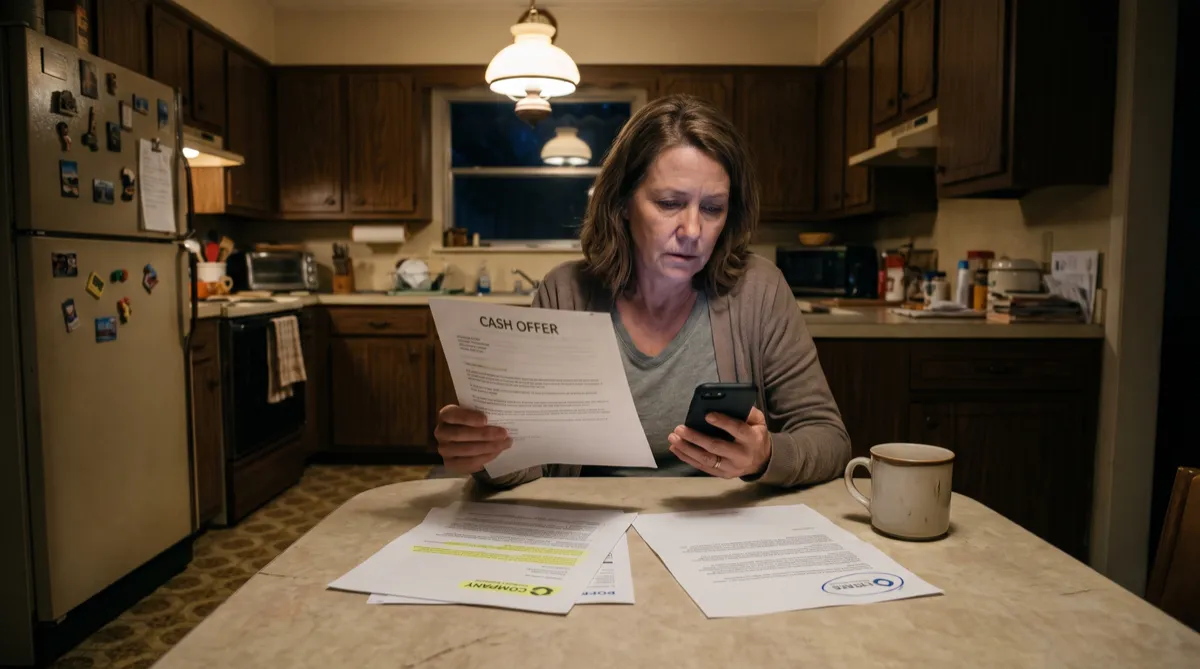
Neither platform consistently pays more — it depends entirely on your home's condition and what matters most to you. Opendoor typically offers near-market value but deducts 7–18% in fees and repair costs, while HomeLight connects you with investors who may offer 50–85% of market value but accept truly "as-is" properties. For DFW families selling a parent's home during a senior transition, the real question isn't which pays most — it's which gives you the speed, certainty, and peace of mind you need right now.
Let's break down the real numbers, fees, and hidden costs so you can see exactly what each platform will put in your pocket.
Sage Senior Support
Free Consultation & Cash Offer in 24 Hours
Core Service Programs:
- Cash Home Buying for families needing to sell a parent's home fast to fund senior care
- Senior Care Resources with personally-vetted community partners to assist your family in the transition for your loved one
- Care Funding Discovery Home sell options for Texas Medicaid, VA benefits, long-term care insurance, and bridge financing
Why Choose Sage Senior Support:
- ✓ Trusted by customers with a perfect 5.0-star Google rating across 30 verified reviews
- ✓ Founded by someone who's lived this transition — twice (2013 & 2024)
- ✓ 100+ DFW families guided through senior care transitions
- ✓ Cash offers within 24–48 hours — close in as few as 7–10 days
- ✓ Zero commissions, zero closing costs, no repairs needed
- ✓ Connection to free care placement — agents paid by the community, not your family
- ✓ Locally owned in Grapevine, TX — serving the entire DFW metroplex
DFW Housing Market Context: Why Speed Matters Now
The DFW housing market has shifted. In 2026, the median home price across the metroplex sits at approximately $415,000 — up just 2.2% year-over-year — and inventory has climbed 9–20% compared to 2025 levels, pushing supply toward five months. That's a meaningful change from the frenzied 1–2 month supply of 2021–2022. Dallas now has roughly 96% more sellers than active buyers, and Tarrant County isn't far behind at 65% more. Buyers have leverage again, and they're using it.
For a family trying to sell a parent's home in this environment, the math gets uncomfortable quickly. Homes are sitting on the market 60–105 days before going under contract, then another 30–45 days to close — a total timeline of three to four and a half months. Every month that home sits vacant costs roughly $1,400 in property taxes, insurance, and utilities alone. At 90 days, that's $4,200 quietly draining from your parent's care fund before you ever reach the closing table.
That's why so many families managing a senior transition are comparing cash offer platforms. Understanding how families are funding senior living costs makes clear that speed and certainty aren't just conveniences — they're financial necessities when a memory care deposit is due or an assisted living move-in date is set.
You're Not Alone in Feeling Overwhelmed
Most adult children managing a parent's care transition feel stuck between wanting to maximize the home's value and needing to move quickly. This tension is real, and it's okay to prioritize speed and certainty over squeezing out every last dollar.
HomeLight Simple Sale: How It Works and What You Actually Pay
HomeLight is not a buyer — it's a marketplace. When you submit your property through HomeLight's Simple Sale program, the company routes your information to a network of pre-vetted cash investors. Those investors make offers based on their own criteria: typically the estimated post-renovation value of your home, minus anticipated repair costs and their required profit margin.
HomeLight itself states it charges sellers no commissions or platform fees for Simple Sale. That's technically accurate, but the investor's profit and expected repair costs are already embedded in the offer price — they're just invisible. Third-party analyses suggest Simple Sale offers typically land at 50–85% of fair market value, depending on the investor and your property's condition. For a home needing significant work, that range can skew toward the lower end.
Where HomeLight genuinely stands out is flexibility. Closing can happen in as few as 10 days, with options extending up to 60 days. No showings, no staging, no repairs — the investor buys the home exactly as it sits. That makes HomeLight's network a realistic path for families dealing with selling an inherited home in DFW that hasn't been updated in decades or has deferred maintenance a traditional buyer would walk away from.
The HomeLight Process: From Inquiry to Closing
You submit basic property details online and typically receive a cash offer within 24 hours. HomeLight pairs that offer with a neighborhood value report from a local agent so you can compare your cash option against a traditional listing estimate side by side. If you accept, you choose your closing date and sign — no obligation before that point. The investor purchases the home as-is, handling any repairs after the sale closes.
Opendoor: Algorithm-Driven Offers and Post-Inspection Surprises
Opendoor operates differently. As a direct iBuyer — publicly traded on NASDAQ under the ticker OPEN — Opendoor purchases homes with its own capital, renovates them, and resells for a profit. Its offer process starts with an automated valuation model that generates a preliminary offer within 24 hours based on your self-reported home details. That number often looks encouraging.
Then comes the assessment.
After you complete a home walkthrough — either through Opendoor's self-assessment app or an in-person visit — the company issues a final offer that reflects its internal estimates for necessary repairs. These "condition adjustments" cover flooring, roof condition, HVAC systems, paint, and landscaping. Sellers commonly report reductions of 15–20% from the preliminary offer once these deductions are applied. For understanding repair costs and home condition assessments in detail, those deductions can be eye-opening.
On top of repair deductions, Opendoor charges a variable service fee (no longer the fixed 5% it once advertised), plus standard seller-side closing costs of 1–3%. When you add it all up, total deductions typically range from 7–18% of the home's sale price. Opendoor also charges daily "late checkout" fees of $100–$500 if you need more than two days after closing to move out.
Watch Out for Post-Inspection Surprises with Opendoor
Opendoor's preliminary offer can drop significantly after the home assessment. Sellers commonly report 15–20% reductions due to repair deductions that may exceed retail contractor quotes. Always read the condition adjustment details carefully before accepting a final offer.
Why Opendoor's Final Offer Often Drops After Assessment
Opendoor's internal repair estimates are not the same as quotes from a licensed contractor. The company uses its own cost models, which may assign higher values to repairs than what a local DFW tradesperson would charge. A roof that a roofer quotes at $8,000 might appear as a $14,000 deduction in Opendoor's condition adjustment. You can dispute these estimates with documentation — receipts for recent work, contractor quotes — but the algorithmic offer itself has limited room for negotiation. The FTC's $62 million settlement with Opendoor in 2022 specifically cited misleading claims about seller earnings, which underscores why reading every line of the final offer matters before signing.
Head-to-Head Comparison: Fees, Net Proceeds, and Condition Requirements
For families comparing cash buyers and traditional listings for DFW homes, the table below cuts through the headline numbers to show what actually differs between these two platforms.
Request a Detailed Net Sheet Before Deciding
Don't compare headline offers — compare net proceeds. Ask both HomeLight's investor and Opendoor to provide a written breakdown showing the offer price minus all fees, deductions, and closing costs. This is the only number that matters for your family's care funding.
| Feature | HomeLight Simple Sale | Opendoor |
|---|---|---|
| Offer Speed | Within 24 hours | Preliminary within 24 hours; final offer after assessment (2–5 days) |
| Offer Range | 50–85% of market value (investor-dependent) | Near market value initially; typically 9% below resale after fees |
| Service Fee | No direct fee; profit embedded in offer discount | Variable (historically ~5%); disclosed in offer breakdown |
| Repair Deductions | Embedded in discounted offer price | 1–5% of offer price as "condition adjustment" post-assessment |
| Closing Costs | Varies by investor; often $0 seller-paid | 1–3% of sale price (seller responsibility) |
| Total Effective Deductions | 15–50% below market (embedded in offer) | 7–18% in explicit fees and deductions |
| Closing Timeline | As few as 10 days, up to 60 days | 21–60 days; extensions possible (daily fees apply) |
| Condition Requirements | Accepts truly as-is; no minimum condition threshold | Fair-to-good condition preferred; may decline major structural issues |
| DFW Availability | Broad — investor network covers most DFW ZIP codes | Selective — excludes some older ZIP codes and properties with foundation issues |
| Negotiation | Directly with individual investor | Limited; repair deductions disputable with documentation |
| Regulatory History | BBB A+; no major regulatory actions | FTC $62M settlement (2022) for misleading seller earnings claims |
Real-World Net Proceeds Example: What You'll Actually Receive
Numbers on paper mean more when they're attached to a real scenario. Take a DFW home with a move-in ready value of $300,000 — but in dated, as-is condition that needs work before a traditional buyer would consider it.
Through HomeLight's investor network, an offer might come in around $215,000. That sounds low, but the seller pays zero commissions, zero closing costs, and makes zero repairs. Net proceeds: $215,000 — in hand, in as few as 10 days.
Opendoor's preliminary offer on the same home might be $270,000 — a number that feels much better. But after a variable service fee (estimated at 5% of the offer, or $13,500), repair deductions for dated flooring, aging HVAC, and cosmetic updates (estimated at 3%, or $8,100), and standard closing costs (1.5%, or $4,050), total deductions reach $25,650. Net proceeds: approximately $244,350. Still more than HomeLight's investor offer, but $25,650 less than that initial $270,000 figure — and that's assuming the condition assessment doesn't push deductions higher, which sellers frequently report.
For comparison, a traditional as-is listing might sell for $240,000 after buyers discount for condition, then cost $14,400 in agent commissions, $2,400 in concessions, $9,000 in buyer-requested repairs, and $3,600 in closing costs — a total of $29,400 in costs. Net proceeds: $210,600. The slowest path, in this scenario, also produces the lowest net.
The "best" option depends entirely on your timeline, your home's actual condition, and whether you need funds in 10 days or can afford to wait three months. There is no universal right answer — only the right answer for your family's situation right now.
Regulatory Status, Licensing, and Consumer Protections in Texas
Both platforms operate legally in Texas, but their structures differ. HomeLight functions as a referral platform — it connects sellers with licensed investors and agents rather than purchasing homes directly. Individual investors in its network hold Texas real estate licenses. Opendoor operates as a direct iBuyer and is a licensed real estate entity in Texas, publicly traded on NASDAQ.
Regardless of which platform you use, Texas Property Code §5.008 requires you to disclose known material defects on a Seller's Disclosure Notice. Selling "as-is" means you won't make repairs — it does not waive your obligation to disclose what you know about the property's condition. This applies to both platforms.
The FTC's 2022 action against Opendoor — resulting in $62 million in refunds to approximately 54,689 sellers — is a meaningful data point. The settlement found that Opendoor misled sellers about the financial benefits of its offers. That history doesn't make Opendoor an illegitimate option, but it does underscore the importance of getting every term in writing before signing. You can verify license status and file complaints through the Texas Real Estate Commission at trec.texas.gov.
For families navigating the legal side of selling a parent's property, understanding probate and legal requirements when selling a parent's home is an important parallel step — especially if the home is part of an estate.
Why Sage Senior Support Is the Right Choice for DFW Families Navigating Senior Transitions
HomeLight and Opendoor are built for transactions. Sage Senior Support is built for families. That distinction matters when you're not just selling a house — you're closing a chapter of your parent's life and trying to fund the next one.
Sage holds a perfect 5.0-star Google rating across 30 verified reviews from DFW families who've been exactly where you are right now. Those reviews don't describe a smooth closing — they describe feeling heard, supported, and relieved. That's a different outcome than what a national algorithm can deliver.
The first call with Sage doesn't start with the house. It starts with "How's Mom or Dad doing?" — because understanding your parent's care situation comes before any conversation about property value. From there, Sage connects families with trusted local resources: placement agents, elder law attorneys, and care funding specialists. With 100+ DFW families guided through senior care transitions, the team has navigated nearly every variation of this situation. Sage's founder has lived it personally — twice, in 2013 and again in 2024 — which means the empathy in every conversation is earned, not performed.
On the financial side, Sage delivers cash offers within 24–48 hours with closing in as few as 7–10 days, zero commissions, zero closing costs, and no repairs required. That matches or beats the speed of both national platforms while providing transparent, line-by-line clarity on exactly how the offer was calculated — no algorithm surprises, no post-inspection reductions.
Schedule a free consultation with Sage Senior Support today — get clarity on what your parent's home is worth, what it will cost to sell, and how those proceeds can support their care. No pressure, no obligation, just honest answers from someone who's been there.
Frequently Asked Questions: HomeLight vs. Opendoor Cash Offers in DFW
Will HomeLight or Opendoor give me more money for my DFW home?
It depends on your home's condition and what you're prioritizing. Opendoor aims for near-market value but typically nets sellers 9–10% less after fees and repair deductions — and that gap widens for homes in dated or as-is condition. HomeLight's investor network offers 50–85% of market value, which sounds lower, but for homes that need significant work, it may be the only realistic cash path. For most well-maintained homes, a traditional listing can achieve a higher gross price — but with a 3–4 month timeline and carrying costs that quietly erode the difference. The real question is whether you need maximum price or maximum speed and certainty right now.
What are the typical fees when selling to HomeLight versus Opendoor?
HomeLight states no direct fees from the platform itself, but the investor's offer is already discounted to cover their profit and anticipated repairs — those costs are embedded, not itemized. Opendoor charges a variable service fee (no longer the fixed 5% it once advertised), plus repair deductions of roughly 1–5% of the offer price, plus standard seller closing costs of 1–3%. When you add it all together, total deductions with Opendoor commonly range from 7–18% of the home's value depending on condition. Always request a written net sheet from both before making any decision — the headline offer number tells you very little on its own.
Can I negotiate the offer from HomeLight or Opendoor?
With HomeLight, negotiation happens directly with the individual investor who submitted the offer — there's more flexibility here since you're dealing with a person, not an algorithm. Opendoor's initial offer is algorithmically generated and generally not open to price negotiation, but you can dispute specific repair deductions if you have documentation to support a different estimate — receipts for recent upgrades, contractor quotes, or permits for completed work. Neither platform requires you to accept their offer. You can decline at any point before signing without penalty, and many sellers use these offers as a free benchmark before exploring other options.
Do I need to make repairs or clean my home before selling to either platform?
No — both platforms advertise as-is purchases, meaning you are not required to complete repairs, deep-clean, or stage the property before the sale. HomeLight's investor network is generally more accommodating of true as-is conditions, including homes with significant deferred maintenance. Opendoor will assess the condition and deduct its estimated repair costs from the final offer rather than requiring you to fix anything upfront. One important note: Texas law still requires you to disclose known material defects on a Seller's Disclosure Notice regardless of which platform you use — "as-is" refers to the repair obligation, not the disclosure obligation.
What makes Sage Senior Support different from HomeLight or Opendoor?
Sage Senior Support starts by understanding your parent's care situation and emotional needs — not just the square footage and condition of the property. Unlike national platforms that run your address through an algorithm, Sage connects families with local resources like placement agents, elder law attorneys, and care funding specialists who can help navigate the full transition. With a perfect 5.0-star Google rating across 30 verified reviews, Sage delivers cash offers within 24–48 hours and closes in as few as 7–10 days — with zero commissions, zero closing costs, and complete transparency on how every number was calculated. The founder has navigated senior care transitions in his own family, which means every conversation comes from a place of genuine understanding, not just transaction expertise. Schedule your free consultation with Sage Senior Support today and get honest, pressure-free answers about what your parent's home is worth and how those proceeds can fund the care they need.
Ready to Compare Your Real Options for Selling a Parent's Home in DFW?
You don't have to choose between fast and fair — or sort through fee structures and post-inspection surprises on your own. Sage Senior Support will walk you through exactly what your parent's home is worth, what it will cost to sell through every available path, and how those proceeds can support their care — all in a single, no-pressure conversation.
Cash offer within 24–48 hours. Close in as few as 7–10 days. Zero commissions, zero closing costs, no repairs needed.
*Service availability, benefit eligibility, and home valuations depend on individual circumstances and current market conditions. This article is for informational purposes only and does not constitute medical, legal, or financial advice. Contact us for personalized guidance specific to your family's situation.