
Can I Sell an Inherited House As-Is With Everything Still Inside?
Can I Sell an Inherited House As-Is With Everything Still Inside?
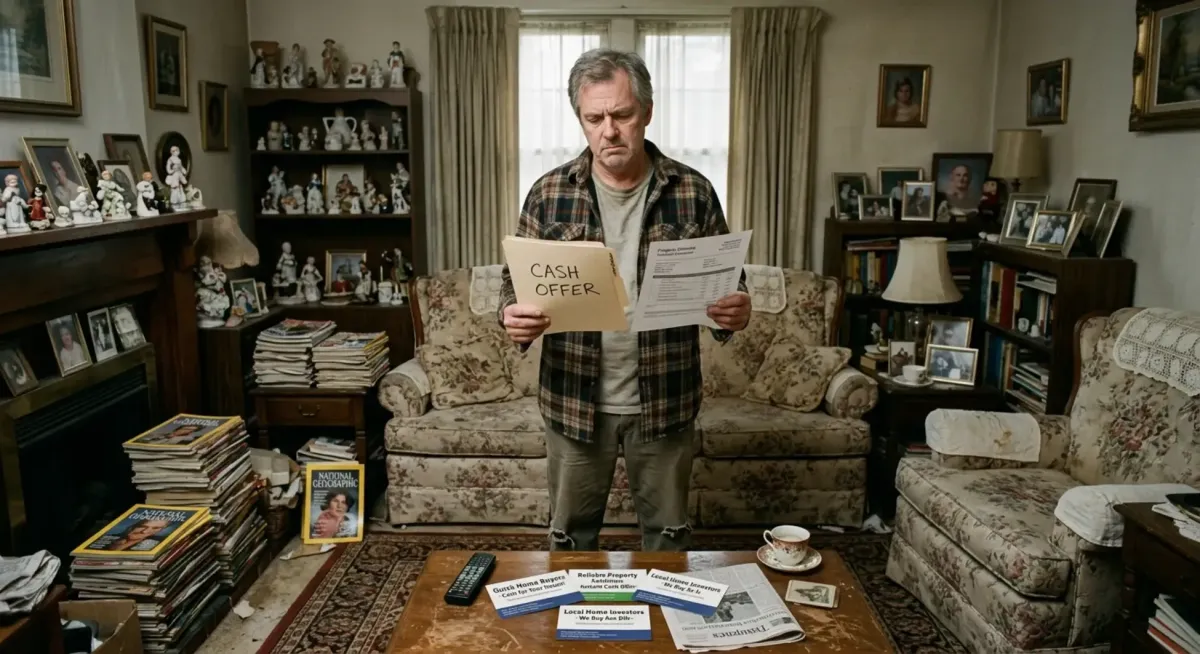
Picture this: Your mother passed away three months ago. You've been handling the funeral, the paperwork, the phone calls, and the grief — all while trying to hold your own life together. Now you're standing in the doorway of her house, looking at forty years of accumulated life: the floral sofa she refused to replace, the kitchen cabinets that haven't been updated since 1987, the closets packed with things you don't even know how to categorize.
And someone just asked you, "So what are you going to do with the house?"
If your stomach dropped a little reading that, you're not alone. This is one of the most common situations families in the Dallas-Fort Worth area face — and one of the most overwhelming. You're not just dealing with a real estate transaction. You're dealing with a home that holds a lifetime of memories, a property that may need significant work, and the very real pressure of figuring out how to fund your parent's ongoing care.
Here's the short answer to the question in the headline: Yes, you can absolutely sell an inherited house as-is with everything still inside. It's not only possible — it's one of the most common ways families in exactly your situation handle this. And in this guide, we're going to walk you through everything you need to know to do it right, without being taken advantage of, without unnecessary stress, and with your family's needs at the center of every decision.
Key Takeaways
- Selling an inherited home as-is — contents and all — is legal, common, and often the smartest path for families navigating grief and care decisions simultaneously.
- You cannot legally sell until the probate court grants authority through Letters Testamentary, a Muniment of Title, or an Affidavit of Heirship — attempting to sell before this can derail the entire transaction.
- As-is homes in DFW typically sell for 5–15% below move-in-ready homes; cash buyers can close in 7–30 days and handle all cleanout and repairs.
- Monthly carrying costs for a vacant inherited home in DFW run $1,200–$2,300+, making delay expensive — not just emotionally, but financially.
- The stepped-up basis rule means most families owe little to no federal capital gains tax when selling shortly after inheritance — Texas has no state capital gains tax at all.
- Not all cash buyers are equal. Knowing how to vet them — and what red flags to watch for — protects you from predatory practices that target grieving families.
- You don't have to choose between fast and fair. A transparent, compassionate sale can fund your parent's care and give your family genuine relief.
Yes, You Can Sell an Inherited House As-Is in DFW — Here's What That Actually Means
Let's start by clearing up what "as-is" actually means in a real estate context, because it gets misused constantly. Selling a home as-is means the buyer accepts the property in its current condition — including deferred maintenance, outdated systems, cosmetic issues, and yes, all the contents still inside. The seller is not required to make repairs, stage the home, or empty it out before closing.
For families dealing with an inherited home, this is enormously significant. You don't have to spend weeks sorting through belongings, hiring contractors, or managing renovation projects from across town. You don't have to spend money you may not have on repairs before you've even received a dollar from the sale. You can, in many cases, hand over the keys and walk away — letting the buyer handle everything that comes next.
This approach is especially common when families are also navigating selling a parent's home to pay for assisted living or memory care costs. When care funding is urgent and the family's bandwidth is already stretched thin, the speed and simplicity of an as-is sale often outweighs the potential upside of a higher retail price.
Here's the honest trade-off: as-is homes in DFW typically sell for 5–15% less than move-in-ready homes of comparable size and location. If the home needs major repairs — foundation work, a new roof, HVAC replacement — that discount can climb to 20–30% or more. But here's what most families don't realize until they run the actual numbers: when you factor in the cost of repairs, the 5–6% real estate commission, months of carrying costs on a vacant home, and the time and emotional energy required for a traditional listing, the net proceeds from an as-is cash sale are often comparable — and sometimes better.
Speed is another major advantage. Cash buyers in DFW can typically close in 7–30 days once legal authority is established, compared to the 45–75 day average time on market for traditional listings — plus another 30–45 days to close after an offer is accepted. When your parent needs care funding now, that difference matters enormously.
You're Not Alone in Feeling Overwhelmed
Selling a parent's home is consistently reported as one of the most stressful life events families face. The combination of grief, guilt, financial pressure, and logistical overwhelm is completely normal — and it doesn't mean you're doing anything wrong. You don't have to figure this out alone, and you don't have to have all the answers before you take the first step.
The Legal Reality: What You Need Before You Can Sell an Inherited Home in Texas
This is the section that can save you from a very costly mistake. Before you sign anything, before you accept any offer, before you even shake hands with a buyer — you need to understand one fundamental rule: you cannot legally sell an inherited property until the probate court grants you the authority to do so.
In Texas, that authority comes in a few forms. The most common is Letters Testamentary, which the probate court issues to the executor named in a will, granting them legal authority to manage and sell estate assets. If there is no will, the court appoints an administrator and issues Letters of Administration. For simpler estates, a Muniment of Title can expedite the process significantly. And in some cases where there is no will and the estate is straightforward, an Affidavit of Heirship may provide a path forward.
Understanding which route applies to your situation is the first critical step. For a detailed breakdown of each option, the guide on selling an inherited home through probate versus an Affidavit of Heirship walks through the key differences in plain language. And if you're navigating the broader probate process alongside a parent who is still living, the resource on selling an inherited house without probate in Texas covers the specific scenarios where that faster path is available.
⚠️ Don't Sell Without Legal Authority
One of the costliest mistakes families make is attempting to sell before the probate court has granted legal authority. This can result in a failed transaction, wasted time, and title issues that are expensive to fix. Always secure Letters Testamentary, a Muniment of Title, or equivalent legal authority before signing any sales contract. A title company will not insure — and a buyer cannot close — without clear legal authority to transfer ownership.
Do You Have a Will, or Is the Estate Intestate?
The answer to this question shapes everything that follows. If your parent left a valid will, the probate court will typically appoint the named executor and issue Letters Testamentary, giving that person authority to act on behalf of the estate — including selling the home. If the will allows for Independent Administration (or if all heirs agree to it), the executor can act with minimal court supervision, which dramatically speeds up the process.
If there is no will — what Texas law calls dying "intestate" — the court appoints an administrator and determines legal heirs based on Texas intestate succession laws. This process is more complex and typically slower. The court must establish who the legal heirs are before anyone has authority to sell. If there are disputes among family members about who inherits what, or if creditors come forward with claims against the estate, the timeline extends further — sometimes to 1.5–2 years or longer.
One important note: all legal heirs must agree to the sale and sign closing documents, regardless of which path you take. If one sibling disagrees, the sale cannot proceed without either a buyout agreement or a court-ordered partition action. This is why early, honest family communication is not just emotionally important — it's legally necessary.
How Long Will the Probate Process Take?
Muniment of Title (Simplest Cases): 1–3 Months
Available when there is a valid will, no unpaid debts (other than those secured by real estate), and no need for an executor to take action beyond distributing assets. The fastest path in Texas for qualifying estates.
Independent Administration with a Will: 6–12 Months
The most common path. Once the court issues Letters Testamentary, the executor has broad authority to manage and sell estate assets. Most straightforward cases fall in this range.
Complex or Contested Estates: 1.5–2+ Years
Disputes among heirs, creditor claims, missing heirs, or estates without a will can extend the process significantly. Dependent Administration (with court approval required for each action) also falls in this range.
Once Legal Authority Is Established: 7–30 Days to Close
With a cash buyer, the actual sale can move extremely quickly once the legal groundwork is in place. You can prepare for sale, gather offers, and have a buyer lined up before probate is complete — you just can't sign a binding contract or transfer title until authority is granted.
What's the Real Cost of Selling As-Is in DFW? A Transparent Breakdown
One of the most important things we can do for you in this guide is give you real numbers — not vague ranges designed to make every option sound equally attractive. Here's what you're actually looking at when selling an inherited home in DFW in 2026.
First, the discount. As-is homes in DFW typically sell for 5–15% below comparable move-in-ready homes. For a home valued at $350,000 in move-in-ready condition, that means an as-is sale might bring $297,500–$332,500. If the home needs major work — a failing foundation (common in North Texas clay soil), a roof at end of life, or an HVAC system that hasn't been serviced in years — that discount can reach 20–30%, bringing the same home to $245,000–$280,000.
But that's only part of the picture. Understanding the real cost comparison between a cash sale and a traditional agent listing requires looking at what you spend to get there, not just the offer price.
Cash Buyer vs. Traditional Realtor Sale: The Real Numbers
| Cost Factor | Cash Buyer (As-Is) | Traditional Realtor Listing |
|---|---|---|
| Offer Price | 10–30% below market value | Closer to market value (if home shows well) |
| Commission | $0 | 5–6% of sale price (~$17,500–$21,000 on $350K home) |
| Repairs / Staging | $0 (buyer handles all) | $5,000–$30,000+ depending on condition |
| Closing Costs (Seller) | 0–1% (often covered by buyer) | 1–3% (title, escrow, recording fees) |
| Carrying Costs | Minimal (7–30 day close) | $7,200–$13,800+ for 6 months vacant |
| Estate Cleanout | $0 (buyer handles contents) | $1,000–$10,000+ professional cleanout |
| Time to Close | 7–30 days | 75–120+ days (market time + closing) |
For estate-condition homes in the 2026 DFW market — where inventory is elevated, buyers have negotiating power, and 66% of homes sold under list price as recently as early 2025 — the net proceeds from a cash sale are often comparable to or better than a traditional listing after all costs are accounted for. The math shifts even further in favor of a cash sale when care funding is time-sensitive.
If you're working through how the sale proceeds might cover your parent's care costs, the guide on assisted living costs in Dallas-Fort Worth can help you understand what you're planning for.
Hidden Costs Families Often Miss
Beyond the obvious costs, there are several financial surprises that catch families off guard. Here's what to watch for:
- Outstanding liens or reverse mortgage balances: Any liens against the property — contractor liens, medical judgment liens, or an outstanding reverse mortgage balance — must be paid from sale proceeds at closing. Families sometimes don't discover these until the title search, which is why a preliminary title search early in the process is worth the investment.
- Property tax reassessment: When ownership transfers, the previous owner's homestead exemption lapses. The property will be reassessed at full market value, potentially increasing the tax bill significantly until a new owner establishes their own exemption. In Dallas and Tarrant counties, with effective tax rates of 2.2–2.5%, the annual bill on a $350,000 home can run $7,700–$8,750.
- HOA liens for unpaid dues: If the home is in an HOA and dues weren't paid during the owner's final months or during probate, late fees and penalties can accumulate quickly. These liens must be cleared before closing.
- Probate attorney fees: Essential, not optional. Budget $3,000–$10,000+ for a simple, uncontested probate. Complex or contested estates cost significantly more.
- Capital gains tax (usually minimal): The stepped-up basis rule typically results in little to no federal capital gains tax when selling shortly after inheritance — but if the home appreciates significantly between the date of death and the sale date, consult a tax professional.
Not Sure If Selling As-Is Makes Financial Sense for Your Situation?
If you're trying to figure out whether the numbers actually work — factoring in your parent's care costs, the home's condition, and what you'd net after everything — that's exactly what a free consultation is designed to answer. We can walk through the specifics of your home and help you see all your options clearly, without any pressure.
Understanding Your Options: Cash Buyers, Wholesalers, and Traditional Agents
Not every offer you receive is created equal, and not every person who calls themselves a "cash buyer" actually is one. Understanding the three main paths — and the real differences between them — is one of the most important things you can do to protect yourself and your family.
Before accepting any offer, it's worth reading through the guide on how to sell your house fast with cash buyers in DFW to understand what a legitimate, transparent process looks like from start to finish.
Direct cash buyers have funds available and purchase the property themselves. They close in 7–30 days, buy as-is with contents, and typically cover closing costs. Their offers are 10–30% below market value, but the savings on commissions, repairs, and carrying costs often make the net proceeds comparable. This is the most reliable option for families who need speed and simplicity.
Wholesalers are a different animal entirely. They contract to buy your home at a low price, then assign that contract to another buyer for a fee — often without ever having the funds to close themselves. They market themselves as cash buyers, but they're not. If they can't find an end buyer willing to pay their markup, the deal falls through and you're back to square one — having wasted weeks or months of precious time. Always ask any buyer to provide verifiable proof of funds, not just a contract.
Traditional real estate agents aim for the highest market price through MLS listing, showings, and negotiation. They earn 5–6% commission, and the seller typically bears the cost of repairs, staging, and carrying costs during the listing period. For estate-condition homes in 2026's elevated-inventory DFW market — where average days on market run 45–75 days — this path requires more time, money, and energy upfront. It can still be the right choice for families who have the bandwidth and aren't under time pressure, but it's not the default best option for every inherited home.
What to Ask Any Cash Buyer Before Accepting an Offer
Before you sign anything, get clear answers to these questions:
- How did you calculate this offer? Ask for comparable sales and a breakdown of their valuation. A legitimate buyer will show their work.
- Are there hidden fees or deductions from the offer price? Some buyers advertise a number, then deduct "repair credits" or "transaction fees" at closing. Get everything in writing upfront.
- What is your exact closing timeline, and how flexible are you? If you need time to coordinate with probate, a good buyer will work with your schedule.
- Can you provide verifiable proof of funds? A bank statement or letter from their financial institution — not just a verbal assurance.
- Can you provide references from other sellers in DFW? Specifically from families who sold inherited or estate-condition homes.
- Who handles the cleanout of contents — is it included in your offer? Confirm this is explicitly part of the deal, not something you'll be billed for later.
Red Flags That Signal a Predatory Operation
Unfortunately, inherited homes attract predatory operators who target grieving families under time pressure. Watch for these warning signs:
- Pressure to sign immediately without time for attorney review
- Vague or evasive answers about how they calculated the offer
- An initial high offer that drops dramatically after "inspection" — a classic bait-and-switch
- Requests for a large non-refundable deposit from the seller
- No verifiable business registration with the Texas Secretary of State
- Refusal to put all terms in writing or to allow your attorney to review the contract
For a deeper dive into protecting yourself, the guide on selling your parent's house as-is in Dallas-Fort Worth covers the vetting process in detail.
Got an Offer You're Not Sure About?
Evaluating cash offers and understanding what each buyer is really proposing can be genuinely confusing — especially when you're already managing so much. If you'd like a second opinion on an offer you've received, or just want help understanding what your options actually are, we're here to talk it through. No pressure, no obligation — just clarity.
The DFW Market in 2026: Why Timing Matters for Inherited Homes
Understanding where the market stands right now isn't just background information — it directly affects the strategy you should use to sell your inherited home and what price you can realistically expect.
DFW housing inventory has reached its highest level since 2003, sitting at approximately 5.4 months of supply across North Texas as of mid-2025. A balanced market in Texas is typically 3–4 months of supply, which means we've moved firmly into buyer's market territory in many areas. Rockwall County is at 6.8 months, Parker at 6.3, and even Dallas and Denton counties are approaching 5 months. This is a meaningful shift from the seller's market conditions of recent years.
What does this mean for you? Buyers have options. They're taking their time. Average days on market across DFW counties ran 45–75 days in mid-2025, representing a 25–65% increase year-over-year. Resale homes averaged 54 days to sell across the metro. And in that same period, 66% of homes sold under list price — meaning buyers are successfully negotiating sellers down.
For estate-condition homes, these numbers are more pronounced. Outdated kitchens, deferred maintenance, and homes that haven't been updated in decades face more scrutiny and longer market times than move-in-ready properties. Traditional buyers increasingly expect move-in-ready condition and are less willing to take on projects in a market where they have alternatives.
For a current read on what these trends mean specifically for your home sale strategy, the DFW housing market trends analysis provides the most up-to-date context.
💡 The Hidden Advantage of Selling As-Is in a Buyer's Market
In 2026's elevated-inventory DFW market, buyers have options — and as-is homes face more scrutiny from traditional buyers. But this same market condition makes your inherited home exactly what cash investors and direct buyers are actively seeking. They're looking for properties they can acquire quickly, renovate, and add value to. Your estate-condition home, with its contents and deferred maintenance, is precisely the type of opportunity they're pursuing — which means motivated, competitive buyers are out there if you know where to look.
The median home price across DFW sits at approximately $392,471 as of mid-2025, with Dallas city homes averaging around $410,000 and Tarrant County homes around $355,000. These figures represent the move-in-ready baseline — your as-is inherited home will be priced relative to these benchmarks, with adjustments for condition, location, and the current buyer's market discount.
What Happens to the Contents? Who Handles the Estate Cleanout?
This is often the question families are most anxious about — not the legal process, not even the price, but the sheer physical reality of what to do with decades of accumulated belongings. The good news is that you have more options than you might think, and the least stressful option is often the most financially sensible one.
When you sell as-is to a direct cash buyer, they typically assume full responsibility for cleanout and disposal of all contents. This is one of the most significant practical advantages of this sale type — it removes what many families describe as the most emotionally and physically exhausting part of the entire process. You take what's meaningful to you, and the buyer handles the rest.
If you want to explore whether there's meaningful value in your parent's belongings before selling, the guide on estate sale secrets and finding hidden value in your parent's belongings can help you identify what's worth pursuing and what's better left to the buyer.
Estate Sale vs. Donation vs. Junk Removal: Which Makes Sense?
Professional estate sale companies charge 30–50% commission on gross sales, plus potential setup and advertising fees. Net proceeds are often more modest than families expect, unless the estate contains genuine antiques, collectibles, or high-value furniture. For a typical household with standard furniture and everyday items, the financial return from an estate sale may not justify the time, effort, and emotional energy required. That said, if your parent was a collector or had genuinely valuable pieces, an estate sale company can be worth it — just go in with realistic expectations about net proceeds after commissions.
Donation is frequently the most practical choice for typical household contents. Many charities offer free pickup, and the tax deduction you receive can sometimes be more financially valuable than the proceeds from a low-grossing estate sale. It also provides a sense of meaning — knowing your parent's belongings are going to people who need them.
Professional junk removal runs $500–$2,000+ for a typical home in DFW. It's fast, it's convenient, and it requires no emotional energy from you. There are no proceeds, but there's also no time investment.
Many families find the most workable approach is a combination: take meaningful items for family members, donate usable goods to charity, and let the cash buyer handle whatever remains. This approach minimizes your burden while honoring the things that actually matter.
Top DFW Cash Home Buyers Compared and Reviewed
There are dozens of companies operating in DFW that will offer to buy your inherited home. Not all of them are equal in transparency, reliability, or how they treat families during a difficult time. Here's an honest comparison of the main options, including their strengths, considerations, and what makes each one different.
For a more detailed breakdown of specific buyers and their offers, the DFW as-is home buyers comparison guide goes deeper into specific transaction histories and offer structures.
Sage Senior Support — Grapevine, TX (Serving All DFW Counties)
Address: 1452 Hughes Rd #200, Grapevine, TX 76051
Service Area: Dallas-Fort Worth metroplex — all major counties including Dallas, Tarrant, Collin, Denton, Rockwall, and surrounding areas.
Specialties: Inherited homes, senior transitions, estate sales, families navigating care decisions simultaneously with home sales.
Approach: Every conversation starts with "How's Mom or Dad doing?" — not "What's the house worth?" The care situation comes first. Only after understanding the family's needs does the conversation move to the home, its condition, and the options available.
- Timeline: 7–30 days to close once legal authority is established
- Differentiator: Mission-first approach grounded in the founder's personal experience with family caregiving and Alzheimer's. Provides resources, referrals, and education even if the family ultimately doesn't sell to Sage. Deep network in senior living, elder law, and care funding.
- What families say: "You didn't just buy the house, you helped us through this whole transition." "You stepped in when I didn't know what to do." "We trusted you because you took the time to explain everything."
Opendoor — DFW Metro (Major Cities and Suburbs)
Approach: Technology-driven iBuyer model with instant online quotes. Streamlined, digital-first process with minimal human interaction.
- Timeline: 7–21 days to close
- Strengths: Instant online offer; no need to wait for inspection; covers closing costs in many cases; convenient for tech-comfortable sellers
- Considerations: Offers often include service fees and repair deductions that reduce the net price. Less suited for homes requiring major work or for families who need personalized guidance through a complex emotional situation. The digital-first model means less human support when you need it most.
Mark Spain Real Estate — DFW (Established Local Presence)
Approach: Direct cash buyer with local market expertise and a straightforward process. Long-standing local reputation with knowledge of DFW neighborhoods.
- Timeline: 7–30 days to close
- Strengths: Established local reputation; direct buyer (not a wholesaler); understands DFW neighborhood values
- Considerations: Offers typically 10–25% below market. Less focus on the family's broader care situation or emotional context. Better suited for sellers who primarily want speed and a straightforward transaction.
House Buyers of Texas — DFW and Surrounding Regions
Approach: Direct cash buyer specializing in as-is purchases, inherited homes, and investment properties. Handles all repairs and cleanout.
- Timeline: 7–30 days to close
- Strengths: Transparent process; no hidden fees; willing to work with complex estates and title issues
- Considerations: Offers are typically below market value. Less personalized approach — better for sellers who are primarily focused on a clean, fast transaction rather than comprehensive family support.
Traditional Real Estate Agents — Neighborhood-Specific Throughout DFW
Approach: MLS listing, professional marketing, staging, showings, and negotiation aimed at achieving the highest market price.
- Timeline: 45–75 days on market average, plus 30–45 days to close — total of 75–120+ days
- Strengths: Potential for higher sale price; professional marketing; access to broader buyer pool; best option for homes in good condition with motivated, flexible sellers
- Considerations: 5–6% commission; seller typically pays for repairs, staging, and cleanout; longer timeline; higher carrying costs; elevated inventory in 2026 means more competition and longer market times for estate-condition homes. The 2024 NAR commission settlement has also introduced new dynamics around buyer agent compensation that sellers should understand.
How to Avoid the Most Costly Mistakes When Selling an Inherited Home
We've seen families make these mistakes. We've watched them cost people money, time, and peace of mind during an already difficult season. Here's what to watch for — and how to avoid each one.
Mistake #1: Waiting too long to act. This is the most common and most costly mistake. Families tell themselves they'll deal with the house "when things settle down" — but things rarely settle down. Meanwhile, the home sits vacant, carrying costs accumulate at $1,200–$2,300+ per month, code enforcement notices arrive, and eventually a health crisis forces a rushed, last-minute decision with far fewer options. The time to plan is before the crisis, not during it.
Mistake #2: Accepting the first offer without understanding the market. Cash buyers know that grieving families under time pressure are more likely to accept the first offer they receive. Get multiple offers. Understand what comparable homes are selling for in your parent's neighborhood. You don't need to spend months shopping — but getting 2–3 offers takes days, not weeks, and can make a meaningful difference in your net proceeds.
Mistake #3: Attempting to sell without legal authority. We covered this in the legal section, but it bears repeating. Signing a sales contract before probate grants authority creates title issues that can take months and thousands of dollars to resolve. Don't skip this step.
Mistake #4: Ignoring outstanding liens, HOA dues, or reverse mortgage balances. These don't disappear when the home sells — they come out of your proceeds at closing. Discovering a $40,000 reverse mortgage balance or $8,000 in HOA liens and penalties at the closing table is a shock no family needs. Order a preliminary title search early.
Mistake #5: Chasing the highest dollar at the expense of everything else. Sometimes the highest offer isn't the right offer. If achieving maximum price requires three months of repairs, staging, showings, and carrying costs — while your parent needs care funding now — the math often doesn't work in your favor. The right sale is the one that serves your family's actual needs, not just the one with the biggest number at the top.
For a comprehensive guide to everything that needs to happen after a parent passes, the complete checklist of what to do when a parent dies walks through each step in order so nothing falls through the cracks.
Talking Through Your Situation Can Change Everything
Many families find that one honest conversation — with someone who understands both the real estate side and the care side — helps them make decisions they feel genuinely good about. If that would help you right now, we're just a conversation away. No pressure, no sales pitch. Just someone who's been through this and wants to help.
The Emotional Side: Guilt, Nostalgia, and Moving Forward
We'd be doing you a disservice if we talked only about numbers and legal processes without acknowledging what's actually happening here. Selling a parent's home is one of the most emotionally complex things a family can do. It's not just a real estate transaction. It's the end of a chapter. It's the physical dismantling of a place that held your family's life together for decades.
The guilt is real. The feeling that you're somehow betraying your parent by selling the home they worked so hard to own — that feeling is completely normal, and it doesn't mean you're doing anything wrong. If anything, it means you loved them. The families we work with most often aren't selling because they don't care. They're selling because they care deeply about funding the care their parent needs and removing a burden that no one in the family is equipped to carry indefinitely.
For families navigating the emotional weight of this transition alongside the practical decisions, the guide on overcoming guilt when moving a parent to senior living speaks directly to what you're feeling and offers a framework for moving forward with both clarity and compassion.
Here's what we've seen consistently: families who choose a quick, transparent, as-is sale — rather than dragging out the process in pursuit of every possible dollar — almost universally report relief, not regret. The relief of having it done. The relief of having funds available for care. The relief of being able to focus on their parent's well-being instead of managing a vacant property from a distance.
It's Okay to Choose Convenience Over Maximum Dollars
Some families push themselves to chase every possible dollar, spending months on repairs, showings, and negotiations while their parent's care needs go unmet or are funded through debt. But if a quick, transparent sale can fund the care your parent needs right now — and remove a major source of stress from your life — that is a wise, loving decision. Choosing relief over maximum proceeds isn't giving up. It's taking care of your family.
The home represents memories, yes. But your parent's quality of life in their final chapter matters more than any number of square feet. Using the proceeds from that home to fund dignified, appropriate care — whether that's assisted living, memory care, or in-home support — is exactly what that home was meant to provide. It served your family for decades. Now it can serve your parent one more time.
Tax Implications and the Stepped-Up Basis Rule: What You Actually Need to Know
Taxes are one of the most misunderstood aspects of selling an inherited home, and the misunderstanding usually goes in one direction: families assume they'll owe a lot more than they actually will. Here's the reality.
Texas has no state income tax and no state capital gains tax. That's one major advantage of being in the Lone Star State. Federal rules apply, but here's where the stepped-up basis rule changes everything for most families.
What "Stepped-Up Basis" Really Means for Your Taxes
When you inherit a home, the IRS resets your cost basis — the value from which capital gains are calculated — to the home's fair market value on the date of death. This means if your parent bought the home in 1978 for $45,000 and it was worth $350,000 when they passed, your cost basis is $350,000, not $45,000. If you sell it shortly after for $330,000, you actually have a capital loss for tax purposes — and owe nothing in capital gains tax. Even if you sell for $360,000 six months later, you only owe tax on the $10,000 of appreciation since the date of death. This is a major financial advantage of inherited property that many families don't realize they have.
The stepped-up basis rule means that for most families who sell within a reasonable time after inheritance, capital gains tax is minimal or nonexistent. The risk comes if you hold the property for a significant period and it appreciates substantially — in that case, the gains above the stepped-up basis become taxable.
One additional consideration: if your parent received Medicaid benefits, you may need to understand the implications of Texas Medicaid estate recovery and how it affects the home. The Texas Medicaid Estate Recovery Program (MERP) can place a claim against the estate for benefits paid — this is separate from capital gains tax, but equally important to understand before closing.
None of this is tax advice — your specific situation requires a qualified CPA or tax professional who knows your complete financial picture. But the general takeaway for most families is encouraging: the tax burden on inherited home sales is usually far lower than people fear.
Frequently Asked Questions About Selling an Inherited House As-Is in DFW
Can I sell an inherited house before probate is finished?
Generally, no. You need legal authority from the probate court — typically Letters Testamentary or a Muniment of Title — before you can sign a binding sales contract and legally transfer title to a buyer. Attempting to sell without this authority creates title issues that can derail the transaction and cost significant time and money to resolve. That said, you can absolutely prepare for sale while probate is pending: research buyers, get preliminary offers, and have a buyer lined up and ready. Once legal authority is granted, closing with a cash buyer can happen in as little as 7–30 days, so the preparation time is not wasted.
Will leaving all the belongings inside affect how quickly the house sells?
Yes, but the impact depends on who you're selling to. Traditional buyers — people looking for a home to live in — often want to visualize their own furniture and may be deterred by a home full of someone else's belongings. For a traditional MLS listing, a full home with dated contents can extend market time and reduce appeal. Cash buyers and investors, however, are accustomed to purchasing homes with contents and typically factor cleanout costs into their offer. With a cash buyer, you can still close in 7–30 days regardless of what's inside — which is one of the primary reasons this path is so appealing for inherited homes.
Do all siblings have to agree to sell an inherited property?
Yes. If multiple heirs jointly own the property — whether through a will or Texas intestate succession — all legal heirs must agree to the sale terms and sign all closing documents. This is true whether you're selling as-is or through a traditional listing. If heirs disagree, one option is for one heir to buy out the others at an agreed-upon value. If no agreement can be reached, a court-ordered partition action may ultimately force the sale — but this is an expensive, time-consuming, and emotionally damaging process that should be a last resort. Early, honest family communication about everyone's priorities and financial needs is far preferable to litigation.
How much will I owe in taxes when I sell an inherited home?
Texas has no state income tax or capital gains tax, so only federal rules apply. Inherited property receives a "stepped-up basis," meaning your cost basis for tax purposes is reset to the home's fair market value on the date of death — not what your parent originally paid for it. If you sell shortly after inheritance, capital gains tax applies only to appreciation since the date of death, which is often very small or zero. If the home has appreciated significantly between the date of death and your sale date, some capital gains tax may apply to that appreciation. Always consult a qualified CPA or tax professional for advice specific to your situation — but most families are pleasantly surprised by how low the tax burden actually is.
What's the difference between a direct cash buyer and a wholesaler?
A direct cash buyer has their own funds and purchases the property themselves, closing in 7–30 days with a straightforward transaction. A wholesaler contracts to buy at a low price and then assigns that contract to another buyer for a fee — they often don't have the funds to close themselves and are essentially acting as middlemen. The risk with wholesalers is that if they can't find an end buyer willing to pay their markup, the deal falls through and you've lost weeks of time with nothing to show for it. Always ask any buyer for verifiable proof of funds — a bank statement or letter from their financial institution — before accepting an offer or signing a contract.
How do I know if a cash buyer is legitimate?
Start by verifying their business registration with the Texas Secretary of State through the SOSDirect website — a legitimate company will have a registered business entity. Check their Better Business Bureau rating and look for unresolved complaints. Request verifiable proof of funds (an actual bank statement or lender letter, not just a verbal claim), and ask for references from past sellers in DFW — specifically families who sold inherited or estate-condition homes. Legitimate buyers are transparent about their offer calculations, patient with your timeline, and willing to put all terms in writing. High-pressure tactics, vague answers about offer calculations, or refusal to allow attorney review are all red flags that should send you elsewhere.
You Don't Have to Figure This Out Alone
If you've made it to the end of this guide, you're doing something right — you're taking the time to understand your options before making a decision under pressure. That matters. The families who navigate this process best aren't the ones who moved the fastest or got the highest offer. They're the ones who took a breath, got clear on their situation, and made a decision that felt right for their whole family.
Whether you're just starting to think about what to do with an inherited home, or you've already received an offer you're not sure about, we'd love to be a resource for you. Our first conversation is never about the house — it's about your family, your parent's situation, and what would actually make this easier.
Schedule a free consultation with Sage Senior Support. We'll listen, answer your questions honestly, and help you see a clear path forward — whatever that path looks like for your family.