
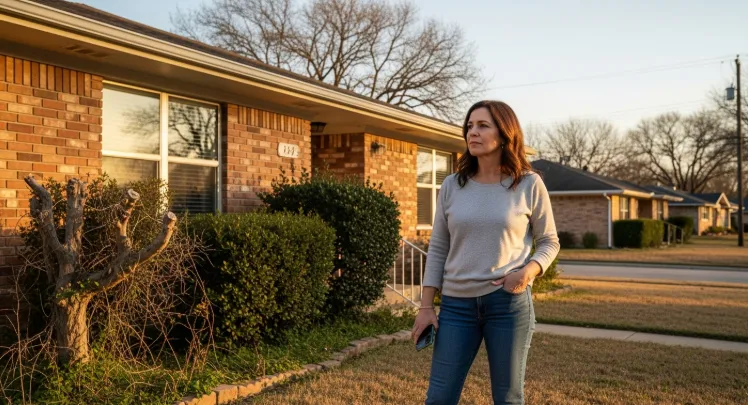
How to Sell Your Parent's House As-Is in Dallas-Fort Worth (Without Getting Lowballed)
Key Takeaways
- You can sell as-is and still get a fair price — if you understand how cash offers are calculated
- The real gap between cash sales and traditional sales is often $5,000-$15,000 (not $50,000+ like many fear)
- Not all cash buyers are the same — knowing the red flags protects you from predatory offers
- Speed matters when care costs are burning $5,000-$8,000 per month
- Texas title law creates unique challenges that often favor cash buyers over traditional sales
Let's Start With What Nobody Tells You
You're probably reading this late at night. Maybe you just got off the phone with a memory care facility talking about move-in deposits. Maybe you walked through your parents' house this weekend and realized just how much work it needs. Maybe you're staring at a "We Buy Houses" postcard wondering if it's a scam or a lifeline.
Here's the truth nobody in real estate wants to say out loud: this isn't a normal transaction. You're not "selling a house." You're trying to convert your parents' largest asset into the cash they need for care — often under a timeline you didn't choose, with a property you can't afford to fix up, while dealing with emotions that make clear thinking almost impossible.
If you're feeling overwhelmed, you're not weak — you're normal. The families we work with at Sage Senior Support are some of the most capable, intelligent people in DFW. They're executives, teachers, nurses, business owners. And almost all of them tell us the same thing: "I had no idea this would be so hard."
The fear that brought you here is probably this: "Am I going to get taken advantage of?"
It's a valid fear. The "We Buy Houses" industry has earned its reputation for lowball offers and pressure tactics. But here's what you need to know: not all cash buyers are the same, and once you understand how offers are actually calculated, you'll know immediately whether you're looking at a fair deal or a ripoff.
By the end of this guide, you'll understand exactly how cash offers work, what's actually fair in the current DFW market, and how to spot the red flags that separate legitimate buyers from predatory ones.
The DFW Market Reality: What You're Actually Dealing With
Before we talk about selling strategies, you need to understand what's happening in the Dallas-Fort Worth real estate market right now — because the market of 2025 is not the market of 2021.
The frenzied, multiple-offer environment where homes sold in 48 hours regardless of condition? That's over. Here's what the data shows:
Average days on market in DFW: 99+ days. That's over three months from listing to closing for a typical traditional sale. For homes that need work, it's often longer.
Inventory is up 22% year-over-year. More homes on the market means buyers have choices. They're not desperate anymore — and they're not willing to overlook outdated kitchens, old carpet, or deferred maintenance the way they were in 2021.
Median home price in DFW: $387,000-$400,000. But that number hides enormous variance. A move-in ready home in Frisco might sell for $600,000+, while a dated 1970s ranch in Garland might struggle to attract any offers at $265,000.
What this means for your parents' house: If the home hasn't been significantly updated in 20+ years, it's competing against new construction and recently renovated properties. Retail buyers — especially those using FHA or VA loans — are looking for move-in ready. They don't want projects. They can't afford to buy a house AND fund a renovation.
This is the fundamental challenge: the cost of assisted living in DFW is $5,000-$8,000 per month. Every month that house sits vacant, you're burning cash on property taxes, insurance, utilities, and lawn care — often $500-$1,000 per month — while simultaneously paying for your parent's care.
The traditional real estate timeline doesn't align with the senior care timeline. That's the core problem we're solving here.
What "As-Is" Actually Means in Texas
Let's clear up a common misconception before we go further.
Selling "as-is" doesn't mean you're hiding anything. It doesn't mean you're avoiding disclosure. It doesn't mean "buyer beware, good luck."
In Texas, you're still required to provide a Seller's Disclosure Notice even in an as-is sale. You must disclose known material defects — foundation issues, roof leaks, plumbing problems, flooding history. What "as-is" means is simply this: the price reflects the current condition, and you're not making repairs.
When you sell as-is, you're saying: "Here's the house. Here's what I know about it. Price your offer based on what you see, because I'm not fixing anything."
Who Actually Buys As-Is Homes?
When you list a home as-is — whether on the MLS or directly to an investor — you're entering a different buyer ecosystem:
Local Rehabbers (Flippers): Private investors or small firms looking to buy, renovate, and resell. They're willing to tackle foundation work, roof replacement, full gut renovations. They use the 70% rule (more on this below) and are the primary buyers for truly distressed properties.
Buy-and-Hold Landlords: Investors seeking rental properties. They prefer cosmetic fixers over major structural projects. Very active in workforce housing areas like Grand Prairie, Irving, and parts of Denton.
iBuyers (Opendoor, Offerpad): Tech-enabled institutional buyers. They've become much stricter in 2024-2025 — most won't touch homes with foundation issues or properties built before 1980. Their service fees (5-8%) plus repair deducts often net out lower than local investors.
Wholesalers: Middlemen who contract properties and assign them to end buyers for a fee. This is where you need to be careful — we'll cover red flags in detail below.
How Cash Buyers Actually Calculate Offers
This is the section that will save you from getting lowballed. Once you understand the math, you can evaluate any offer you receive.
Professional real estate investors use a valuation formula called the 70% Rule. It's not arbitrary — it's a safeguard against the real costs and risks of renovation projects.
The Formula:
Maximum Offer = (After Repair Value × 70%) – Estimated Repair Costs
Example: If a renovated home would sell for $400,000 and needs $50,000 in repairs:
($400,000 × 0.70) – $50,000 = $230,000 Maximum Offer
Why 70%? Breaking Down the 30% Margin
Sellers often look at that 30% and assume it's pure profit for the investor. It's not. That margin must cover four distinct cost buckets:
1. Transaction Costs (Back-End): 7-8%
When the investor resells the renovated home, they pay 5-6% in realtor commissions plus 1-2% in closing costs and title fees.
2. Holding Costs: 4-6%
Property taxes, insurance (higher for vacant/renovation properties), utilities, and HOA dues for the 4-6 month project duration. In DFW, this typically runs $1,000-$1,500 per month.
3. Cost of Capital: 5-8%
Most investors use "hard money" loans with interest rates of 10-12% plus 2-3 points (origination fees). That capital isn't free.
4. Actual Profit: 8-12%
What's left after all costs is the investor's compensation for project management, risk assumption, and running a business.
What this means for you: A legitimate investor offering 65-70% of ARV minus repairs is operating within normal industry margins. An offer at 50-55%? That's a lowball. Walk away.
The Real Cost Comparison: Traditional vs. Cash Sale
Let's do actual math with real DFW numbers. No games, no inflated gaps designed to make one option look better than it is.
Case Study: A Typical 1970s Ranch in Richardson
Property: 2,000 sq. ft., original 1975 condition
Issues: Foundation movement, aging cast iron plumbing, 15-year-old roof, original HVAC, dated kitchen and bathrooms
After Repair Value (ARV): $450,000
Estimated Repairs: $70,000
Path A: Renovate and List Traditionally
You spend $70,000 to fully renovate the home, then list with an agent.
Sale Price: $450,000
(–) Agent Commission (6%): $27,000
(–) Closing Costs (2%): $9,000
(–) Renovation Cost: $70,000
(–) Holding Costs (6 months): $6,000
Net to You: ~$338,000
Risk: Construction overruns, market shifts during renovation, 6+ months of stress and management
Path B: List As-Is on the MLS
You list the home as-is with an agent. Retail buyers discount heavily for condition.
Likely Sale Price: $300,000 (buyers deduct repairs + "hassle factor")
(–) Agent Commission (6%): $18,000
(–) Closing Costs (2%): $6,000
(–) Inspection Concessions: $10,000
(–) Holding Costs (3 months): $3,000
Net to You: ~$263,000
Risk: High fallout rate, inspection negotiations, retail buyers often walk away
Path C: Cash Investor Sale
You sell directly to a cash buyer using the 70% rule.
Offer: ($450,000 × 0.70) – $70,000 = $245,000
(–) Agent Commission: $0
(–) Closing Costs: $0 (investor typically pays)
(–) Repairs: $0
(–) Holding Costs: $0 (closes in 7-14 days)
Net to You: ~$245,000
Timeline: 7-14 days. Certainty: High. Stress: Minimal.
The Real Gap
Look at the actual numbers. The difference between Path B (as-is retail listing) and Path C (cash investor) is approximately $18,000.
That's not $50,000. That's not $100,000. It's $18,000 — roughly 7% of the asset value.
Important Reality Check: If you listed this same home traditionally without making repairs, buyers would see the same issues. You'd likely receive offers around $290,000-$310,000 (75-80% of move-in ready value), then face repair negotiations that reduce the price further — or deals that fall through entirely when lenders won't finance homes with active foundation problems.
Now Factor in Care Costs
Here's where the math gets real. Let's say your parent needs memory care at $6,000 per month.
The traditional path (Path B) takes approximately 3-4 months. During that time:
Care costs: $6,000 × 3 = $18,000
Holding costs: $1,000 × 3 = $3,000
That $18,000 "gap" between the as-is retail sale and the cash sale? It's completely consumed by care costs during the wait.
And you took on zero risk of the deal falling through. No contractor coordination stress. No inspection battles. Your parent moved into appropriate care three months sooner.
The DFW-Specific Issues That Kill Home Values
Understanding why your parents' house might need more work than you think is critical for evaluating offers. These aren't hypothetical problems — they're endemic to the DFW housing stock.
Foundation Problems: The Big One
The Dallas-Fort Worth Metroplex sits on highly expansive clay soils that swell when wet and shrink when dry. This causes violent vertical movement in foundations — and foundation repair is the most common significant defect in DFW real estate.
Signs of foundation issues: Sheetrock cracks (especially diagonal cracks from door/window corners), brick separation, sticking doors and windows, gaps at the frieze board.
Repair costs: Standard residential repairs typically range from $8,000 to $25,000, depending on the number of piers required. Extensive failure requiring interior piers can exceed $30,000.
Why this matters: Retail buyers using FHA or VA financing cannot close on a home with active foundation failure. The lender will require a structural engineer's report and repair completion before funding. This effectively removes a huge segment of the buyer pool for as-is retail listings, pushing sellers toward cash buyers who accept properties with faults.
The Cast Iron Plumbing Crisis
Homes built in DFW before the mid-1980s almost exclusively used cast iron piping for sewer lines. These pipes have a functional lifespan of 50-60 years. We are now in the peak failure window for homes built in the 1960s and 70s.
Unlike a cracked foundation wall, plumbing failure is often invisible until a hydrostatic test is performed. The bottom of the pipe corrodes and rots out, allowing sewage to leak into the soil under the slab — which exacerbates foundation problems.
Replacement cost: $10,000 to $30,000+ for a full system replacement. Spot repairs ($3,000-$7,500) often just delay the inevitable.
Sophisticated investors assume all pre-1980 homes need plumbing work and will deduct this from their offer unless the seller provides a passing hydrostatic test report.
Roofing in "Hail Alley"
North Texas severe weather limits the lifespan of asphalt shingle roofs to 10-15 years. If your parents' roof is approaching that age, investors will deduct replacement cost from their offer.
Replacement cost in 2025: $7,500 to $12,500 for a typical 2,500 sq. ft. roof.
Electrical and Mechanical Obsolescence
Homes from the 1960s-1980s may contain Federal Pacific or Zinsco electrical panels — known fire hazards that many insurance carriers won't cover. Replacement: $2,300-$4,100.
HVAC systems that need replacement must now meet 2025 SEER2 efficiency standards, pushing replacement costs to $10,000-$12,000+ for high-efficiency units.
The Title Maze: Why Cash Buyers Can Close When Others Can't
Here's something most families don't expect: the legal authority to sell a deceased parent's home is often the biggest hurdle in the process. And it's an area where cash buyers have a significant advantage.
Probate: The Standard Path
In Texas, a will is not enough — the will must be probated to be effective. Probate is the court-supervised process of authenticating the will and appointing an Executor.
Timeline: 2-6 months to receive "Letters Testamentary" (the document that gives you legal authority to sell). This timeline depends on which county court you're filing in.
Once you have Letters Testamentary, any buyer — retail or investor — can close on the property.
Affidavit of Heirship: The Faster (But Riskier) Path
When a parent dies without a will (intestate), or when the family wants to avoid probate costs, an Affidavit of Heirship can be used. This is a document recording family history, signed by the heirs and two disinterested witnesses, then filed in county property records.
The challenge: Texas law states that an Affidavit of Heirship is only prima facie evidence of title after it has been on record for 5 years. Because of this, many title companies won't insure a sale based on a recent AOH — they're worried an undisclosed heir might surface.
The cash buyer advantage: Many investors work with "investor-friendly" title companies that specialize in AOH transactions. They can often close on an Affidavit of Heirship when a retail buyer's mortgage lender would reject the title entirely.
Medicaid Estate Recovery (MERP)
If your parent received Medicaid benefits for long-term care (nursing home) after age 55, the State of Texas has a statutory right to recover those costs from the estate. When the house sells, the title company must pay the state from proceeds before heirs receive anything.
Requesting a MERP clearance letter can take weeks — initiate this early to avoid stalling your closing.
For more on navigating executor responsibilities and inherited home sales in DFW, see our detailed guides.
Red Flags: How to Spot a Predatory Buyer
Not all "We Buy Houses" signs are the same. Here's how to protect yourself.
Wholesalers vs. Actual Buyers
Wholesaling is legal in Texas, but it's prone to abuse. A wholesaler contracts to buy your home but actually intends to sell that contract to another investor for a fee (called an assignment fee).
The risk: If they can't find a buyer, they cancel the contract — often on the last day of the inspection period — leaving you with nothing but wasted time.
🚩 Red Flags to Watch For
- Low earnest money: $10 or $100 in earnest money suggests they have no "skin in the game." Legitimate investors put up $1,000-$5,000.
- Long inspection periods: 14-30 day inspection periods are a sign they're shopping your contract to other investors. Real cash buyers need only 3-7 days.
- "And/or assigns" in the buyer name: This signals intent to assign the contract. Ask directly: "Are you the actual buyer, or are you assigning this contract?"
- Proprietary contracts: Demand they use standard TREC (Texas Real Estate Commission) forms. Proprietary "letters of intent" often lack seller protections.
- No proof of funds: Any legitimate cash buyer can provide a bank statement from the last 30 days showing they have the funds to close.
- Closing at unusual locations: Legitimate transactions close at licensed title companies, not coffee shops or their office.
- Pressure to sign immediately: "This offer expires today" is a manipulation tactic. Fair buyers give you time to think.
- Last-minute price reductions: If someone tries to lower the price after you're under contract, that's a major red flag.
✓ What Legitimate Buyers Provide
- Proof of funds (bank statement from last 30 days)
- Clear explanation of how they calculated the offer
- TREC contract forms with standard terms
- Earnest money of $1,000 or more
- Short inspection period (3-7 days)
- Named, licensed title company for closing
- References or reviews you can verify
- Willingness to answer all your questions without pressure
The Hidden Value of "Leave It All Behind"
Here's something that doesn't show up in the financial comparison but matters enormously to exhausted families: the ability to leave the contents behind.
If you've ever tried to clear out a house where your parents lived for 30-40 years, you know what we're talking about. The garage full of tools. The closets stuffed with decades of belongings. The furniture that's too heavy to move. The emotional weight of deciding what to keep, what to donate, what to throw away.
Professional junk removal in DFW costs $2,000-$5,000. The time investment? Weeks of sorting, loading, hauling, and emotional exhaustion.
Most cash buyers allow sellers to take what they want and leave the rest. The investor's crew handles everything else.
"All I needed to do was get the items of value used for my dad, and Logan took care of the rest of the contents. It was a huge relief knowing I didn't have to deal with cleaning out the house and making it sale ready." — Linda, whose parents transitioned to assisted living
For families already stretched thin by caregiving demands, this benefit alone can be worth thousands of dollars and immeasurable stress relief.
Tax Implications You Need to Know
Before you sell, understand the tax advantages that may apply to your situation.
The Stepped-Up Basis Advantage
This is the single most significant tax benefit for heirs. When a person dies, the tax basis of their assets "steps up" to the fair market value on the date of death.
Example:
Your parents bought the home in 1980 for $40,000. It's worth $400,000 today.
If they had sold before death: Potential $360,000 taxable gain (though the primary residence exclusion might apply).
If heirs sell after death: The basis resets to $400,000. If you sell for $400,000, your taxable gain is $0.
Only appreciation that occurs after the date of death is potentially taxable. If you inherit at $400,000 and sell two years later for $420,000, you'd only owe tax on the $20,000 difference.
Important: This is general information, not tax advice. Consult a CPA for your specific situation, especially if there's a surviving spouse, the property was not a primary residence, or other complicating factors exist.
Making the Decision: A Framework
Every family's situation is different. Here's a framework to help you determine which path makes sense:
The Triage Questions
If you have less than 3 months of financial runway, speed is the priority. Cash buyer path is likely best.
Foundation cracks, old plumbing, dated electrical? Retail financing will be difficult. Cash buyer path is likely best.
Move-in ready with only cosmetic updates needed? Traditional listing may net more.
Clean probate with Letters Testamentary? Any path works.
No will, need Affidavit of Heirship? Cash buyer is often required.
Time and energy for showings, negotiations, and repairs? Traditional path is viable.
Already burned out from caregiving and need this off your plate? Cash buyer path provides relief.
What to Expect From a Legitimate Cash Buyer
If you decide to explore the cash buyer route, here's what a professional, ethical process looks like:
Step 1: Initial Conversation
A legitimate buyer asks about your situation first — not just the house. They want to understand why you're selling, what your timeline looks like, and what matters most to you. If someone jumps straight to "What's your address?" without any human conversation, that's a yellow flag.
Step 2: Home Visit
They'll want to walk through the property to assess condition. They should take photos, ask questions about the age of major systems, and note any issues you're aware of. This is the only "inspection" — there shouldn't be a parade of contractors or a second round of negotiations later.
Step 3: Written Offer
You receive a written offer that explains how they calculated the number. They should be able to show you the comparable sales they used for ARV and walk you through their repair estimate. The contract should be a standard TREC form with earnest money of at least $1,000.
Step 4: Clear Timeline
Inspection period: 3-7 days (just to verify what they saw).
Closing: 7-30 days, depending on your preference. If you need time to move belongings or coordinate care placement, a good buyer will accommodate.
Step 5: Flexible Closing
Closing happens at a licensed title company. If your parent is in a care facility and can't travel, mobile closings can be arranged to bring the paperwork to them.
What You Should NOT Experience
Pressure to sign immediately. Vague explanations of how they calculated the price. Requests to sign a deed before closing. Last-minute price reductions after you're under contract. Anyone telling you not to have a lawyer review the contract.
If any of these happen, walk away.
Frequently Asked Questions
Yes, Texas allows as-is sales. However, you're still legally required to provide a Seller's Disclosure Notice disclosing known material defects. "As-is" means you're not making repairs — it doesn't exempt you from disclosure requirements.
Typically 15-25% less than fully renovated value. However, you avoid repair costs (often $30,000-$70,000+), holding costs, agent commissions, and timeline risk. When you account for all costs, the actual gap is often much smaller than expected — frequently $5,000-$15,000.
You'll need legal authority to act on her behalf — either through a valid Power of Attorney executed before she lost capacity, or through a court-appointed guardianship. Consult an elder law attorney in Texas to understand your options. If you already have POA, verify it includes real estate transactions.
Cash buyers can typically close in 7-14 days with clean title. Traditional sales in DFW currently average 99+ days from listing to closing. The speed difference is significant when care costs are depleting assets monthly.
If you inherited the property, you receive a "stepped-up basis" — the home's tax basis resets to fair market value at the date of death. You only owe capital gains tax on appreciation that occurs after inheritance. Consult a CPA for your specific situation.
Request proof of funds (recent bank statement), verify they use TREC contract forms, confirm closing at a licensed title company, check for online reviews, and ensure earnest money is at least $1,000. Be wary of long inspection periods (over 7 days) or "and/or assigns" language that signals wholesaling.
Possibly, using an Affidavit of Heirship if there's no will. However, many title companies are cautious about recent AOH filings. Cash buyers working with investor-friendly title companies can often close on AOH when traditional buyers' lenders cannot.
You Have Options
If you've read this far, you now understand something most families don't: how cash offers are actually calculated, what's fair, and how to protect yourself from predatory buyers.
Here's what I want you to take away:
You can sell fast AND fair. They're not mutually exclusive. The key is understanding the math, knowing the red flags, and working with buyers who prioritize transparency.
The "gap" is usually smaller than you think. Once you account for commissions, closing costs, holding costs, and care costs during the wait, the difference between a cash sale and a traditional sale often shrinks to $5,000-$15,000 — not the $50,000+ that fear suggests.
Speed has real value when care is urgent. Every month of delay costs $5,000-$8,000 in memory care alone, plus holding costs on the vacant house. Getting your parent into appropriate care three months sooner has value that doesn't show up on a spreadsheet.
The goal here isn't just selling a house. It's funding care for someone you love, simplifying an overwhelming situation, and finding some peace in a season that offers very little of it.
Whatever path you choose — traditional listing, cash sale, or something else entirely — go in with information, not fear. You've earned that.
If you're navigating this in Dallas-Fort Worth, we're here to help. At Sage Senior Support, we start every conversation by asking how your parent is doing — not what's the address. We'll walk you through your options honestly, even if the best option isn't selling to us. Start with a care plan assessment, or just give us a call. No pressure. No obligation. Just guidance from people who understand what you're going through.