
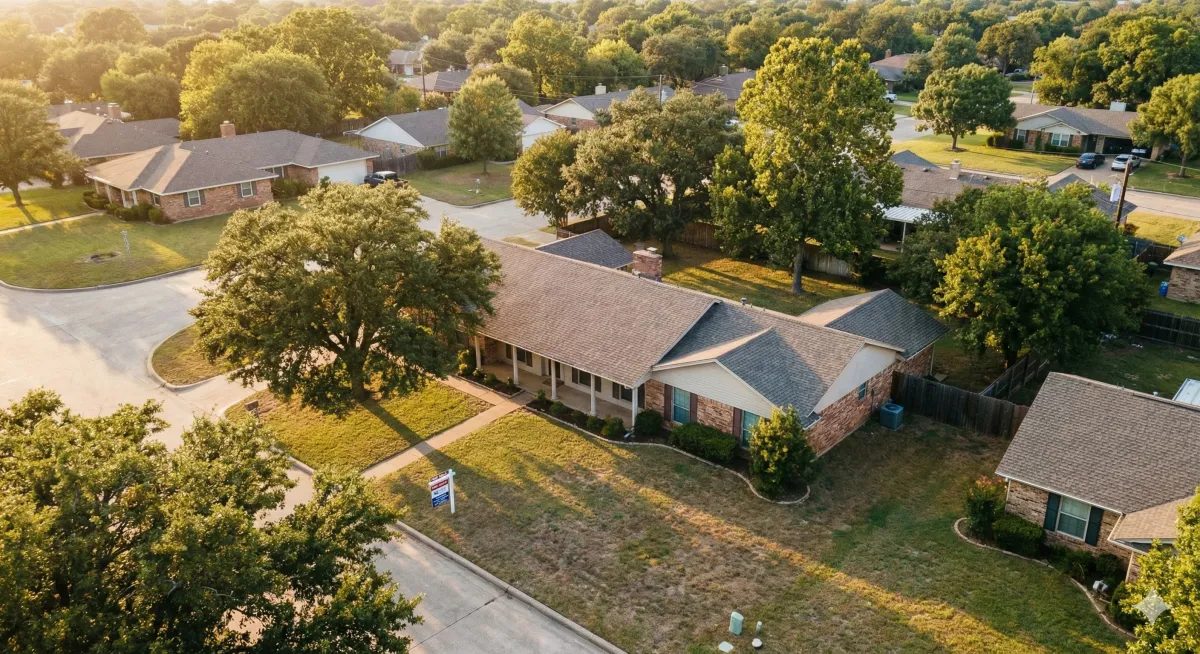
Selling a Parent's Home in Hurst, TX to Pay for Memory Care or Assisted Living: A Complete Family Guide
Last month, a daughter named Sarah called us three days after finding her mother wandering in the front yard at 2am. Mom had lived in their Hurst home for 37 years. The house was full of decades of memories, the kitchen hadn't been updated since 1992, and the foundation had that telltale crack running through the living room that everyone pretended not to notice.
Sarah wasn't calling about the house, though. Not really. She was calling because she'd just learned that memory care in the Mid-Cities costs $6,500 a month, the facility she wanted had exactly one opening, and she had maybe two weeks to figure out how to pay for it before that spot went to another family.
"I don't even know where to start," she said. "Do I list the house? Do I sell it to one of those 'we buy houses' people? How do I even sign anything when Mom can't remember what day it is?"
If you're reading this—probably late at night, probably exhausted, probably wondering how you're supposed to navigate a real estate transaction while also managing a parent's health crisis—this guide is for you.
You're not losing your mind. This is genuinely one of the hardest things a family can face. The fact that you're researching solutions means you're already doing better than you think.
Key Takeaways
- Memory care in the Hurst/HEB area costs $5,600-$7,500/month—and it's rising about 10% annually
- The Hurst real estate market is split: North Hurst (76054) averages $460K with 12.7% appreciation; South Hurst (76053) averages $305K and is declining
- You can sell a parent's home in 14-30 days with the right approach—you don't have to wait months
- A Durable Power of Attorney with "Real Property" authority is required before you can legally list or sell
- Bridge financing exists to cover $5,000-$7,000 move-in costs while the home sells
- You don't have to choose between fast and fair—but you do need to understand your options
Before We Talk About the House: How's Mom (or Dad) Doing?
Here's something most real estate investors won't ask you, because they're focused on the transaction: What's actually happening with your parent's health?
The house is the funding vehicle. It's not the problem to solve. The problem to solve is making sure your parent is safe, cared for, and that you have the resources to sustain that care for as long as they need it.
So before we dive into market data and legal requirements, let's acknowledge why you're really here. You're here because something has changed—or something is about to change—and the family home has suddenly become the key to unlocking the next chapter of your parent's life.
Signs it might be time to consider a care community include wandering or getting lost in familiar places, repeated falls or near-misses, medication mismanagement, inability to manage daily tasks like bathing or dressing, and—this is the one nobody talks about—when the person caring for them (probably you) is burning out.
If you're feeling like caregiving is consuming your life, that's not a personal failing. That's a signal that the current arrangement isn't sustainable. And selling the house to fund proper care isn't abandonment. It's often the most loving thing you can do.
For more on recognizing when it's time, see our guide on when home is no longer safe for aging parents.
What Memory Care and Assisted Living Actually Cost in Hurst
Let's talk real numbers, because the sticker shock is part of what makes this so overwhelming.
Assisted Living in the HEB Area (Hurst, Euless, Bedford)
Assisted living is for seniors who need help with activities of daily living—things like bathing, dressing, medication reminders—but don't require 24-hour skilled nursing or a secured memory care unit.
The base rent at assisted living communities in the Bedford/Hurst area typically ranges from $3,500 to $5,500 per month. Facilities like Brookdale Eden Estates and Heartis Mid Cities quote rates in the $4,350 to $5,900 range.
But here's what catches families off guard: that "base rate" usually covers the room and meals. Care is a separate line item, and it's charged in levels.
Level 1 (medication management): Add $500/month. Level 2 (bathing and dressing assistance): Add $1,000/month. Level 3 (incontinence care, transfer assistance): Add $1,500 or more per month.
This means a resident with moderate care needs should realistically budget $5,500 to $7,000 per month for assisted living in the Mid-Cities.
Memory Care in the HEB Area
Memory care units are secured environments with higher staffing ratios, designed specifically for residents with dementia or Alzheimer's. They typically cost 20-30% more than assisted living.
In the Hurst/Bedford area, memory care runs from $5,600 to over $7,500 per month. Some communities offer "all-inclusive" pricing (one flat rate covers everything), while others use the base-plus-levels model. The all-inclusive approach gives you predictability; the à la carte model might be cheaper in the early stages but escalates as the disease progresses.
The Inflation Problem Nobody Mentions
According to the 2024 Genworth Cost of Care Survey, assisted living costs are increasing at approximately 10% year-over-year—significantly outpacing general inflation. A facility costing $6,000 per month today will likely cost around $7,900 per month in just three years.
This matters because you're not just funding this month's care. You're trying to ensure the proceeds from your parent's home can sustain care for potentially years. The equity nest egg has to be large enough to absorb compound growth in costs.
For a deeper dive into these numbers, see our complete breakdown of assisted living costs in Dallas-Fort Worth.
What Your Parent's Hurst Home Is Actually Worth
Here's where it gets interesting—and where a lot of families get tripped up. The Hurst housing market isn't one market. It's two very different markets divided roughly by Highway 183.
North Hurst (76054): The Stronger Market
If your parent's home is in the 76054 zip code (generally north of Airport Freeway), you're in a position of relative strength. The median sale price in this sector has climbed to approximately $460,000, reflecting double-digit appreciation of 12.7% year-over-year. The price per square foot runs around $221.
Homes here are selling in an average of 54 days. That's longer than the pandemic frenzy of 2021-2022, but it reflects a buyer pool that's more discerning and willing to pay a premium for quality.
The strategic implication: If you're in 76054, you have more leverage, but buyers paying nearly half a million dollars expect move-in ready properties. The return on investment for cosmetic updates (paint, flooring, fixture updates) is significantly higher here.
South Hurst (76053): A Challenging Environment
The 76053 zip code tells a different story. The median sale price here is roughly $305,000, representing a year-over-year decline of about 4.26%. This is a buyer's market with rising inventory levels (up over 15%) and homes sitting for 39-60 days depending on the neighborhood.
If your parent's home is in this zone, pricing aggressively (slightly below market) is essential to securing liquidity. The expectation of bidding wars common in 2021-2022 is not aligned with current data. A "wait and see" pricing strategy risks stagnation and mounting holding costs that erode your net proceeds.
The "Aging Inventory" Problem
A substantial portion of Hurst's housing stock was built in the 1960s through 1980s. For adult children selling a parent's long-term residence, deferred maintenance is the single largest threat to equity preservation.
Three specific issues are endemic to this era of construction in North Texas:
Foundation volatility. Hurst sits on high-plasticity clay soils that expand when wet and shrink during droughts. This cyclical movement wreaks havoc on slab foundations. Minor stabilization (pressed pilings) typically costs $3,300-$7,000. Extensive failure requiring full perimeter underpinning can escalate to $15,000-$25,000 or more. Conventional lenders generally won't approve mortgages on homes with unrepaired structural defects, limiting your buyer pool to cash investors unless repairs are completed.
Cast iron plumbing crisis. Homes built before the mid-1980s typically use cast iron piping for sewer lines. After 40-50 years, these pipes corrode from the inside out. Worse, a leak under the slab introduces water into the clay soil, causing foundation heaving—so plumbing failure often causes foundation failure. Replacing under-slab plumbing via tunneling runs $15,000-$30,000.
Roof age and insurability. North Texas is a high-frequency hail zone. Many insurers now refuse to write new policies on roofs older than 15 years, or will only offer Actual Cash Value coverage rather than Replacement Cost. A full asphalt shingle replacement runs $7,500-$12,000 for an average home.
| System | Risk Level | Cost Exposure | Transaction Impact |
|---|---|---|---|
| Foundation | High (Soil Plasticity) | $3K - $25K+ | Deal killer. Precludes financing. Must be disclosed. |
| Plumbing | High (Cast Iron Age) | $15K - $30K | Major concession. Often discovered during inspection. |
| Roof | Moderate (Hail History) | $7.5K - $12K | Insurability issue. Buyer may demand replacement. |
| HVAC | Moderate (R-22 Phase-out) | $6K - $12K | Price deduction. Obsolete systems trigger negotiation. |
For more on navigating these issues, see our guide on selling a house with foundation problems in DFW.
The 113-Day Problem: Why Timing Matters More Than You Think
Here's the math that keeps families up at night.
A traditional home sale takes 45-60 days on market, plus another 30-45 days to close. That's 3-4 months from listing to cash in hand.
Meanwhile, memory care openings don't wait. When a facility tells you they have one available room, they mean it—and if you can't commit, that room goes to the next family on the waitlist. The "take it or lose it" pressure is real.
So what happens during that 90-120 day gap between when Mom needs care and when the house actually sells?
Holding costs accumulate. Property taxes, homeowners insurance, utilities (even minimal), and lawn maintenance don't stop because the house is empty. In Hurst, expect to pay $800-$1,200 per month just to keep a vacant home maintained.
Care costs start immediately. If memory care costs $6,000 per month and the traditional sale takes three months, that's $18,000 in care costs that has to come from somewhere before the house closes.
Insurance coverage can lapse. Here's a trap most families don't know about: Standard homeowner policies typically void coverage for vandalism, glass breakage, and water damage if the property is vacant for more than 60 days. In North Texas, the risk of pipe bursts during winter freezes is significant. If a pipe bursts in a vacant, unmonitored home and the insurer deems it "vacant" without the proper endorsement, the claim will be denied. Vacant home policies cost 50-60% more than standard coverage.
The Real Cost of the Gap: The time between when Mom needs care and when a traditional sale closes can cost families $15,000-$25,000 in combined holding costs and care expenses—often exceeding any "premium" they might have gained from a longer marketing period.
This is why we talk about how families actually move into senior living this week—because the funding gap is the missing piece most families don't anticipate.
Your Three Options for Selling
Adult children navigating this situation have three primary paths. Each has trade-offs, and the right choice depends on your specific circumstances—the home's condition, your timeline, and how urgently care funds are needed.
Option A: Traditional Sale (MLS Listing with Agent)
This path targets owner-occupant buyers and typically yields the highest gross price.
Timeline: 3-4 months from listing to close.
What it requires: The home must be cleared of personal property, cleaned, staged (ideally), and free of major structural defects. Buyers financing through FHA, VA, or conventional loans will require inspections, and lenders won't approve mortgages on homes with unaddressed foundation, plumbing, or roof issues.
Best for: Homes in good condition (especially in 76054), families who have several months to wait, and situations where maximizing gross sale price is the priority.
Tax note: This path maximizes your ability to use the Section 121 Capital Gains Exclusion ($250K for single/$500K for married), provided your parent lived in the home for at least two of the last five years.
Option B: List As-Is with Agent
This middle path lists the home on the MLS but targets investors and buyers comfortable with renovation projects.
Timeline: 60-90 days.
What it requires: Full disclosure of all known issues. The home doesn't need to be repaired, but it does need to be accessible for showings and cleared of enough clutter for buyers to evaluate the space.
Price expectation: Typically 75-80% of what a move-in ready comparable home would sell for. An outdated 1970s ranch in Hurst that would sell for $350,000 fully updated might bring $265,000-$280,000 as-is on the open market.
Best for: Families who want market exposure and competitive bidding but can't (or don't want to) invest in repairs.
Option C: Direct Sale to Cash Buyer
This path skips the open market entirely and sells directly to an investor or company that purchases homes for cash.
Timeline: 7-30 days from agreement to close.
What it requires: Nothing. Serious cash buyers will purchase homes in any condition, full of belongings, with foundation issues, with tenants in place—whatever the situation is.
Price expectation: Cash buyers typically offer 70-80% of the After Repair Value (ARV), minus the cost of repairs they'll need to make. This sounds like a steep discount until you factor in the traditional sale costs you're avoiding: 6% in agent commissions, 2% in closing costs, 3-4 months of holding costs, and potentially tens of thousands in care costs during the waiting period.
Best for: Crisis situations where care placement is urgent, homes with significant structural issues that would fail conventional financing, and families who need liquidity now rather than maximum price later.
| Factor | Traditional Sale | As-Is with Agent | Direct Cash Sale |
|---|---|---|---|
| Timeline | 3-4 months | 2-3 months | 7-30 days |
| Gross Price | Highest (100%) | Medium (75-80%) | Lower (70-80% of ARV minus repairs) |
| Agent Commission | 5-6% | 5-6% | $0 |
| Repairs Required | Yes | No | No |
| Cleanout Required | Yes | Partial | No |
| Inspection Contingency | Yes | Yes | No |
| Deal Fall-Through Risk | Higher | Medium | Low |
Warning: Predatory Practices to Watch For
Not all cash buyers operate ethically. Watch out for these red flags:
- "Subject to" schemes: The investor takes the deed but leaves your parent's mortgage in place (and often unpaid)
- No proof of funds: Legitimate cash buyers can provide a bank statement or letter from their lender showing they have the funds to close
- Pressure tactics: "Sign today or the offer expires"—reputable buyers give you time to think
- No title company involvement: Always close through a reputable title company, never directly
For more on vetting cash buyers, see our guide: We Buy Houses for Cash—Here's How to Know If You're Getting Scammed.
The Legal Requirements You Can't Skip
In many cases, the physical condition of the house is secondary to the legal authority to sell it. If your parent is suffering from cognitive decline, they may not be able to legally sign a deed or listing agreement. Establishing your authority is the prerequisite to any market activity.
Power of Attorney Requirements
The cornerstone of asset management for an incapacitated parent is the Texas Statutory Durable Power of Attorney.
It must be specific. The document must explicitly grant the agent (you) authority for "Real Property Transactions." A general POA that's vague about real estate may be rejected by title company underwriters.
Durable is better than springing. A "Durable" POA remains effective if the principal (your parent) becomes incapacitated. A "Springing" POA only kicks in upon incapacity—which sounds sensible but often requires letters from two physicians certifying the incapacity. This creates delays and scrutiny. For real estate transactions, durable is vastly preferred.
It must be recorded. To sell the property, the POA must be recorded in the Real Property Records of Tarrant County.
Recency matters. Title companies are wary of "stale" POAs signed 10-15 years ago. You may need to provide an "Agent's Certification" or affidavit stating the POA has not been revoked.
If Your Parent Has Already Passed
When there's no will or the family wants to avoid full probate, the path to sale becomes more complicated.
Affidavit of Heirship. This document, filed in county records, describes the family history and asserts who the heirs are. It's often promoted as a "cheaper, faster" alternative to probate. However, there's a significant catch: Texas law states that an Affidavit of Heirship is only prima facie evidence of title after it's been on file for five years. Most title companies in Tarrant County won't insure a sale based on an AOH filed less than five years ago.
Some title companies will accept a recent AOH if strict criteria are met: all heirs sign the deed, two disinterested witnesses (who knew the deceased for 10+ years and aren't beneficiaries) swear to the facts, and there are no debts owed by the estate.
Judicial Determination of Heirship. If title companies reject the AOH, you're looking at a court process in Tarrant County Probate Court. The court appoints an independent attorney to investigate and find unknown heirs. Timeline: 3-9 months. Cost: $2,500-$5,000+ in legal fees.
Muniment of Title. If there is a will but no need for estate administration (no debts other than the mortgage), probating the will as a "Muniment of Title" is a streamlined option. It essentially validates the will and treats it as a deed transfer to beneficiaries.
For more detail, see Can You Sell an Inherited House Without Probate in Texas?
Tax Strategies to Know About
Section 121 Exclusion. If your parent lived in the home as their primary residence for at least 2 of the last 5 years, up to $250,000 of capital gains ($500,000 for married couples) can be excluded from federal taxes.
Tax Deferral Affidavit (Form 50-126). For homeowners 65 and older, Texas allows deferral of property tax collection. Taxes aren't forgiven—they accrue at 5% simple interest annually—but this can preserve cash during the transition. The total becomes due 180 days after the sale.
Step-up in basis. For inherited homes, the cost basis "steps up" to the fair market value at the date of death. This can dramatically reduce capital gains taxes if you sell shortly after inheriting.
Bridge Financing: Covering Move-In Costs Before the Sale
Here's a common scenario: Mom needs placement now. The facility wants a $5,000-$7,000 move-in deposit plus the first month's rent. The house is full of 40 years of belongings and hasn't been listed yet. Where does the cash come from?
This is the "liquidity gap," and specialized financial products exist to bridge it.
Senior Care Bridge Loans
Companies like ElderLife Financial and Second Act specialize in lending to families during senior care transitions. These are short-term lines of credit (typically 12 months) designed to pay the facility directly. They're usually structured as interest-only loans, with the principal balloon payment due when the home sells.
Interest rates are higher than mortgage rates, and origination fees apply. But they enable families to choose the best facility immediately rather than being forced into a "fire sale" of assets or settling for whatever community has availability when the money finally comes through.
How One Family Made It Work
We worked with a gentleman named Sherwood in Burleson who was moving with his wife to assisted living after he'd suffered a stroke. They simply didn't have the finances to cover the move-in deposits and secure the apartment while also maintaining the house.
Our company was able to cover their move-in costs—the community fees, the non-refundable deposits that typically range from $4,000 to $8,000—as part of the home purchase. Within 30 days of meeting with them, they were situated in their new community without having to deplete savings they didn't have.
For families in similar situations, this kind of bridge financing can mean the difference between immediate placement and months of dangerous waiting.
HELOC limitations: If you're thinking about a Home Equity Line of Credit, know that most banks won't issue a HELOC on a home that's currently listed for sale. If you anticipate needing liquidity, the HELOC must be secured before the listing agreement is signed.
Learn more about funding options in Selling Mom's House to Pay for Assisted Living: What DFW Families Need to Know.
VA Benefits Most Families Miss
If your parent—or their late spouse—served in the military during wartime, there's a significant benefit that often gets overlooked entirely.
Aid and Attendance Pension (2025 Rates)
The VA's Aid and Attendance benefit provides monthly income to help cover the cost of care. Current maximum rates are approximately $2,358/month for a single veteran, $2,795/month for a married veteran, and $1,515/month for a surviving spouse.
That surviving spouse benefit is particularly important. Many widows and widowers have no idea they qualify for over $1,500 per month simply because their late spouse served during a qualifying war period.
The Asset Timing Trap
Here's where it gets strategic: The home is an exempt asset for A&A eligibility while it's owned. But once sold, the cash proceeds count toward the VA's net worth limit (set at $163,699 effective December 2025).
This means selling the home before applying for A&A can disqualify your parent due to excess assets. Conversely, selling after approval requires immediate spend-down or financial planning (such as a Medicaid-compliant annuity) to avoid losing the benefit.
The timing of the home sale versus the VA application matters enormously. Get this wrong and you could cost your family tens of thousands of dollars in benefits.
For the full breakdown, see Can't Afford Assisted Living? This Overlooked VA Benefit Could Help.
Managing the Move: What to Do With 40 Years of Stuff
The logistics of emptying a family home while simultaneously managing a parent's health crisis can push even the most capable adult children to the breaking point.
Senior Move Managers
If you have the budget, Senior Move Managers (SMMs) specialize in exactly this situation. They create floor plans for the new facility apartment to ensure furniture fits, manage the packing and moving, and organize the liquidation of remaining items.
Local providers serving the HEB area include A Changing Season, which specializes in senior relocation in Dallas/Fort Worth, and RetireEase Move Management, a member of the National Association of Senior Move Managers.
Estate Sales and Liquidation
Estate sale companies typically charge 30-40% commission on gross sales. For a sale to be viable, there generally needs to be $5,000-$10,000 worth of sellable items. For items of lower value, charities like Mission Central in Hurst or 6 Stones in Bedford may offer pickup services, providing a tax deduction rather than cash.
What to Bring to a Memory Care Room (300 sq ft)
- Comfortable recliner or favorite chair
- Small dresser (facilities often provide bed and nightstand)
- Family photos in unbreakable frames
- Familiar bedding or quilt
- A few treasured decorative items
- Comfortable, easy-to-put-on clothing (labeled with name)
- Toiletries (check with facility for restrictions)
- Important documents (kept with you, not in the room)
For a complete guide, see What to Pack (and Leave Behind) When Moving a Parent to Assisted Living.
Taking Care of Yourself Through This
We need to talk about something that doesn't show up in the real estate data or the care cost spreadsheets: what this transition does to you.
Caregiver burnout is real. The signs include withdrawal from friends and activities you used to enjoy, changes in sleep patterns or appetite, feeling hopeless about your situation, and increasing irritability—especially with the parent you're caring for.
Here's what nobody tells you: the guilt you feel about "putting Mom in a home" is normal, but it's often based on outdated assumptions about what senior living looks like. Modern memory care communities are designed around dignity and engagement. The alternative—a parent wandering at night while an exhausted adult child tries to provide 24/7 supervision—is often far less dignified for everyone involved.
If you're feeling like you're losing your mind, you're not. This is genuinely one of the hardest things a person can go through. The fact that you're researching how to do this well—instead of just shutting down—says something important about who you are.
The Alzheimer's Association North Central Texas Chapter runs caregiver support groups specifically in the HEB area. Sometimes just being in a room with people who understand—who don't need you to explain why this is so hard—makes all the difference.
For more on navigating the emotional side, see Taking Care of My Mom Is Killing Me: What to Do When You've Hit the Breaking Point.
Local Hurst Resources
Transportation and Aging Services
- NETS (Northeast Transportation Service): Door-to-door paratransit for Hurst, Euless, Bedford residents 65+ or disabled. Cost: ~$2.50 per one-way trip. Covers medical appointments, shopping, social visits.
- Meals on Wheels Tarrant County: Provides nutritious meals and daily safety checks for homebound seniors. No income restriction.
- Area Agency on Aging of Tarrant County: Provides an Ombudsman—a neutral advocate who visits facilities and can offer insight into local community quality.
Facility Research Tools
- Texas HHSC TULIP Database: Look up state inspection reports and substantiated complaints for any licensed facility. Search by facility name to see "Scope and Severity" of deficiencies.
- Placement Services: Companies like CarePatrol of Northwest DFW help families identify appropriate communities at no cost to the family (they're paid by the facilities).
Frequently Asked Questions
Can I sell my deceased parent's house without probate in Texas?
Sometimes. Texas offers several alternatives to full probate, including the Affidavit of Heirship (if all heirs agree and there are no debts) and Muniment of Title (if there's a will but no need for administration). However, the five-year seasoning requirement for Affidavits of Heirship means many title companies won't insure a sale based on a recently filed AOH. Each situation is different—consult with an elder law attorney to determine your options.
How much does assisted living cost in Hurst, TX?
Base rates for assisted living in the Hurst/Bedford/Euless area range from $3,500 to $5,500 per month. However, care is typically charged separately in "levels." A resident with moderate care needs should budget $5,500-$7,000 per month total. Memory care runs $5,600-$7,500 per month or higher.
Will Medicare pay for assisted living in Texas?
No. Medicare does not cover room and board at assisted living facilities. It may cover certain skilled nursing services delivered at an assisted living community, but not the residential cost itself. Families typically fund assisted living through private pay (often from home equity), long-term care insurance, VA Aid & Attendance benefits, or Medicaid waiver programs (which have limited availability and waitlists).
When can a nursing home take your house in Texas?
The home is generally an exempt asset for Medicaid eligibility purposes while owned. However, upon the beneficiary's death, Texas is required to attempt recovery of Medicaid costs from the estate through MERP (Medicaid Estate Recovery Program). A "Lady Bird Deed" (Enhanced Life Estate Deed) is a Texas-specific legal instrument that can potentially shield the home from MERP recovery by transferring it outside of probate. Legal counsel is mandatory for this strategy.
How do you sell inherited property with multiple owners in Texas?
All owners (heirs) must agree to the sale and sign the deed. If heirs disagree, one option is a partition action in court, which forces a sale—but this is expensive and contentious. In most cases, families benefit from having honest conversations early and, if necessary, having one heir buy out the others' interests rather than selling the entire property.
Is selling a house for cash a good idea?
It depends on your priorities. Cash sales are faster (7-30 days vs. 3-4 months), require no repairs or cleanout, and carry less risk of deals falling through. The trade-off is typically a lower gross price. For families facing urgent care needs, homes with significant structural issues, or situations where minimizing stress is the priority, a cash sale often makes sense. For homes in good condition where the family has time, a traditional sale may yield more net proceeds.
What disqualifies you from assisted living?
Assisted living facilities can decline residents whose care needs exceed what they're licensed to provide. Common disqualifiers include requiring 24-hour skilled nursing care, certain behavioral issues (aggression, wandering without appropriate supervision available), and inability to participate in evacuation during emergencies. Memory care communities are specifically designed for residents with dementia and have fewer behavioral disqualifiers.
You Don't Have to Figure This Out Alone
If there's one thing we want you to take from this guide, it's this: you have options, and you don't have to navigate this alone.
At Sage Senior Support, we've walked this path with families across the Mid-Cities—including our own family, when we helped Logan's grandfather transition after the loss of his grandmother. We've seen the 2am panic searches. We've sat at kitchen tables covered in decades of memories and helped families find a path forward.
Our approach is different from typical "we buy houses" companies. We start by asking how Mom or Dad is doing—because understanding the care situation comes before talking about the house. We'll walk you through all your options, even if the best option for your family isn't selling to us.
Some families need to list traditionally. Some need a fast cash sale. Some need bridge financing to cover move-in costs while they figure out the rest. We help you see the full picture so you can make the decision that's right for your situation.
Ready to Explore Your Options?
Whether you're just starting to think about this transition or you're in crisis mode and need to move quickly, we're here to help.
Or call us directly: We answer our phones, even on weekends.