
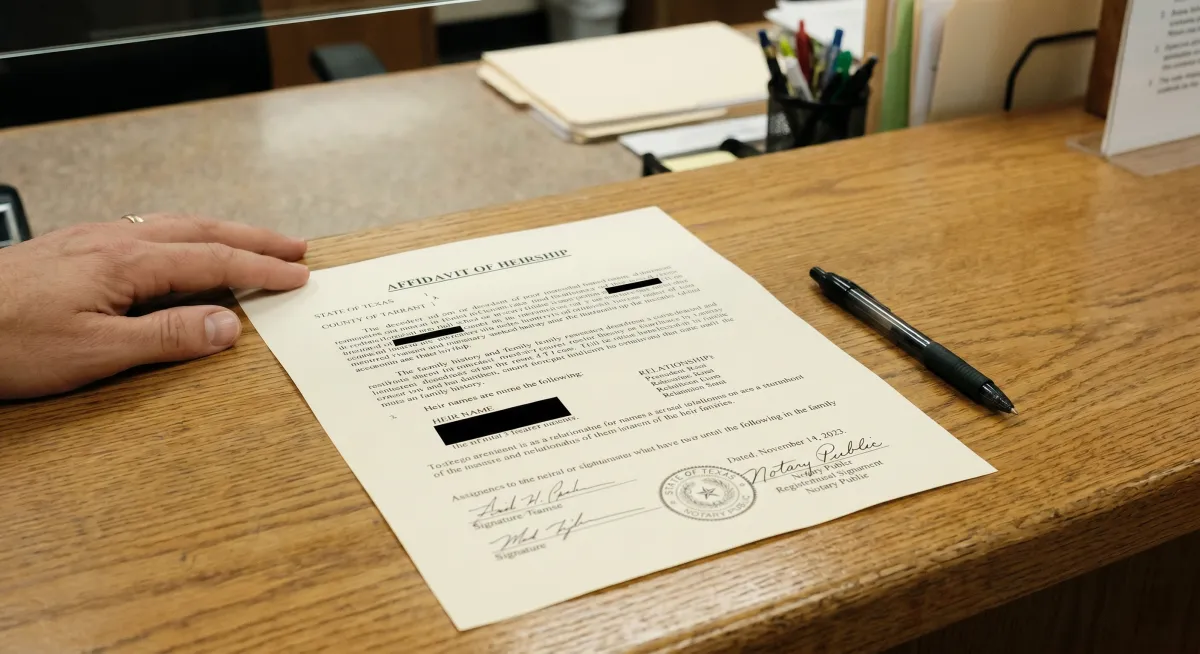
Is an Affidavit of Heirship Enough to Sell a House in Texas?
You're standing in your parent's house — maybe the one they lived in for 40 years — and you're trying to hold it together. There's grief, there's family pressure, there's a stack of mail you haven't opened, and somewhere in the back of your mind is the question that brought you here: "Do we need to go through probate, or can we just use an Affidavit of Heirship to sell this house?"
It's a completely reasonable question. And the fact that you're asking it before you're already in the middle of a sale puts you ahead of a lot of families we talk to — families who discovered the answer at the closing table, when it was too late to avoid a costly delay. You're right to be concerned. This decision matters more than most people realize, and the answer isn't as simple as a quick Google search makes it sound.
Let's walk through what an Affidavit of Heirship actually does, when it's enough, when it's not, and what you'll need to know before you commit to a path — so you can move forward with clarity instead of regret.
🔑 Key Takeaways
- An Affidavit of Heirship can be enough to sell a house in Texas — but only under specific conditions: no valid will, all heirs in agreement, no significant debts or liens, and the title company accepts it.
- If a valid will exists, you cannot use an Affidavit of Heirship to bypass probate. The will must be formally probated or admitted as a Muniment of Title.
- Title companies have the final say. They can — and often do — refuse to insure a property based solely on an Affidavit, especially in complex situations.
- Hidden costs are real: title curative work can run $5,000–$20,000+, and carrying costs of $500–$2,000/month add up fast while delays drag on.
- Cash buyers in DFW will often accept Affidavits, but typically at 15–30% below market value to offset their title risk.
- A $1,000 consultation with a Texas estate attorney now can save you $10,000+ and months of delays later.
- The Texas Estates Code §203.001 governs Affidavits of Heirship — including a five-year residency rule many families don't know exists until it's already a problem.
What Is an Affidavit of Heirship and How Does It Work in Texas?
An Affidavit of Heirship is a legal document that establishes presumptive heirship for real property in Texas — without going through formal probate court. It's governed by Texas Estates Code §203.001, which allows such affidavits to be used as evidence of heirship under specific conditions.
Here's what that means in plain language: the affidavit tells the world who the heirs are. It doesn't go before a judge. It doesn't require a court order. It's a sworn statement — signed, witnessed, notarized, and recorded in the county where the property is located — that says, "This is who inherited this property when the owner died."
What it does not do is equally important. An Affidavit of Heirship does not clear liens, debts, or claims against the estate. It does not override a valid will. It does not guarantee that a title company will insure the property for a buyer. And it does not provide the same legal certainty as a court order from formal probate. If you're trying to sell an inherited house without going through probate in Texas, an Affidavit is one tool — but it's not always the right one.
To be valid under Texas law, an Affidavit of Heirship must:
- Be signed by a knowledgeable non-heir (or an heir with direct personal knowledge of the family history)
- Be witnessed by two disinterested parties who are at least 12 years old and are not beneficiaries
- Be notarized
- State specific family history facts — births, deaths, marriages, and the family relationships that establish heirship
- Be recorded in the county where the property is located
Families often gravitate toward Affidavits because they seem faster and cheaper than formal probate. And in simple situations, they can be. But "simple" is the operative word — and many families discover their situation isn't as simple as they thought once they're already in the process. For a deeper look at how this compares to the formal alternative, our guide on navigating the probate process with an elderly parent walks through what formal probate actually involves.
The Five-Year Residency Rule (And When It Matters)
Here's a rule that catches families completely off guard: Texas Estates Code §203.001(a)(2) generally requires the affiant — the person signing the Affidavit — to have lived in the family's established community for at least five years. The purpose is to ensure the affiant has genuine, intimate knowledge of the family's history, not just a secondhand understanding.
Exceptions exist if the affiant is an heir themselves or has other demonstrable, direct knowledge of the family's history. But if the most knowledgeable person you can find to sign the affidavit is a neighbor who moved to the area three years ago, or a cousin who only reconnected with the family recently, you may have a problem.
This waiting period can delay the marketability of the property if the primary person who could sign the affidavit doesn't meet the requirement. Many families don't realize this rule exists until they're ready to sell and suddenly discover they have to wait — or find an alternative signer — before they can move forward.
💛 You're Not Alone in This Confusion
Most families don't know the difference between an Affidavit of Heirship and probate until they're already in the middle of selling. The fact that you're researching this now puts you ahead — you can make an informed decision instead of discovering problems at the closing table. We've talked with hundreds of families in exactly this situation, and the questions you're asking are exactly the right ones.
The Short Answer: Is an Affidavit of Heirship Enough to Sell a House in Texas?
It depends on your specific situation. That's not a dodge — it's genuinely the most honest answer available, and any attorney or title professional who tells you otherwise without knowing your circumstances is oversimplifying.
An Affidavit of Heirship can be enough to sell a house in Texas, but only when several conditions align: there's no valid will, all heirs are in agreement and cooperating, the estate has no significant debts or liens, and — critically — the title company is willing to insure the property based on the affidavit.
If a valid will exists, there are disputed heirs, significant debts, or the title company deems the risk too high — no, an Affidavit of Heirship alone won't be enough. You'll likely need formal probate or a Muniment of Title instead.
The piece that surprises most families is this: the title company has the final say. They are under no legal obligation to insure a property based on an Affidavit of Heirship if they believe the risk is too high. And in the DFW market, underwriters are increasingly scrutinizing these transactions. Many DFW families discover too late that their Affidavit isn't enough, leading to costly title curative work or a delayed sale that erodes the equity they were counting on.
For a detailed side-by-side look at both paths, our resource on selling an inherited home in probate vs. using an Affidavit of Heirship breaks down the trade-offs in depth.
Not Sure Which Path Is Right for Your Family?
If you're trying to figure out whether an Affidavit of Heirship makes sense for your specific situation, talking with someone who understands both the legal and emotional side of inherited home sales can save you months and thousands of dollars. That's exactly the kind of conversation we have every day — no pressure, just clarity.
When an Affidavit of Heirship IS Sufficient to Sell
There are genuine situations where an Affidavit of Heirship works well and gets the job done. Here's what that scenario typically looks like:
- No valid will exists. If the deceased died intestate — without a will — an Affidavit of Heirship can establish heirship directly under Texas intestacy law. There's no competing document to navigate around.
- All heirs are in agreement. Every known heir must consent and cooperate. If even one heir disputes the heirship, is unreachable, or refuses to participate, the Affidavit becomes legally problematic and title companies will flag it immediately.
- The estate is simple and solvent. No significant debts, no Medicaid liens, no unpaid property taxes, no creditor claims — beyond a standard mortgage that will be paid off at closing.
- The title company accepts it. This is the critical gate. Some DFW underwriters are more comfortable with Affidavits than others, particularly when the supporting documentation is strong and the family history is clear.
- No minor or incapacitated heirs are involved. When all heirs are adults with full legal capacity, the process is significantly simpler. Minor heirs require court oversight to protect their interests.
- The property has clear title history. No prior title defects, boundary disputes, or unresolved ownership questions from previous transfers.
- The buyer is a cash buyer willing to accept the Affidavit. Traditional lenders — the banks behind conventional mortgages — typically require clearer title than an Affidavit provides. Cash buyers have more flexibility, though they price that risk into their offer.
Many families in this situation are also racing against time financially. If you're trying to sell Mom's house to pay for assisted living in DFW, the urgency is real — and understanding whether an Affidavit will actually get you to closing quickly, or whether it will create delays, is critical to your care funding plan.
When an Affidavit of Heirship Is NOT Enough
This is where families get into trouble. The situations where an Affidavit of Heirship falls short are more common than most people expect — and discovering the problem mid-sale is expensive and stressful.
- A valid will exists. This is the most important one. If there's a will — even one that's old, informal, or handwritten — it must be formally probated or admitted as a Muniment of Title. An Affidavit of Heirship cannot override or bypass a will. Attempting to do so creates a significant title defect that most title companies will refuse to insure.
- Heirs are in dispute or one heir refuses to cooperate. If family members disagree about who should inherit, how the property should be handled, or simply can't be located, formal probate or a partition lawsuit is necessary to establish clear title.
- There are significant debts, liens, or claims against the estate. Medicaid Estate Recovery liens, unpaid property taxes, creditor claims, or outstanding mortgage debt must be addressed through formal probate — not papered over with an Affidavit. An Affidavit does not clear these obligations.
- Minor or incapacitated heirs are involved. The court must oversee transactions involving heirs who cannot legally act on their own behalf. There's no shortcut here.
- The title company refuses to insure based on the Affidavit. This is increasingly common in DFW as underwriters tighten their standards. A refusal means you cannot close without additional steps — either a quiet title action or formal probate.
- Unknown or undiscovered heirs may exist. If there's any possibility of heirs the family isn't aware of — a child from a prior relationship, an estranged sibling — title companies will require a quiet title action or formal probate before they'll insure.
- The property is high-value or has a complex ownership history. Title companies prefer court certainty for high-stakes transactions. The higher the value, the more exposure they have if an unknown heir surfaces later.
- The sale is to a buyer with a traditional mortgage. Most conventional lenders require clear, court-ordered title. If your buyer is financing the purchase, an Affidavit of Heirship alone almost certainly won't satisfy the lender's title requirements.
One of the most significant and often overlooked issues is Medicaid. If your parent received Medicaid benefits for long-term care, the state of Texas may have a claim against the estate through the Medicaid Estate Recovery Program. Understanding how Texas Medicaid Estate Recovery affects inherited property sales is essential before you assume an Affidavit will be sufficient — because these liens don't disappear just because you filed a document at the county clerk's office.
⚠️ Red Flags That Your Affidavit of Heirship Could Create Problems
If any of these apply to your situation, consult a Texas estate attorney before relying on an Affidavit. These are the scenarios where families most commonly discover — too late — that they needed probate or a quiet title action instead.
- You're not sure whether a will exists, or you found conflicting documents
- One or more heirs are unreachable, estranged, or refusing to cooperate
- The deceased had significant debts, unpaid taxes, or received Medicaid benefits
- You're selling to a buyer who is financing the purchase with a traditional mortgage
- The title company has already expressed concerns or asked for "additional documentation"
- The property has been in the family for decades and the ownership history is unclear
- You're under time pressure to sell quickly and cannot afford delays if title issues arise
- You discovered a will late in the process, after already starting the Affidavit route
The Real Costs: What You'll Actually Pay with an Affidavit of Heirship
Families often choose the Affidavit route because it looks cheaper on paper. And upfront, it is. But the full financial picture is more complicated — and the hidden costs can quickly exceed what formal probate would have cost.
Here's a realistic breakdown of what you might actually spend:
- Affidavit preparation by an attorney: $750–$2,500+ depending on complexity and local DFW rates. Don't try to do this with an online template — defective affidavits are one of the most common reasons title companies refuse to insure.
- Notary fees: $5–$20 (minimal, but required).
- County Clerk filing fees: Under $100 (varies by county).
- Title insurance underwriting fees: Often higher than standard because title companies charge extra for insuring over an Affidavit due to the increased risk they're accepting.
- Potential title curative work: $5,000–$20,000+ if the title company requires a quiet title action or additional documentation before they'll insure. This is not a rare outcome — it's increasingly common in DFW.
- Heir location services: $500–$2,000+ if heirs are difficult to find or verify.
- Deed preparation and transfer costs: $300–$750+.
- Carrying costs during delays: $500–$2,000+/month in property taxes, insurance, HOA fees, and utilities. Over 6–12 months, that's $3,000–$24,000+ in equity that simply evaporates while you're waiting for title issues to resolve.
- Price reduction for cash buyers: 15–30% below market value because buyers are pricing in the title risk they're accepting.
For comparison: formal probate typically costs $3,000–$10,000+ in legal fees, but it produces a court-ordered title that title companies readily insure, opens the property to the full buyer pool including traditional lenders, and formally addresses any debts or disputes. When you add up the potential hidden costs of the Affidavit route, formal probate often ends up being the more economical choice — especially for complex estates.
The carrying costs alone deserve serious attention. If you're managing a care transition and counting on home sale proceeds to fund your parent's care, understanding how families are funding senior living costs and the role of home sales in that equation can help you see why a 6–12 month delay isn't just an inconvenience — it's a financial crisis.
Why Title Companies Often Require More Than Just the Affidavit
Title companies aren't being difficult when they ask for more documentation — they're managing real financial risk. If they insure over a defective Affidavit and an unknown heir surfaces two years after closing with a valid claim to the property, the title company is liable. That's not a hypothetical risk; it's the reason title insurance exists.
In DFW, major underwriters like Fidelity National, First American, Stewart, and Old Republic typically require corroborating evidence alongside the Affidavit: death certificates, birth records, marriage licenses, and often affidavits from multiple knowledgeable individuals — not just one. Some require a five-year waiting period or specific endorsements to reduce their exposure. And if their risk assessment is high enough, they may demand a quiet title action before they'll insure at all — adding $5,000–$20,000+ and two to four months to your timeline.
Understanding what the specific title company will require before you commit to the Affidavit route can save you months of frustration and thousands of dollars. Ask upfront. Don't wait until you're at the closing table to find out.
The DFW Market Reality: What Title Companies and Cash Buyers Actually Accept
The DFW market has its own dynamics that shape how Affidavits of Heirship play out in practice. Here's what families actually encounter when they try to sell an inherited home in the Metroplex.
DFW title companies vary significantly in their acceptance of Affidavits. Major underwriters like Fidelity, First American, and Stewart all have specific guidelines — but those guidelines aren't uniform, and they're not publicly posted. What one underwriter accepts with minimal conditions, another may refuse without a quiet title action. The only way to know is to ask.
Most DFW title companies require additional underwriting when insuring over an Affidavit, including corroborating documents and sometimes escrow holdbacks to protect against future claims. This adds time and cost to every transaction.
Cash buyers in DFW will often purchase "as-is" with an Affidavit — but they price the risk into their offer. Expect 15–30% below what the home would fetch on the open market. Many cash buyers will also require a quiet title action before closing, which extends the timeline to 6–12 months and costs $5,000–$20,000+. If you're considering this route, our guide on selling a house fast with cash buyers explains what to expect from the process and how to evaluate offers fairly.
Traditional real estate agents in DFW often discourage Affidavits because they complicate the sale and dramatically limit the buyer pool. Most buyers using conventional financing cannot purchase a property with only an Affidavit of Heirship as the basis for title.
DFW probate court backlogs in Tarrant and Dallas Counties can delay formal probate 6–18+ months, which sometimes pushes families toward Affidavits despite the risks. Independent Administration typically takes 6–12 months; Dependent Administration can stretch to 12–24 months. Muniment of Title — a streamlined option when a will exists and there are no debts — typically takes 3–6 months.
Inherited homes in DFW often date from the 1950s–1980s, with deferred maintenance that makes cash buyers more willing to accept title risk if the price is right. But that willingness comes with a discount — and families who don't understand the market dynamics often accept offers that are far lower than necessary.
As the DFW market has cooled entering 2026, carrying costs and the desire for a quick sale are becoming more prominent — but title company scrutiny is simultaneously increasing. Understanding how DFW real estate trends affect inherited property sales can help you time your decision and set realistic expectations for what the market will bear.
Feeling Overwhelmed by the Decision?
We help families in DFW understand their options and choose the path that works best for their situation — not just the fastest or the most convenient. If you're trying to figure out whether to pursue an Affidavit, probate, or something else entirely, let's talk through it together. No pressure, just honest guidance from people who've been through this journey themselves.
Probate vs. Affidavit of Heirship: A Side-by-Side Comparison
When you're trying to make this decision under emotional pressure, a clear comparison helps. Here's how the two paths actually stack up across the dimensions that matter most to families selling inherited homes in DFW.
| Factor | Affidavit of Heirship | Formal Probate |
|---|---|---|
| Timeline | 1–3 months if accepted; 6–12+ months if title curative work is needed | 6–18+ months depending on type (Muniment: 3–6 months; Independent: 6–12 months) |
| Upfront Cost | $750–$2,500+ in legal fees | $3,000–$10,000+ in legal fees |
| Total Cost Risk | $5,000–$20,000+ if title issues arise | Predictable; clear title at the end |
| Title Certainty | Presumptive; title company may refuse to insure | Court-ordered; title companies readily insure |
| Buyer Pool | Limited to cash buyers or investors willing to accept risk | Full buyer pool including traditional lenders |
| Debt Handling | Does NOT clear debts or liens | Formally addresses and settles debts |
| Dispute Resolution | No court mechanism if heirs disagree | Court oversees and resolves disputes |
| Will Required? | Best used when NO will exists | Required if a will exists; also used without a will |
| Best For | Simple estates, all heirs in agreement, no debts, cash buyer | Complex estates, debts, disputes, high-value property, traditional buyer |
For families who want a thorough understanding of the formal probate process as an alternative, the Texas probate guide covers the full process, timelines, and what to expect at each stage. And if you're specifically weighing your options for a Dallas-Fort Worth inherited property, our guide on selling an inherited house in Dallas-Fort Worth covers the local nuances that matter.
💡 Questions to Ask Your Estate Attorney Before You Choose
Before committing to an Affidavit of Heirship, bring these questions to your attorney. Their answers will clarify which path is right for your situation and help you avoid costly surprises.
- "Is an Affidavit of Heirship the most appropriate tool for my specific family situation and property?"
- "What additional documentation will the title company require, and how long will that take to gather?"
- "What is the estimated total cost, including potential title curative work if issues arise?"
- "What are the risks if an unknown heir surfaces after closing, and how would that affect the sale?"
- "Can you provide references from DFW title companies you work with regularly on inherited property transactions?"
- "If we go with an Affidavit and run into title issues, what's the backup plan and how much will it cost?"
Common Mistakes Families Make with Affidavits of Heirship
We've seen families make the same mistakes repeatedly — not because they're careless, but because they're overwhelmed and operating with incomplete information. Here's what to watch out for.
- Assuming an Affidavit is always faster than probate. If title issues arise, curative work can take longer and cost more than formal probate would have. The "faster" path can easily become the slower one.
- Not verifying all heirs are in agreement before starting. Discovering a dispute mid-process — after you've already paid for the Affidavit and listed the property — can derail the entire sale and leave you starting over from scratch.
- Skipping the attorney consultation. Families often try to DIY the process using online templates, resulting in defective affidavits that title companies reject outright. The money saved on the attorney is lost many times over in delays and curative costs.
- Not gathering supporting documents upfront. Death certificates, birth records, and marriage licenses should be collected before the affidavit is drafted — not scrambled for after the title company asks for them.
- Underestimating carrying costs. Families focus on the Affidavit preparation cost and forget that property taxes, insurance, HOA fees, and utilities continue to accrue every month while the sale is delayed. At $500–$2,000/month, a six-month delay costs $3,000–$12,000 in equity before you've solved a single title problem.
- Accepting the first cash offer without understanding the title risk discount. Many families don't realize they're accepting 20–30% below market value because of the Affidavit risk — not because the house is worth less. Understanding the real cost of selling Mom's house to a cash buyer vs. listing with an agent helps you evaluate offers with clear eyes.
- Not asking the title company upfront what they'll require. Waiting until you're under contract to discover additional requirements can delay closing by weeks or months — and potentially cost you the buyer entirely.
- Assuming a will doesn't exist when it actually does. Families sometimes discover a will late in the process — after they've already committed to the Affidavit route — forcing them to restart with probate. Check thoroughly before you begin.
One of the most painful mistakes we see is families accepting a deeply discounted cash offer without understanding that the discount is driven by title risk, not property condition. If you're worried about being taken advantage of in this process, our guide on how to avoid being taken advantage of when selling an inherited home to a cash buyer walks you through how to vet buyers and evaluate offers fairly.
Top DFW Title Companies and How They Handle Affidavits of Heirship
Understanding how the major title underwriters in DFW approach Affidavits of Heirship can help you choose the right title company for your situation — and set realistic expectations for what the process will require. Here's an honest look at how each major underwriter operates, along with information about Sage Senior Support's role in helping families navigate this process.
For a broader overview of everything involved in inheriting a home in DFW and understanding your options, that resource covers the full picture from the moment you inherit through the final closing.
Fidelity National Title Insurance Company (DFW Operations)
Service Area: Statewide Texas, including all DFW counties — Dallas, Tarrant, Collin, Denton, Rockwall, and surrounding areas.
Approach to Affidavits of Heirship: Fidelity accepts Affidavits of Heirship with specific underwriting conditions. They typically require corroborating evidence — death certificates, birth records — and affidavits from multiple knowledgeable individuals. They often request five-year residency verification or direct heir knowledge documentation, and may require escrow holdbacks or specialized endorsements to reduce their exposure.
Timeline: 2–4 weeks for underwriting if documentation is complete; longer if title curative work is needed.
Strengths: Experienced with inherited property transactions in DFW; relatively flexible with Affidavits when supporting documentation is strong. Strong local presence with underwriters familiar with Texas Estates Code §203.
Considerations: Higher underwriting fees for Affidavit-based transactions compared to clear probate orders. Expect additional requirements beyond the Affidavit itself.
First American Title Insurance Company (DFW Region)
Service Area: Statewide Texas, with strong DFW presence in Dallas, Fort Worth, Arlington, Plano, and surrounding areas.
Approach to Affidavits of Heirship: First American has stricter underwriting standards for Affidavits. They often require extensive corroborating documentation and may demand a quiet title action for higher-risk scenarios. Multiple affidavits from disinterested parties, comprehensive family history documentation, and proof of no competing claims are standard requirements.
Timeline: 3–6 weeks for underwriting; 2–4 months if a quiet title action is required.
Strengths: Thorough underwriting reduces the risk of post-closing title claims. Clear communication of requirements upfront. Strong reputation for protecting both insureds and investors.
Considerations: More conservative approach means a higher likelihood of requiring additional steps beyond the Affidavit alone. Not the best fit if you need a quick, simple closing.
Stewart Title Guaranty Company (DFW Market)
Service Area: Statewide Texas, with active DFW operations in all major counties.
Approach to Affidavits of Heirship: Stewart takes a middle-ground approach — they accept Affidavits of Heirship but require solid supporting documentation and clear evidence of heirship. Standard requirements include the death certificate, birth records, and at least one affidavit from a knowledgeable non-heir. May require additional documentation if heirs are numerous or the family history is complex.
Timeline: 2–3 weeks for underwriting if documentation is readily available.
Strengths: Responsive underwriting; experienced with inherited property in DFW; reasonable balance between thoroughness and efficiency. Known for working collaboratively with real estate professionals to streamline the process.
Considerations: May require escrow holdbacks for certain scenarios to protect against unknown heir claims.
Old Republic Title Insurance Company (DFW Operations)
Service Area: Statewide Texas, including all DFW counties.
Approach to Affidavits of Heirship: Old Republic accepts Affidavits of Heirship with careful underwriting. They focus on verifying the affiant's knowledge and ensuring no competing claims exist. Comprehensive family documentation, affidavits from multiple knowledgeable individuals, and clear evidence that no will exists are standard requirements.
Timeline: 2–4 weeks for underwriting; longer if additional verification is needed.
Strengths: Thorough but fair underwriting; willing to work with families on complex inherited property scenarios. Strong focus on customer service and clear communication throughout the underwriting process.
Considerations: May require a quiet title action if any title defects or competing claims are discovered during underwriting.
Sage Senior Support: Your Partner in Inherited Home Sales
Service Area: Dallas-Fort Worth metroplex, including Grapevine, Southlake, Colleyville, Arlington, Fort Worth, Dallas, Plano, and surrounding communities. 1452 Hughes Rd #200, Grapevine, TX 76051.
Our Approach: We start with your family's care situation and financial needs — not the transaction. Before we talk about the house, we ask how Mom or Dad is doing. That's not a formality; it's how we actually operate. We guide families through every option, including whether an Affidavit of Heirship makes sense for their specific circumstances, with complete transparency about costs, timelines, and risks.
What We Do Differently: We don't just buy houses. We educate families on all their options — listing with an agent, renovating, renting, or selling directly. We have trusted relationships with DFW title companies and understand their specific requirements for Affidavits. We've built a network of elder law attorneys, placement agents, and financial professionals who can support families through every aspect of the transition.
Our Process: Free consultation to understand your situation → honest assessment of whether an Affidavit is viable for your circumstances → clear explanation of costs and timeline → transparent offer if a direct purchase makes sense → support through closing and beyond.
When to Consider Reaching Out: You're overwhelmed by the inherited home and need someone to simplify the process. You want a fair, transparent offer without pressure. You need to move quickly to fund senior care. You want someone who understands both the emotional and financial sides of this transition — because we've been through it ourselves.
What Makes Us Different: We listen first. We've personally navigated the Alzheimer's and caregiving journey in our own family, and we understand the guilt, stress, and complexity that families face. We provide resources and guidance even if you don't sell to us — because our mission is to support families through this transition, not just close transactions.
Frequently Asked Questions About Affidavits of Heirship in Texas
These are the questions we hear most often from families navigating inherited home sales in DFW. We've answered them honestly — because you deserve clarity, not corporate hedging.
Can I sell my inherited house in Texas with just an Affidavit of Heirship if not all heirs agree?
No. An Affidavit of Heirship requires the consent and cooperation of all known heirs to be legally sound and insurable by a title company. If heirs disagree — about who should inherit, how to proceed, or anything else — you'll need formal probate or a partition lawsuit to establish clear title before selling. Proceeding without all heirs' agreement doesn't just create a legal problem; it creates a title defect that will prevent closing. Even one uncooperative heir can derail the entire process, and title companies will not insure over a known dispute.
Will a cash buyer purchase my inherited Texas house using only an Affidavit of Heirship?
Some cash buyers will, but almost always at a significantly discounted price — typically 15–30% below market value — to compensate for the title risk they're accepting. They'll likely require extensive supporting documentation alongside the Affidavit, and many will still demand a quiet title action before closing, which adds 2–4 months and $5,000–$20,000+ to the process. Always ask the buyer upfront what their specific title requirements are before you accept an offer, so you're not surprised mid-transaction. Our guide on selling your parents' house as-is in Dallas-Fort Worth covers how to evaluate these offers fairly.
What happens if there's a will, but we want to use an Affidavit of Heirship to sell the inherited house in Texas?
An Affidavit of Heirship is generally not sufficient if a valid will exists. The will must be formally probated — or admitted as a Muniment of Title if the estate qualifies — to legally determine heirship and clear title according to the testator's wishes. Relying solely on an Affidavit when a will exists creates a significant title defect that most title companies will refuse to insure. Attempting to bypass a known will with an Affidavit doesn't just risk the current sale; it can create legal liability for the heirs involved. If you've discovered a will late in the process, consult an estate attorney immediately before taking any further steps.
Does an Affidavit of Heirship clear Medicaid Estate Recovery liens or unpaid property taxes in Texas?
No — and this is one of the most important things families need to understand. An Affidavit of Heirship establishes who the heirs are; it does not clear any debts or liens against the estate. Medicaid Estate Recovery claims, unpaid property taxes, creditor claims, and any other obligations attached to the property must be addressed and satisfied through formal probate or directly by the heirs before clear title can be conveyed to a buyer. Ignoring these liens will not make them disappear — they will surface during title underwriting and prevent closing. If your parent received Medicaid benefits for long-term care, this is a critical issue to address before you commit to any sale strategy.
How long does it actually take to sell an inherited Texas house using an Affidavit of Heirship?
In the best-case scenario — all heirs cooperating, documentation readily available, and the title company accepting the Affidavit with minimal conditions — the process might take 2–4 months from start to closing. However, if title curative work is required, heirs need to be located, or legal disputes arise, the process can extend to 6–12 months or longer, which is comparable to informal probate timelines. The honest answer is that the Affidavit route is only reliably faster when your situation is genuinely simple. Always budget for potential delays, especially if you're counting on sale proceeds to fund ongoing care costs. Understanding what happens if you wait too long to sell the house can help you weigh the cost of delays against the urgency of your situation.
What if I'm an heir, but I don't meet the 5-year residency requirement for signing an Affidavit of Heirship in Texas?
If you don't meet the five-year residency rule under Texas Estates Code §203.001(a)(2), you can still sign an Affidavit of Heirship if you have direct, personal knowledge of the deceased's family history — not just general knowledge, but specific, demonstrable familiarity with births, deaths, marriages, and family relationships. However, title companies may still require additional affidavits from disinterested parties or extensive corroborating evidence to mitigate the risk. The safest approach is to consult a Texas estate attorney who can evaluate whether your knowledge qualifies and what additional documentation the title company is likely to require before they'll insure the transaction.
The Bottom Line: Making Your Decision with Confidence
An Affidavit of Heirship can be enough to sell a house in Texas — but only when your situation is genuinely simple: no will, all heirs in full agreement, no significant debts or liens, and a title company willing to insure it. When those conditions align, an Affidavit can be a faster, lower-cost path to closing.
When any complexity exists — a will, disputed heirs, Medicaid liens, title company concerns, or a buyer using traditional financing — you'll likely need formal probate or a quiet title action. And the costs of discovering that truth mid-sale are almost always higher than the cost of getting proper legal guidance at the start.
The most important things to remember:
- The title company has the final say. Ask them upfront what they'll require before you commit to any strategy.
- Don't assume an Affidavit is always faster or cheaper. Title curative work, carrying costs, and cash buyer discounts can erase any savings quickly.
- Consult a Texas estate attorney before committing. A consultation that costs $1,000 now can save $10,000+ and months of delays later.
- If you're selling to fund senior care, speed matters — but so does certainty. Choosing the path that balances both is worth the upfront investment in professional guidance.
- You don't have to navigate this alone. Whether you work with an estate attorney, a trusted title company, or an advisor who understands inherited property sales in DFW, professional guidance is worth the investment.
If you're ready to understand all your options — not just the Affidavit route — our comprehensive guide on what to do with Mom's house when moving to care covers every path forward, from listing with an agent to selling directly to a buyer who understands the emotional weight of what you're going through.
And if you're specifically weighing whether to handle this without a realtor, our guide on whether you need a realtor to sell an inherited house in Texas breaks down the trade-offs honestly.
Ready to Move Forward? We're Here to Help.
Navigating an inherited home sale while managing grief, family dynamics, and the pressure to fund care is one of the hardest things a family can do. We know — because we've been through it ourselves. You don't have to figure this out alone, and you don't have to choose between moving quickly and being treated fairly.
If you're trying to determine whether an Affidavit of Heirship is the right move for your family's situation — or if you just need someone to talk through your options without pressure or a sales pitch — schedule a free consultation. We'll listen to your family's story, answer your questions honestly, and help you understand every path forward. No obligation. Just real guidance from people who genuinely care about getting this right for your family.