
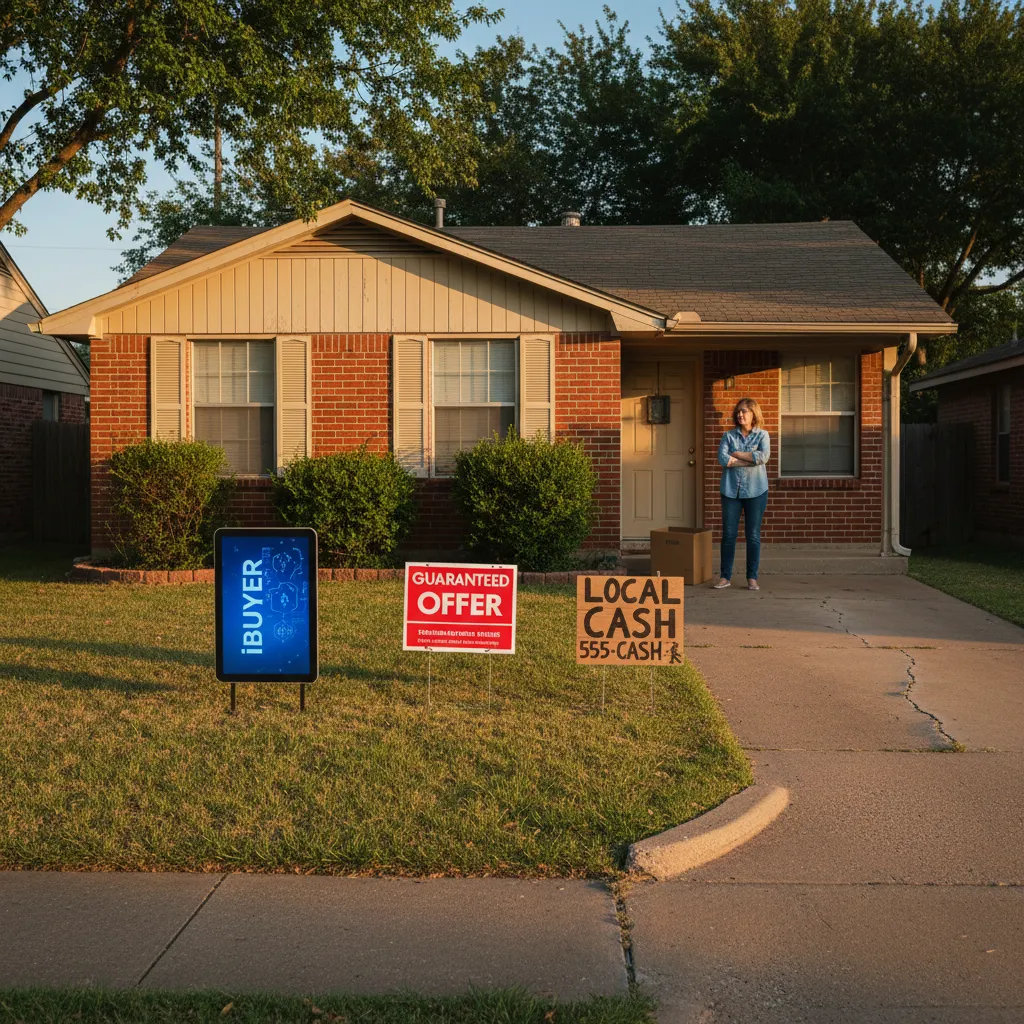
Mark Spain vs. Opendoor vs. Local Cash Buyer: The Real Cost Comparison for Selling Mom's House
Mark Spain vs. Opendoor vs. Local Cash Buyer: The Real Cost Comparison for Selling Mom's House
What You Need to Know Before You Read Another Word
- Mark Spain's "Guaranteed Offer" isn't a cash offer from Mark Spain. They connect you with third-party investors (sometimes Opendoor itself) and charge a 3%–3.5% commission on top. Offers typically arrive at 50%–75% of market value.
- Opendoor's initial offer looks strong — then the inspection happens. Their 5% service fee is just the starting point. Repair deductions of 1%–15% frequently reduce the final number well below the "preliminary" figure they showed you.
- Local cash buyers skip the middleman, the algorithm, and the fees — but not all local buyers are created equal. Some specialize in senior care transitions and offer services far beyond the purchase price.
- The real comparison isn't about the highest number. It's about which option actually gets your mother into care on the timeline she needs — without bleeding $6,600+ per month in memory care costs while the house sits unsold.
- On a typical $300,000 DFW home, the net proceeds difference between all three options is often $5,000–$15,000 — not the $50,000+ gap most families fear.
A few months ago, a woman named Darla called us after inheriting a family home three hours from where she lived. She was the executor of the estate, hadn't seen the property in over a decade, and had four different buyers sending her four different versions of contracts with four wildly different numbers.
She shut down. Stopped returning calls. Couldn't figure out who to trust.
After six months of patient conversations — not pitches, not pressure — she chose to sell to us. We weren't the highest offer. But we were the ones who actually explained what every number meant, coordinated with her attorney, and showed up on closing day to help her move the last of her family's belongings into a trailer.
If you're staring at your phone right now trying to figure out whether Mark Spain, Opendoor, or some local "we buy houses" company is going to screw you over the least — you're asking the right question. You're doing the hard work of protecting your family. This guide exists because you deserve real numbers, not marketing spin.
Here's what we're going to walk through: how each of these three options actually works behind the curtain, what they really cost when all the fees are totaled, and which one makes sense depending on your mother's home, your timeline, and your family's bandwidth for managing the process.
No sales pitch. Just the math. Let's get into it.
How Mark Spain's "Guaranteed Offer" Actually Works (It's Not What You Think)
Mark Spain Real Estate runs heavy advertising across Dallas–Fort Worth and twelve other metro areas. The promise is compelling: submit your home's information, get a guaranteed cash offer, close in as few as 21 days. For a family in crisis — mom just fell, the memory care community has one spot left, the deposit is due next week — that sounds like exactly what you need.
But here's what the ads don't explain: Mark Spain does not buy your home.
They're a brokerage. A large, well-funded brokerage with a network of third-party investors and institutional buyers — sometimes including Opendoor itself — who actually purchase the property. Mark Spain is the middleman who facilitates the transaction and takes a commission for connecting you with those buyers.
That distinction matters enormously when you're trying to sell your mother's home to pay for assisted living.
The Step-by-Step Process Most Families Don't Expect
You fill out the form online or call the number from the radio ad. A specialized agent reaches out for a phone consultation. So far, so good.
Then comes the pivot most families aren't prepared for: before you see any specific cash offer numbers, you're asked to sign an exclusive listing agreement. This contract locks you into working with Mark Spain — often for six months — during which they earn a commission regardless of whether you sell to their investor network or to a traditional buyer they find on the open market.
Once you've signed, the agent presents a suite of offers from their network within two to five business days. The advertised 21-day closing timeline is technically possible, but it assumes the property meets all investor criteria — which many aging parents' homes do not.
The Exclusivity Trap: If the cash offers come in lower than you expected (and they often do), you're still locked into the listing agreement. You can't take the home to another agent or cash buyer without owing Mark Spain their commission. For families in a care crisis with a tight timeline, this creates real financial pressure to accept a low offer just to get the transaction done.
What It Actually Costs
Mark Spain charges a standard realtor commission of 3% to 3.5% on all transactions — including those completed through the Guaranteed Offer program. On a $300,000 home, that's $9,000–$10,500 off the top before you see a dime.
But that's not the full picture. The cash offers themselves are generated by investors who need their own profit margin. Research consistently shows these "guaranteed offers" arrive at 50% to 75% of fair market value — significantly below the "up to 100% of value" that marketing materials sometimes imply.
So the real cost equation for Mark Spain looks like this: a below-market offer from a third-party investor, minus a 3%–3.5% commission to Mark Spain, minus standard Texas closing costs that Mark Spain does not absorb. For families comparing net proceeds, this double-dip — low offer plus commission — can be a painful surprise.
What Actual Sellers Say
Mark Spain's reputation is split right down the middle. Their Google rating sits at 4.7 stars across 5,200+ reviews — driven largely by families who used their traditional listing service, which operates like any other real estate brokerage and tends to generate satisfied clients.
The Guaranteed Offer side tells a different story. Their Yelp rating is 2.4 stars across 153 reviews, with recurring complaints about misleading marketing, low-ball cash offers, and contractual entrapment. BBB filings reference similar patterns. Reddit threads in communities like r/RealEstate and r/Nashville contain blunt warnings from sellers who felt the process was deceptive.
In late 2025, Mark Spain's parent entity was named in a $44 million class-action settlement involving allegations of anticompetitive commission practices. The settlement now prohibits Mark Spain from enforcing blanket rules that required sellers to cover both sides of broker fees — a meaningful reform for anyone negotiating with them in 2026.
Trying to figure out how to actually pay for your mother's care? Before you sign anything, understand all your options.
How Opendoor Actually Works in Dallas–Fort Worth
If Mark Spain is the middleman, Opendoor is the machine. They're an institutional iBuyer — a technology company that uses algorithms to generate offers, purchase homes directly with corporate capital, and then resell them on the open market for profit.
For families who need speed and predictability, Opendoor's model can feel like relief. You submit your home online, receive a preliminary offer within 24–48 hours, and can close in as few as 14 days. No showings, no open houses, no staging your mother's bedroom while she's transitioning to memory care.
The catch is in the details — specifically, what happens between the initial offer and the final number on the closing documents.
The "Bait and Switch" Dynamic
Opendoor's preliminary offer is generated by an algorithm that analyzes comparable sales, neighborhood data, and market trends. For a well-maintained home in a strong DFW submarket, that initial number can be surprisingly competitive — sometimes 90%–95% of market value.
Then comes the home assessment.
An Opendoor representative visits the property (or reviews submitted photos) and identifies repairs that the algorithm prices into a deduction. This is where families selling an aging parent's home get hit hardest. That foundation crack that's common in North Texas clay soil? The HVAC system that's 18 years old? The carpet that hasn't been replaced since 2003?
Opendoor's repair deductions typically range from 1% to 3% on well-maintained homes. But for older, outdated properties — which describes the vast majority of homes owned by aging parents — deductions of 5% to 15% are documented. In extreme cases involving structural or mechanical systems, deductions as high as 30% have been reported by consumer advocates.
And here's the part that stings: these deductions are non-negotiable. Unlike a traditional sale where you can get your own contractor's estimate and push back, Opendoor's number is take-it-or-leave-it. You can't hire someone to fix the issue for less and have them adjust the deduction.
The Full Fee Stack
Opendoor's 5% service fee is the headline number — and to their credit, they're transparent about it. On a $300,000 home, that's $15,000. But the total cost picture includes more:
| Opendoor Fee Component | Typical Range | On a $300,000 Home |
|---|---|---|
| Service Fee | 5% | $15,000 |
| Closing Costs (Title, Escrow) | ~1% | $3,000 |
| Repair Deductions (Standard) | 1%–3% | $3,000–$9,000 |
| Repair Deductions (Older Home) | 5%–15% | $15,000–$45,000 |
| Total Cost Range | 7%–21%+ | $21,000–$63,000+ |
That 5% service fee can quietly become 15%–20% of the home's value once repair deductions are factored in. For a family that was counting on those proceeds to cover years of assisted living costs in Dallas–Fort Worth, the gap between the preliminary offer and the final check can be devastating.
What Opendoor Won't Buy
This is the part that eliminates a huge number of aging parents' homes from the Opendoor funnel entirely. Their eligibility criteria for DFW include:
Opendoor will decline your home if it has: active foundation issues (extremely common in North Texas), unpermitted additions or enclosed garages, septic systems instead of city sewer, location in a flood zone, a price point above $600,000 or below $100,000, or if it's currently tenant-occupied.
For a family selling a parent's home that was built in the 1970s or 1980s in areas like Arlington, Hurst, or North Richland Hills — where foundation movement, dated plumbing, and older electrical systems are practically standard — Opendoor may reject the property before a human ever looks at it.
Post-2023 Reality Check: Following financial difficulties in 2022–2023, Opendoor stabilized its business model but became significantly more selective about which properties it purchases. In January 2026, an Arizona federal court approved a $39 million settlement resolving claims that Opendoor misled investors about its pricing algorithm. Translation for families: the algorithm is designed to protect Opendoor's resale margin, not to maximize your proceeds.
How Local Cash Buyers Work — And Why They're Not All the Same
When most people hear "we buy houses," they picture a handwritten sign on a telephone pole and assume it's a scam. And honestly? Some of them are. Texas residents lost a combined $22 million to real estate scams in 2025, with a 118% increase in fraudulent activity.
But legitimate local cash buyers serve a function that neither Mark Spain nor Opendoor can fill — especially for families navigating the complex intersection of a home sale and a senior care transition.
What "Local" Actually Means for Your Family
A local cash buyer is typically a small-to-mid-sized investment firm or individual based in your metro area who purchases homes directly with their own funds. No algorithms. No investor networks. No listing agreements. They walk through the property, assess the condition, and make an offer based on what they can see — not what a computer model predicted from satellite imagery.
The critical distinction from Mark Spain: a local buyer is the actual purchaser. There's no middleman taking a commission between you and the person buying the home.
The critical distinction from Opendoor: a local buyer can purchase homes that institutional iBuyers won't touch. Foundation problems, houses packed with decades of belongings, probate situations, properties where a power of attorney is signing instead of the homeowner — these are situations local buyers handle regularly.
The Offer Structure: Transparent When Done Right
Most legitimate cash buyers in DFW base their offers on the After-Repair Value (ARV) of the property minus the cost of renovations needed and their profit margin. A responsible buyer will walk you through exactly how they arrived at their number.
Here's what that looks like in practice for a $300,000 home needing $40,000 in work:
Sample Cash Buyer Calculation: After-repair value: $300,000. Minus renovation costs: $40,000. Minus holding costs during renovation: $8,000. Minus resale costs (commission + closing): $21,000. Minus profit margin (15%): $45,000. Maximum offer: approximately $186,000–$210,000. The range depends on actual repair costs and the buyer's operating model.
Yes — that's lower than what you'd net through Opendoor or a traditional listing. But here's what the math doesn't show: zero commission, zero service fees, zero closing costs (reputable local buyers cover them), and a closing timeline of 10–14 days instead of 30–120.
The Services That Change the Equation
This is where the comparison gets interesting — and where the right local buyer becomes more than just a transaction.
Some local DFW cash buyers who specialize in senior transitions offer services that have real financial value beyond the purchase price:
Contents removal: Your family takes the items of sentimental value, and the buyer handles everything else — the furniture, the boxes in the garage, the 30 years of accumulated belongings. For families we work with, this alone eliminates weeks of stress and thousands of dollars in estate cleanout costs.
Bridge financing for care deposits: Most DFW assisted living and memory care communities require a non-refundable community fee of $2,500–$5,000 at move-in. Some local buyers maintain programs that cover these upfront costs while the sale closes — preventing families from losing a placement spot because the money isn't available yet.
Flexible access after closing: Unlike institutional buyers who change the locks on closing day, many local buyers allow family members to return to the home after the sale to collect remaining items at their own pace.
Transition coordination: The best local buyers don't just purchase the home — they connect families with placement agents, elder law attorneys, VA benefit specialists, and senior move managers.
What This Looks Like in Practice: A woman named Diane came to us through a Fort Worth memory care community. She was the power of attorney for a friend who had been abandoned by family and was rapidly declining from dementia — wandering her own neighborhood, unable to recognize where she was.
Diane needed a fair price and she needed to close immediately. We purchased the home, but that wasn't the half of it. During our walkthrough, we learned her friend was the surviving spouse of a veteran. She'd never heard of VA Aid & Attendance surviving spouse benefits. We connected her with a local attorney who helped secure additional monthly income to help pay for memory care.
The home also had an unprobated will, so we coordinated with our title office to complete an Affidavit of Heirship — navigating estranged family members and complex legal documentation — and closed within Diane's timeline.
No algorithm would have caught the VA benefits. No iBuyer would have purchased a home with an unprobated will. No listing agreement would have solved the problem that needed solving that week.
Need to understand your options for selling your parent's home? We'll walk you through every path — including the ones that don't involve selling to us.
The Real Numbers: Side-by-Side Net Proceeds on a $300,000 DFW Home
Let's stop talking in percentages and start talking in dollars. Here's what the math actually looks like for a typical aging parent's home in a DFW suburb like Arlington, Mesquite, or Hurst — a 25-year-old property that's outdated but structurally sound, needing cosmetic updates and some mechanical work.
| Cost Factor | Traditional Agent | Opendoor | Mark Spain Cash | Local Cash Buyer |
|---|---|---|---|---|
| Gross Offer | $300,000 | $282,000 | $225,000 | $210,000 |
| Commission | -$18,000 (6%) | $0 | -$7,875 (3.5%) | $0 |
| Service Fee | $0 | -$14,100 (5%) | $0 | $0 |
| Repair Costs / Deductions | -$10,000 | -$8,000 | $0 (As-Is) | $0 (As-Is) |
| Closing Costs | -$3,000 (1%) | -$2,820 (1%) | -$2,250 (1%) | $0 (Buyer Pays) |
| Holding Costs | -$6,000 (4 mo) | -$1,500 (1 mo) | -$1,500 (1 mo) | -$500 (10 days) |
| Estimated Net Proceeds | $263,000 | $255,580 | $213,375 | $209,500 |
| Timeline to Cash | 120 Days | 30 Days | 30 Days | 14 Days |
At first glance, the traditional listing wins by $53,500 over the local cash buyer. Case closed, right?
Not even close. Because that table doesn't account for the most expensive line item in your family's budget: the cost of care during the wait.
The Number Nobody Puts on the Spreadsheet
Memory care in Dallas–Fort Worth averages $6,681 per month. Assisted living averages $3,650 per month in Dallas and $3,079 in Fort Worth. And those are base rates — before medication management ($300–$700/month), incontinence care ($300–$800/month), and care level add-ons ($1,000–$2,500/month).
Let's factor that reality into the comparison:
That $53,500 gap between a traditional sale and a local cash buyer? After four months of memory care costs ($26,724), four months of holding costs on the vacant home ($6,000+), and the emotional toll of managing showings and inspections during a medical crisis — the real gap shrinks to roughly $20,000.
And that assumes everything goes perfectly. No buyer's inspection that kills the deal at day 45. No financing that falls through at day 60. No repair negotiations that reduce the contract price by $15,000 after you've already committed to the care facility.
The question isn't "which option pays the most?" The question is: "Which option gets Mom into safe care this month without my family hemorrhaging $6,000+ per month while the house sits on the market?" When you frame it that way, the math changes completely.
For a deeper dive into this calculation for your specific city, check our guides for selling a home to pay for care in North Richland Hills, Hurst, or Arlington.
The Holding Cost Problem Nobody Warns You About
North Texas property taxes are no joke. Dallas and Tarrant County tax rates run between 2.18% and 2.37%, which translates to $550–$600 per month in taxes alone on a $300,000 home. Add homeowners insurance ($400–$600/month), utilities to keep the pipes from freezing ($250–$400/month), and basic maintenance — and you're looking at $1,200–$1,600 per month just to keep a vacant house standing.
Four months of that is $4,800–$6,400. Out of your pocket. While you're simultaneously trying to scrape together the money for your mother's assisted living move-in deposits.
Every 30 days your mother's home sits on the market is equivalent to one month of professional care that could have been funded. For families navigating caregiver burnout, that math hits different at 2am when you're running the numbers for the fourth time this week.
Which Option Is Right for Your Family?
There's no universal answer. The right choice depends on three factors: the condition of the home, your timeline, and your family's bandwidth to manage the process.
Choose a Traditional Listing If:
The home is in a desirable school district (Carrollton, Frisco, Richardson) and has been well-maintained. You have 4–6 months before the care situation becomes urgent. You or a sibling lives nearby and can manage showings, repairs, and inspections. The equity in the home is high enough that the 6% commission and holding costs are manageable.
Choose Opendoor If:
The home is relatively modern (built after 1990), has no major structural issues, and is in a neighborhood Opendoor actively purchases in. You need speed but can absorb the 5% service fee plus repair deductions. You want a predictable process without showings or open houses. Be prepared: have the home assessed before accepting the preliminary offer so the deductions don't blindside you.
Choose Mark Spain's Guaranteed Offer If:
You're genuinely unsure whether to list traditionally or take a cash offer and want to see both options side by side. You're comfortable signing an exclusive listing agreement and understand the commission structure. You want a baseline cash offer as a safety net while testing the open market. Be prepared: negotiate the exclusivity period down and read the cancellation terms carefully.
Choose a Local Cash Buyer If:
The home has foundation issues, major deferred maintenance, or condition problems that disqualify it from Opendoor. You need to close in under 30 days to secure a care facility placement. The home is in probate, involves a power of attorney, or has other legal complexity. Your family cannot manage showings, cleanouts, or repairs while simultaneously navigating a care crisis. You need help beyond the home sale — placement guidance, VA benefits identification, bridge financing for move-in costs, or contents removal.
Not sure which path fits your family's situation? Our care plan assessment helps you think through all the moving parts — the home, the care, the finances, and the timeline.
How to Vet Any Cash Buyer (Including Us)
Whether you're considering a local buyer, an iBuyer, or a brokerage program, run every company through the same filter. We tell families this even when we're competing for the business — because a scam doesn't just cost you money. It costs your parent care time.
Cash Buyer Vetting Checklist
- Proof of funds: A legitimate buyer provides a redacted bank statement or financial institution letter showing the cash is available for your specific transaction. Ask for it before signing anything.
- No upfront fees: Any request for an "application fee," "appraisal fee," or "service fee" before closing is a scam. Period. Walk away.
- Physical presence: Verify a local office address. Check the Texas Secretary of State website for registered business filings. Google the address.
- BBB and review history: Check BBB, Google, and Yelp ratings. Look specifically at reviews from the last 12 months — not five years ago.
- Title company closing: The transaction should close at a reputable DFW title company — not in someone's kitchen. The title company protects both parties.
- Contract clarity: You should be able to read and understand every line of the purchase contract. If you can't, have an elder law attorney review it before signing.
- Cancellation terms: Ask what happens if you change your mind. A reputable buyer won't penalize you for walking away before closing.
- References: Ask for contact information from two or three recent sellers. Call them. Ask how the process went and whether the final number matched the original offer.
The new FinCEN rule effective March 2026 requires all-cash entity buyers (LLCs and Trusts) to report beneficial ownership information to the Department of Treasury. This is a positive development for families — it adds accountability. But it may extend closing timelines slightly as title companies gather additional documentation. Ask your buyer how they're handling this requirement.
The DFW Market Reality in 2026
Understanding the current market helps you evaluate whether any offer — from any source — is fair.
As of early 2026, the DFW median home price sits at approximately $435,000, with year-over-year appreciation of 3.8%. Inventory remains at 2.5–3.2 months, which means the market favors sellers in most submarkets. Average days on market for a properly priced home is 35–50 days, with the total traditional sale timeline (including closing) running 90–120 days.
For older homes in the $200,000–$350,000 range — the price point where most aging parents' homes fall in areas like Haltom City, Bedford, or Watauga — demand is strong because they represent entry-level housing for first-time buyers. This is actually encouraging news: even outdated homes have buyers in this market.
But "having buyers" and "closing in time to secure a memory care placement that's available for 72 hours" are two very different things.
What Families Actually Regret (And How to Avoid It)
After working with hundreds of families navigating senior transitions in DFW, the regrets we hear most often aren't about the money.
The Mark Spain regret: "I signed the listing agreement thinking I'd get a great cash offer, and when it came in low, I was stuck. I couldn't go to another buyer for six months."
The Opendoor regret: "The first number they showed me was great. Then the inspection happened, and they knocked off $15,000 for things I thought were normal wear and tear. I felt trapped because I'd already told the care community we were closing."
The waiting regret: "We listed with an agent because we wanted top dollar. The house sat for three months, the deal fell through after inspection, and my mother was in a hospital bed the whole time because we couldn't afford the memory care deposit."
The cash buyer regret: "We sold too fast to a company that seemed legitimate but ghosted us after we signed the contract. We lost two months and almost lost mom's placement."
The through-line in every one of these stories is the same: the family didn't fully understand the process before they committed. That's fixable. That's what education looks like before a crisis turns into a catastrophe.
You're not going to make the perfect decision here. There's no magic option that gives you full market value in 14 days with zero fees and someone who shows up to help you move the bookshelf. But you can make an informed decision — one where you understand exactly what you're trading and exactly what you're getting. That's enough. That's more than enough.
Senior Care Costs in DFW: Why Speed Matters More Than Price
Let's bring it back to why any of this matters. You're not selling a house because you want to. You're selling it because your mother needs care, and the house is how you pay for it.
| Care Type | Dallas (Monthly) | Fort Worth (Monthly) | Plano/Frisco (Monthly) |
|---|---|---|---|
| Assisted Living (Base) | $3,650 | $3,079 | $8,000–$10,500 |
| Memory Care (Base) | $6,681 | $6,000+ | $10,000+ |
| Care Level Add-On | $1,000–$2,500 | $1,000–$2,500 | $2,000+ |
| Medication Management | $300–$700 | $300–$700 | $500+ |
| Community Fee (One-Time) | $2,500–$5,000 | $2,500–$5,000 | $3,500–$7,500 |
The math is brutal: at $6,681/month for memory care in Dallas, every month you spend trying to squeeze an extra $5,000 out of the home sale costs you $6,681 in care. You're spending $6,681 to save $5,000. That's not a strategy — it's a trap.
And here's the reality that keeps families up at night: when a spot opens at a quality memory care community in DFW, it typically fills within 72 hours. You don't have the luxury of waiting for a traditional sale to close. You either have the money or you lose the placement. Understanding how to afford assisted living in DFW starts with understanding that timing and price are connected — not separate — variables.
Frequently Asked Questions
Are Opendoor and Mark Spain the same company?
No. Opendoor is an iBuyer — a technology company that purchases homes directly with corporate funds. Mark Spain is a real estate brokerage that connects sellers with third-party investors (which sometimes includes Opendoor). The key difference is that with Opendoor, you're selling to the company making the offer. With Mark Spain, you're selling through an intermediary who takes a commission.
Does Mark Spain give fair offers?
Mark Spain's "Guaranteed Offers" come from their investor network, not from Mark Spain itself. Research and consumer reviews indicate these offers typically range from 50%–75% of fair market value. Their traditional listing service, which operates like a standard brokerage, often generates better outcomes — but requires the typical listing timeline of 60–120 days. Check their Yelp profile (2.4 stars, 153 reviews) alongside their Google profile (4.7 stars, 5,200+ reviews) to see the split between listing satisfaction and cash offer satisfaction.
What are Opendoor's total fees?
Opendoor charges a transparent 5% service fee, plus approximately 1% in closing costs. However, repair deductions after their home assessment can add 1%–15% (or more) to the total cost. For an outdated home owned by an aging parent, total costs of 10%–20% of the home's value are documented. Always get the final number in writing before committing to a care facility deposit based on the preliminary offer.
Can you negotiate with Mark Spain?
You can negotiate the listing agreement terms — specifically the exclusivity period and the commission percentage. The 2025 class-action settlement now gives you more legal ground to push back on commission structures. However, the cash offers themselves come from third-party investors, and Mark Spain has limited control over those numbers. Your best leverage is getting competing offers before signing the exclusivity agreement.
How likely is a cash offer to fall through?
With a legitimate local cash buyer who provides proof of funds and closes at a title company, the fall-through rate is extremely low — typically under 5%. Opendoor's fall-through rate is higher because their repair assessment process can produce deductions the seller won't accept. Mark Spain's cash offers have a similar dynamic — the initial numbers are preliminary until the investor completes their own due diligence. Traditional financed offers fall through at the highest rate (approximately 15–20%) due to appraisal issues, financing denial, or inspection disputes.
What's the fastest way to sell my parent's house in DFW?
A local cash buyer with proof of funds can close in as few as 7–14 days. Opendoor can close in 14–30 days. Mark Spain's cash offers close in 21–30 days. Traditional listings average 90–120 days from listing to funded close. If your parent has a care placement that needs to happen this month, the local cash buyer or Opendoor are the only realistic options.
What if Opendoor won't buy my parent's house?
If the home has foundation issues, is too old, needs major repairs, or falls outside Opendoor's price range and condition criteria, your options are a traditional listing (with the associated timeline) or a local cash buyer who specializes in as-is properties. Many homes owned by aging parents in DFW — particularly in areas with expansive clay soil — are automatically disqualified from iBuyer programs. A local as-is buyer may be your most realistic path.
The Bottom Line for Your Family
Here's what we believe at Sage Senior Support — and we'll say it even though we're one of the options being compared in this article:
The "best" price is the one that funds your parent's care on the day the care is needed.
If your mother's home is in excellent shape, in a hot submarket, and you have four to six months to spare, list it with a great agent and maximize the equity. We'll even recommend agents we trust if that's the right move.
If the home qualifies for Opendoor and you can absorb their fees, that's a perfectly valid path. Just make sure you see the final number — after repair deductions — before committing.
If you're locked in a Mark Spain agreement and the numbers aren't working, know your rights under the 2025 settlement and negotiate hard.
And if the home is outdated, has issues, involves legal complexity like probate or power of attorney, and you need to close in weeks instead of months — a local buyer who specializes in senior care transitions isn't the fallback option. It might be the only option that actually solves the problem.
You don't have to choose between fast and fair. You don't have to choose between protecting your mother's equity and protecting her safety. But you do have to understand what each option actually costs — in dollars, in time, and in the emotional bandwidth your family has left.
We're in this together. There are tools and resources to help you manage it all.
Ready to talk through your family's options? No pressure, no listing agreements, no algorithms. Just a real conversation about what makes sense for your mother's home and her care.